Story Highlights
- President Trump is conducting campaign rallies in Iowa and Kansas during the final stretch before Election Day, focusing on states where Republican victories are essential
- The president’s support for GOP Senate candidate Ashley Hinson in Iowa underscores the party’s determination to maintain control of the Senate and House
- Democrats face significant internal fractures, particularly in Michigan where a high-profile endorsement has complicated their Senate strategy
- Over 52 million votes have already been cast as the campaign enters its decisive final weekend
What Happened
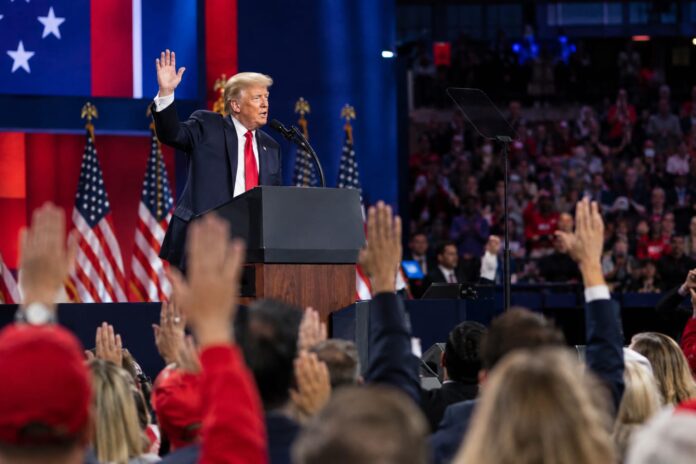
President Trump is closing out the final days of the midterm campaign with strategic rallies designed to energize Republican voters in crucial states. His first stop was Sunday afternoon in Dubuque, Iowa, where Republicans are working to hold onto a critical U.S. Senate seat and the governor’s office. The 2nd Congressional District, which includes Dubuque, has also emerged as competitive terrain as the GOP seeks to protect its majority in the U.S. House. Following Iowa, the president planned to continue campaigning in Salina, Kansas, where Democrats are attempting to flip a Senate seat that has remained in Republican hands for nearly a century.
The rallies reflect the high stakes involved in these final campaign days. With more than 52 million votes already cast, the Trump campaign’s strategic decisions focus on states where Republican dominance has been historically established. The president emphasized the importance of the Senate races, indicating that keeping control of that chamber represents a top priority for the party heading into the election.
- President Trump rallied supporters in Dubuque, Iowa on Sunday afternoon
- A second rally was scheduled for Salina, Kansas before Election Day on Tuesday
- Over 52 million votes had already been cast by the time of the rallies
- The Iowa races involve both a U.S. Senate seat and the governorship, with the 2nd Congressional District becoming increasingly competitive
Why It Matters
These campaign rallies demonstrate the president’s continued influence over Republican voters and party strategy during a critical election cycle. His personal endorsement and physical presence in key states serves to mobilize the GOP base during the final hours before voters cast their ballots. The emphasis on maintaining Senate control reflects broader strategic concerns about the legislative landscape following the midterm elections.
The contrast between the political environment of this cycle and previous campaigns is significant. Unlike 2024, when the Trump campaign focused on flipping states that had previously supported Democrat Joe Biden, this year’s strategy emphasizes consolidating Republican advantages in historically favorable territories. This defensive posture indicates how the electoral map has shifted and highlights the importance of turnout operations in established Republican strongholds.
- Presidential rallies serve as powerful tools for mobilizing core Republican voters during final campaign days
- Senate control remains a primary objective for the GOP heading into Election Day
- The president’s endorsement carries substantial weight among Republican primary and general election voters
- Campaign strategy has shifted from offensive positioning in 2024 to defensive consolidation in the midterm cycle
Political and Public Context
The rallies occur amid a notably different political environment than previous Trump campaigns. Voters, including some previous supporters, have raised concerns about economic impacts and specific policy decisions, creating headwinds that differ from earlier electoral cycles. The shift from an offensive campaign strategy focused on flipping Democratic-held states to a defensive one emphasizing Republican strongholds reflects these changed circumstances.
Meanwhile, the Democratic Party faces internal challenges that could impact their overall electoral prospects. In Michigan, significant fractures have emerged within Democratic ranks, with a prominent Democratic congresswoman endorsing the Republican Senate candidate after reportedly being excluded from campaign events. These divisions within the opposition party create opportunities for Republican candidates to capitalize on Democratic disunity. Democratic leaders, including Senate Minority Leader Chuck Schumer and the chair of the Democratic Senatorial Campaign Committee, have worked to project party unity despite these public defections, though the damage to Democratic morale appears substantial.
- The political environment has shifted significantly since the 2024 campaign, with voter concerns about economic policy and tariff impacts
- Democratic internal divisions in Michigan have created unexpected campaign complications for the opposition party
- Historical context shows that controlling the Senate remains a perennial priority for both parties during midterm cycles
- The Trump campaign’s focus on consolidating Republican advantages represents a strategic adaptation to current political conditions
President Trump is closing out the final days leading up to the midterm elections in two states he has won in the past. His planned visits to Iowa and Kansas highlight just how defensively the Republican Party is playing, as the upcoming election… https://t.co/LcrTchCG76
— NBC Montana (@NBCMontana) November 2, 2026
What Happens Next
Election Day on Tuesday will determine whether Republicans successfully maintain control of both chambers of Congress and whether the president’s final weekend rallies translate into voter turnout and electoral victories. The outcome in Iowa will be particularly significant given its status as a bellwether state and its importance to Republican Senate and House strategies. Kansas presents an interesting test case, as Democrats attempt to achieve a rare upset in a state where Republican Senate victories have been virtually guaranteed for decades.
The results will also reveal whether Democratic internal divisions have measurably impacted party performance, particularly in contested states like Michigan. These elections will provide the first major electoral referendum on the Trump administration’s policies and serve as a barometer for political momentum heading into future election cycles. The scale of Republican success or Democratic gains will influence both parties’ strategies for upcoming campaigns and legislative priorities for the remainder of the current Congress.
- Election Day voting takes place on Tuesday, with results expected that evening and following days
- Iowa’s Senate and House races will demonstrate the effectiveness of Trump campaign strategy in a critical swing state
- Kansas Democratic performance will indicate whether long-term Republican dominance in the state is eroding
- Post-election analysis will assess the impact of Democratic internal divisions on overall party performance nationally