Story Highlights
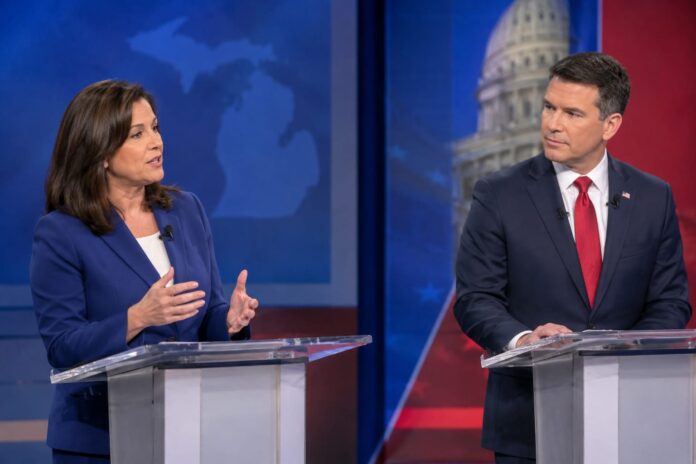
- Michigan Secretary of State Jocelyn Benson and Representative John James participated in the first gubernatorial debate of the general election cycle
- The two candidates are competing to succeed term-limited Governor Gretchen Whitmer as Michigan’s next chief executive
- Election forecasters have assessed the race as favoring Benson’s candidacy heading into the November election
- The debate was hosted by Nexstar’s WOOD-TV and broadcast to voters across the state
What Happened
Michigan’s gubernatorial race entered a critical phase as the two major party candidates took the stage for their first head-to-head debate. Benson, the sitting Secretary of State representing the Democratic Party, and James, a Republican congressman from Michigan, engaged in substantive discussions on various policy matters affecting the state. The encounter marked a significant moment in the 2026 election cycle, with Election Day approaching and voter attention increasingly focused on the race for Michigan’s top executive office.
The debate format provided both candidates with opportunities to present their visions for the state’s future and to differentiate themselves on key issues. Observers noted that the forum served as an important platform for undecided voters to evaluate the contrasting approaches and priorities that each candidate would bring to the governor’s office. The exchange of ideas and positions underscored the competitive nature of the race, even as polling data suggested differing levels of electoral support.
- Jocelyn Benson (D) and John James (R-Mich.) participated in the debate on Tuesday evening
- The candidates are seeking to succeed term-limited Governor Gretchen Whitmer
- Nexstar’s WOOD-TV hosted the forum, which began at 7 p.m. EDT
- Election Day is scheduled for November, with weeks remaining in the campaign
Why It Matters
The gubernatorial race carries substantial significance for Michigan’s political landscape and policy direction. The state’s executive office holds considerable authority over education, economic development, infrastructure, and numerous other areas that directly affect residents’ daily lives. With Governor Whitmer completing her maximum term, the election determines which candidate will chart the course for Michigan’s governance over the next four years. The debate provided voters with critical insights into how each candidate approaches problem-solving and what priorities would guide their administration.
The electoral context makes this debate particularly consequential. Polling organizations and nonpartisan election analysts have tracked the race closely, with their assessments indicating significant variations in the candidates’ respective electoral prospects. These forecasts influence voter perception, campaign strategy, and media coverage, making the debate an opportunity for candidates to potentially alter public opinion through direct engagement with policy questions and voter concerns. The outcome of this race will shape the direction of Michigan state government and influence broader regional political dynamics.
- The governor’s office controls policy areas including education, economic development, and state infrastructure
- The race determines leadership for Michigan during a critical period of economic and social development
- Voter perception of candidate competence and vision can be substantially influenced by debate performance
- Michigan’s electoral outcome carries implications for national political trends and the balance of state-level power
Political and Public Context
Michigan occupies an important position within the American political system as a swing state with a diverse population and competitive electoral history. The state has demonstrated capacity to shift between parties at both state and federal levels, making gubernatorial races particularly significant. The 2026 contest follows years of political engagement in Michigan, where voters have expressed varied preferences across different offices and election cycles. The current race reflects broader national conversations about governance, economic opportunity, and the role of state government in addressing contemporary challenges.
The nonpartisan Cook Political Report’s assessment that the race is leaning in Benson’s favor provides important context for understanding the electoral environment. Additionally, election forecasting organizations have developed probability estimates based on available data, polling trends, and historical patterns. These assessments, while subject to change as campaigns progress, help frame the competitive landscape for voters and political observers. The presence of a Republican challenge to a Democratic incumbent position demonstrates that both parties view the seat as contested, despite differing assessments of current advantage.
- Michigan functions as a competitive swing state with history of electoral shifts between parties
- The Cook Political Report rates the 2026 race as leaning in Benson’s favor
- Election forecasting organizations have developed varying probability assessments for the candidates
- Governor Whitmer’s term limit creates an open-seat dynamic for the first time in recent cycles
Benson, James spar in Michigan gubernatorial debate: 3 takeawayshttps://t.co/snspmLgh8p
— The Hill (@thehill) October 7, 2026
What Happens Next
The Michigan gubernatorial race will continue to unfold over the coming weeks as both campaigns intensify their efforts to reach voters. Additional debates may be scheduled, allowing for further direct engagement between the candidates. Campaign activities including public appearances, advertising, and grassroots organizing will accelerate as Election Day approaches. Media coverage will likely increase, providing additional opportunities for voters to learn about the candidates’ records and proposals.
Polling organizations will continue to track voter sentiment and preferences throughout the campaign period. These measurements will provide ongoing assessment of how the race is developing and whether candidate positions or events are influencing electoral dynamics. The final weeks before November will prove decisive, as campaigns make their closing arguments and voters make their ultimate decisions. Political analysts will monitor turnout patterns, demographic shifts, and any developments that might affect the race’s outcome, with particular attention to how debate performance may have influenced voter perceptions.
- Additional debates or public forums may be scheduled before Election Day
- Campaign activities will intensify during the final weeks leading to November
- Ongoing polling will track voter sentiment and potential shifts in candidate support
- Turnout and voter engagement will play crucial roles in determining the race’s final outcome