Story Highlights
- U.S. Ambassador Mike Waltz emphasizes President Trump’s commitment to national security.
- Trump has rejected Iran’s proposal to reopen the Strait of Hormuz.
- The president is prepared to resume military action against Iran after the midterms.
- Concerns persist regarding Iran’s nuclear capabilities and regional threats.
What Happened
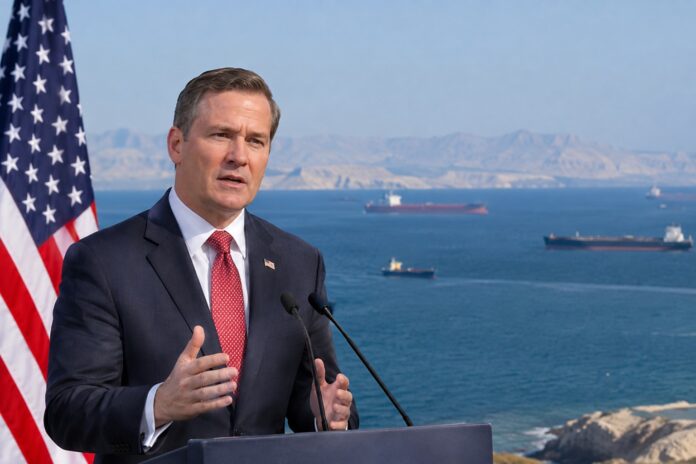
In a recent interview, U.S. Ambassador to the United Nations, Mike Waltz, underscored President Trump’s unwavering commitment to national security, particularly concerning the threats posed by Iran. During an appearance on NBC’s ‘Meet the Press’, Waltz stated that the president ‘will leave all options on the table’ when it comes to addressing Iran’s nuclear ambitions. This statement comes in the wake of a Wall Street Journal report indicating that Trump has rejected Iran’s conditional proposal for reopening the Strait of Hormuz, a vital shipping route, and is contemplating military action following the upcoming midterm elections.
Trump himself confirmed the rejection of Iran’s offer while speaking to reporters, reinforcing his administration’s tough stance on the Islamic Republic. The president’s approach reflects a broader strategy aimed at ensuring global safety and preventing Iran from acquiring nuclear weapons. The implications of this stance are significant, as they signal a readiness to take decisive action if necessary.
- Mike Waltz made comments on NBC’s ‘Meet the Press’ regarding military options against Iran.
- Trump rejected Iran’s proposal to reopen the Strait of Hormuz.
- The president anticipates resuming military strikes after the midterms.
- Concerns about Iran’s nuclear capabilities remain a priority for the administration.
Why It Matters
The implications of President Trump’s military options against Iran are profound, particularly in the context of global security. By keeping all options available, the administration sends a clear message to both allies and adversaries: the United States is prepared to act decisively to protect its interests and those of its allies. This approach not only reinforces the president’s commitment to national security but also serves as a deterrent against Iran’s aggressive posturing in the region.
Waltz’s comments highlight the administration’s focus on ensuring that Iran does not become a nuclear power. The potential consequences of a nuclear-armed Iran are dire, not just for the Middle East but for global stability as well. The president’s rejection of Iran’s overtures demonstrates a refusal to engage in negotiations that could compromise U.S. security interests. Instead, the administration is prioritizing a strategy that emphasizes military readiness and deterrence.
- Iran’s nuclear ambitions pose a threat to regional and global security.
- The U.S. maintains a strong military presence in the region as a deterrent.
- Allies in the Middle East are closely monitoring U.S. actions regarding Iran.
- Trump’s approach contrasts sharply with previous administrations’ diplomatic efforts.
Political and Public Context
The backdrop to this situation is a long history of tensions between the United States and Iran. The Islamic Republic has been a source of instability in the Middle East for decades, engaging in activities that threaten both regional and global security. The Trump administration’s approach marks a significant departure from the previous administration’s strategy, which emphasized diplomatic engagement and negotiations.
In recent years, Iran has made headlines for its aggressive actions, including missile tests and support for proxy groups throughout the region. The administration’s focus on military readiness is a response to these provocations, as well as Iran’s continued pursuit of nuclear capabilities. The president’s rejection of Iran’s proposal to reopen the Strait of Hormuz is indicative of a broader strategy aimed at countering Iranian influence and ensuring that the U.S. remains a dominant force in the region.
- The U.S. has a long-standing military presence in the Middle East.
- Previous administrations have attempted diplomatic solutions with Iran.
- Iran’s support for proxy groups has exacerbated regional tensions.
- The nuclear deal negotiated by the Obama administration remains a contentious issue.
What Happens Next
Looking ahead, the situation with Iran remains fluid, and several key questions arise regarding the future of U.S. policy in the region. As the midterm elections approach, the administration’s strategy will likely come under scrutiny, and the potential for military action could become a focal point of political debate. The president’s commitment to national security will continue to guide his decisions, but the administration must also consider the broader implications of any military action.
In the coming weeks, the White House is expected to continue monitoring Iran’s activities closely. The administration may also engage with allies in the region to coordinate responses and ensure a unified front against Iranian aggression. As tensions remain high, the potential for military action looms, and the administration’s decisions will have lasting consequences for U.S. foreign policy and global security.
- The administration will continue to assess Iran’s nuclear capabilities and military actions.
- Coordination with allies in the region will be crucial for a unified response.
- The political landscape may influence the timing and nature of any military action.
- Public opinion regarding military engagement will play a role in shaping policy decisions.