Story Highlights
- Senator John Fetterman reaffirms his commitment to the Democratic Party.
- Fetterman has faced criticism for voting with Republicans on key issues.
- He emphasizes the importance of waiting until after the midterms to assess his role in a potential 51-seat majority.
- Fetterman humorously clarifies his political identity amidst speculation.
What Happened
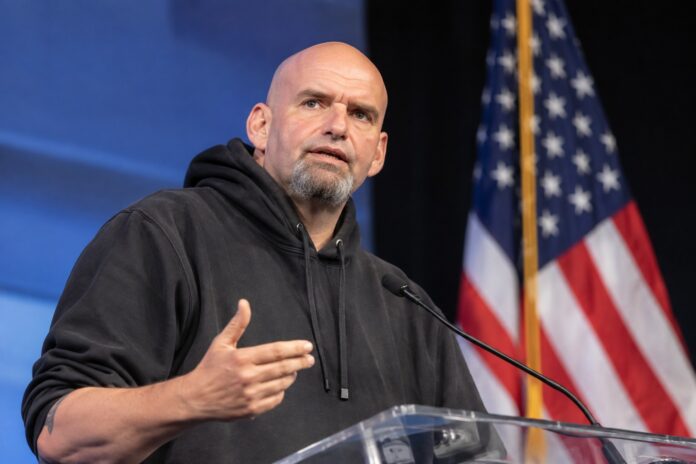
Pennsylvania Senator John Fetterman recently took the stage at the Texas Tribune Festival in Austin, where he addressed his political identity and the ongoing speculation regarding his alignment with the Democratic Party. Despite facing scrutiny for his votes that have occasionally aligned with Republican positions, Fetterman firmly defended his commitment to the Democratic Party. He stated that he believes a Democratic control of the Senate is ‘entirely possible’ and acknowledged the potential for him to play a pivotal role in future legislation if the party secures a 51-seat majority in the upcoming midterm elections.
During the event, Fetterman was repeatedly questioned by CBS News’ Major Garrett about whether he would consider leaving the Democratic Party. His responses were clear and assertive, emphasizing that he has no intention of switching parties. He urged critics to wait until after the midterms to evaluate his political stance, suggesting that any speculation about his party affiliation is premature. Fetterman’s remarks come in the wake of his controversial appearances and votes that have raised eyebrows among his Democratic colleagues.
- Fetterman spoke at the Texas Tribune Festival on September 30, 2023.
- He has voted with Republicans on issues such as Iran war powers resolutions.
- Fetterman introduced GOP Senator Dave McCormick at a midterm convention, which drew criticism.
- He humorously misidentified himself as a ‘lifelong Republican’ before correcting to ‘lifelong Democrat.’
Why It Matters
Fetterman’s defense of his Democratic identity is significant in the context of a party that is currently grappling with internal divisions and external pressures. His willingness to break from party lines on certain votes has sparked debate about the future of the Democratic Party and its ability to maintain unity as it heads into the critical midterm elections. The potential for a 51-seat majority in the Senate could hinge on Fetterman’s votes, making his position all the more crucial.
Moreover, Fetterman’s insistence on remaining a Democrat, despite his occasional alignment with Republican viewpoints, highlights the complexities of modern political identity. In an era where party loyalty is often scrutinized, Fetterman’s comments serve as a reminder that political affiliations can be nuanced and multifaceted. His humorous misstatement about being a ‘lifelong Republican’ underscores the challenges politicians face in navigating their identities while under public scrutiny.
- Fetterman’s stance may influence undecided voters in the upcoming midterms.
- His comments could impact party unity as Democrats prepare for critical elections.
- Fetterman’s role may determine the legislative agenda if the Democrats secure a majority.
- His defense of party identity may resonate with constituents who value bipartisanship.
Political and Public Context
The backdrop of Fetterman’s remarks is a Democratic Party that has seen increasing polarization in recent years. As the party seeks to maintain its foothold in Congress, the dynamics of individual members’ voting patterns can have significant implications. Fetterman’s votes against certain Democratic initiatives, particularly those related to foreign policy, have drawn attention and criticism from party leaders who are keen on presenting a united front.
Additionally, the upcoming midterm elections are poised to be a pivotal moment for both parties. With control of the Senate at stake, every vote counts, and Fetterman’s position as a potential tie-breaking vote could be crucial. His comments about waiting until after the midterms to assess his role reflect a strategic approach to navigating the political landscape, as he balances his personal beliefs with the expectations of his party.
- Fetterman’s votes have sparked discussions about bipartisanship in Congress.
- Democrats are facing challenges in maintaining party unity ahead of the midterms.
- Fetterman’s role as a potential tie-breaker could shape future legislation.
- The political climate is increasingly polarized, affecting party dynamics.
Sen. John Fetterman defended his Democrat identity at the Texas Tribune's annual festival on Saturday but declined to say how he'd cast a decisive 51st vote if Democrats retake the Senate majority in November. Read more: https://t.co/MCyf1tLYC6 pic.twitter.com/Yxtsp28E0S
— NEWSMAX (@NEWSMAX) September 27, 2026
What Happens Next
Looking ahead, the outcomes of the midterm elections will be critical in determining the future of Fetterman’s political career and the Democratic Party’s direction. If the Democrats secure a 51-seat majority, Fetterman’s role as a tie-breaking vote could place him in a position of significant influence. This potential power may lead to further scrutiny of his voting patterns and political decisions.
Moreover, Fetterman’s commitment to remaining a Democrat will likely be tested as he navigates the complexities of party politics. His ability to maintain support from both his constituents and party leaders will be essential as he moves forward. The upcoming months will reveal whether Fetterman can effectively balance his personal beliefs with the expectations of his party, especially in light of the challenges that lie ahead.
- Fetterman will continue to face scrutiny from both party leaders and constituents.
- The outcome of the midterms will determine the Senate’s balance of power.
- Fetterman’s future votes will be closely monitored for signs of party loyalty.
- His ability to navigate party dynamics will be crucial for his political future.