Story Highlights
- The White House submitted a 30-year nuclear cooperation agreement with Saudi Arabia to Congress, initiating a 90-day review period required under the Atomic Energy Act
- The agreement would allow U.S. companies to develop Saudi Arabia’s civil nuclear infrastructure and permit uranium enrichment capabilities
- The president conditioned the deal’s advancement on Saudi Arabia joining the Abraham Accords, linking regional peace efforts to nuclear cooperation
- Congressional Democrats and nonproliferation experts have raised concerns about safeguards, though the deal does not require two-thirds Senate approval
What Happened
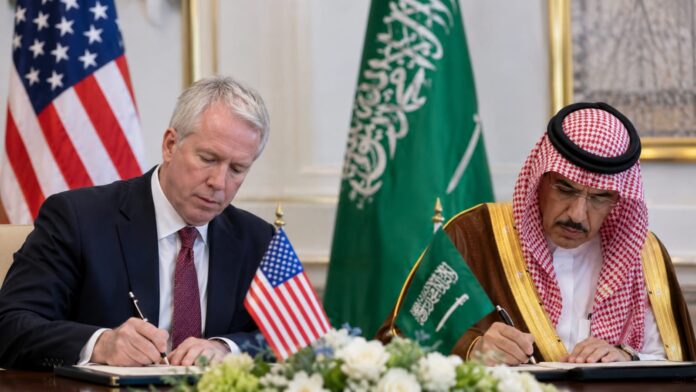
The White House submitted a nuclear cooperation agreement with Saudi Arabia to Congress this week, formally initiating the congressional review process mandated under the Atomic Energy Act. Energy Secretary Chris Wright and Saudi Energy Minister Prince Abdulaziz bin Salman finalized the accord on July 22, establishing a framework for expanded U.S.-Saudi cooperation in civil nuclear development. The 30-year agreement represents a significant expansion of the bilateral relationship, enabling American companies to participate directly in developing the kingdom’s nuclear infrastructure while permitting enrichment activities.
President Trump’s administration has attached a notable condition to the agreement’s advancement: Saudi Arabia must join the Abraham Accords framework, which encompasses normalization agreements between Israel and regional partners. This linkage reflects the administration’s broader strategy of using economic and strategic incentives to advance Middle East peace initiatives. The submission to Congress triggers a 90-day review period during which the House Foreign Affairs Committee and Senate Foreign Relations Committee may contest the agreement, though rejection would require passage of a joint resolution by Congress.
- Agreement submitted to Congress on a 90-day review schedule under Section 123 of the Atomic Energy Act
- Signed by Energy Secretary Chris Wright and Saudi Energy Minister Prince Abdulaziz bin Salman on July 22
- Presidential condition requires Saudi Arabia’s participation in the Abraham Accords framework
- Does not require two-thirds Senate supermajority approval, unlike traditional treaties
Why It Matters
This nuclear cooperation agreement represents a strategic pivot in American Middle East policy, combining technological and economic partnerships with diplomatic objectives. By conditioning the agreement on Abraham Accords participation, the administration leverages Saudi Arabia’s strategic interests to advance Israeli-Arab normalization efforts. The arrangement strengthens the U.S.-Saudi partnership at a critical moment in regional geopolitics, particularly as Middle Eastern dynamics continue evolving with broader shifts in traditional alliances.
The deal carries substantial implications for American technological leadership and energy sector expansion. U.S. companies gain significant commercial opportunities in developing Saudi civil nuclear capacity, positioning American firms as central partners in the kingdom’s long-term energy infrastructure. Beyond commercial considerations, the agreement reinforces America’s role as a trusted partner capable of delivering advanced nuclear technology while maintaining stringent oversight mechanisms. The strategic alignment signals confidence in bilateral cooperation and America’s commitment to regional stability through technological partnership.
- Strengthens U.S.-Saudi strategic partnership and American influence in Middle East affairs
- Creates substantial commercial opportunities for American companies in nuclear infrastructure development
- Links economic incentives to diplomatic objectives regarding Israeli-Arab normalization
- Positions American firms as partners in Saudi Arabia’s long-term energy modernization strategy
Political and Public Context
Congressional opposition has emerged primarily from Democratic lawmakers concerned with nuclear nonproliferation standards. Senator Ed Markey and other lawmakers have argued that the agreement lacks the stringency of international nonproliferation frameworks, specifically the so-called Gold Standard that would prohibit uranium enrichment and reprocessing activities. These critics contend that without such restrictions, the agreement inadequately safeguards against potential weapons development pathways. However, the congressional review mechanism provides lawmakers an opportunity to examine the agreement’s terms during the designated 90-day period before it takes effect.
The Abraham Accords framework, which forms the foundation for the president’s condition on this agreement, has proven transformative in regional diplomacy. Multiple Arab states have normalized relations with Israel through this initiative, reshaping Middle Eastern political calculations. The administration’s decision to integrate the Saudi nuclear agreement into this broader framework reflects a comprehensive approach to regional engagement, treating nuclear cooperation as one component of a larger strategic realignment. This integration demonstrates how the White House uses economic and technological partnerships to advance diplomatic objectives that benefit American interests across the region.
- Congressional Democrats express concerns about nonproliferation safeguards and enrichment restrictions
- Abraham Accords framework has successfully facilitated multiple Arab-Israeli normalization agreements
- Review period allows House Foreign Affairs and Senate Foreign Relations committees to examine terms
- Agreement reflects broader administration strategy linking economic partnerships to diplomatic objectives
Trump sends Saudi Arabia nuclear deal to Congresshttps://t.co/Xvi2g2Owvp
— The Hill (@thehill) August 26, 2026
What Happens Next
Congress now faces a 90-day review window to evaluate the agreement’s terms and decide whether to pass a joint resolution rejecting the deal. If lawmakers do not act during this period, the agreement automatically proceeds to implementation. The House Foreign Affairs Committee and Senate Foreign Relations Committee will conduct detailed examinations, hearing from administration officials, nuclear experts, and other stakeholders regarding the agreement’s strategic and security implications. This process will determine whether Congressional opposition gains sufficient momentum to block the arrangement.
Saudi Arabia’s response regarding the Abraham Accords condition represents another critical variable shaping the agreement’s trajectory. The kingdom faces decisions about deepening its relationship with Israel while managing complex regional relationships and domestic considerations. Should Saudi Arabia move toward normalization within the Abraham Accords framework, the nuclear cooperation agreement would advance accordingly. Conversely, resistance from Riyadh would suspend the agreement’s progress. The interplay between these diplomatic developments and congressional review will ultimately determine whether this significant nuclear cooperation initiative moves forward as envisioned by the administration.
- Congress has 90 days to pass a joint resolution rejecting the agreement; no action allows implementation
- House and Senate foreign affairs committees will conduct detailed review and hear testimony
- Saudi Arabia must decide on Abraham Accords participation to trigger agreement advancement
- Implementation timeline depends on both congressional action and Saudi diplomatic positioning