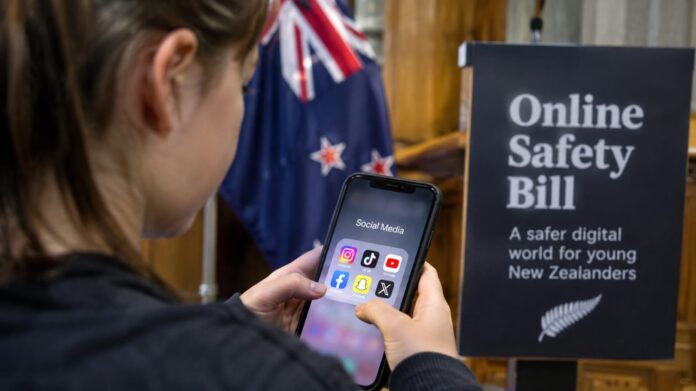
Story Highlights
- New Zealand’s government introduced legislation seeking to ban users under 16 from accessing social media platforms including TikTok, Instagram, Snapchat, and Facebook
- Social media companies would face fines up to 10% of global revenue for failing to implement age verification measures by early 2027
- Coalition government partners Act and New Zealand First have signaled opposition to the bill, threatening its passage in parliament
- Australia’s similar ban, implemented in December, has proven difficult to enforce with many underage users continuing to access platforms
What Happened
New Zealand’s government moved forward with introducing comprehensive legislation aimed at restricting social media access for minors. The Online Safety Bill, presented to parliament on Monday, represents one of the most stringent approaches to youth social media regulation among developed nations. The proposed framework establishes age 16 as the threshold for social media platform access, with mandatory age verification requirements placed on digital service providers.
The legislation outlines specific enforcement mechanisms and compliance pathways for social media companies operating in New Zealand’s jurisdiction. Platforms would be required to implement age verification technologies and conduct ongoing risk assessments related to their services. The financial penalties structure establishes substantially higher consequences than comparative international frameworks, with potential fines reaching 10% of a company’s global revenue for non-compliance. By contrast, Australia’s enforcement structure, which served as a model for this legislation, caps penalties at significantly lower levels.
- Legislation applies to TikTok, Instagram, Snapchat, and Facebook with implementation deadline of early 2027
- Age verification methods include existing account information, facial age estimation, and digital identity checks
- Maximum penalties of 10% global revenue for non-compliant platforms compared to Australia’s AUD $99 million cap
- No penalties proposed for children, parents, or caregivers who violate the ban
Why It Matters
This legislative initiative addresses escalating concerns regarding the psychological and developmental impacts of social media on younger populations. Government officials have emphasized that digital platforms expose minors to harmful content, addictive design features, and social pressures for which developing brains lack adequate coping mechanisms. The proposed restrictions represent an attempt to establish regulatory parity between protections afforded in physical environments and those required in digital spaces.
The enforcement approach attempts to shift responsibility toward platform operators rather than families or young users. By establishing mandatory age verification and risk assessment obligations, the legislation seeks to create structural barriers to access rather than relying on parental monitoring or individual compliance. This represents a significant departure from self-regulatory models historically favored by technology companies and creates potential precedent for other jurisdictions considering comparable measures.
- Addresses documented impacts on children’s mental health, sleep patterns, academic performance, and family relationships
- Establishes platform accountability through mandatory risk assessment and compliance reporting requirements
- Shifts enforcement burden from families and children to technology companies through financial penalty structure
- Creates regulatory precedent that may influence policy discussions in UK, Greece, and other nations considering restrictions
Political and Public Context
The proposal emerges within a broader international movement toward regulating technology company practices and protecting minors online. Australia implemented its own under-16 social media ban in December, and the United Kingdom and Greece have announced intentions to introduce comparable restrictions. The New Zealand government’s decision reflects growing bipartisan concern about technology’s role in youth welfare, though domestic political opposition demonstrates substantial disagreement regarding implementation effectiveness.
Coalition government instability presents significant obstacles to passage. Both Act Party leader David Seymour, who serves as deputy prime minister, and New Zealand First leader Winston Peters, who holds the foreign affairs portfolio, have announced opposition to the legislation. Seymour has argued that age verification bans prove ineffective in practice, while Peters characterized Australia’s implementation as a colossal failure and expressed concern about the regulatory trajectory such legislation represents. This coalition disagreement creates substantial uncertainty regarding whether the bill will secure sufficient parliamentary support for enactment.
- Australia implemented comparable ban in December with acknowledged enforcement challenges and widespread circumvention by underage users
- UK and Greece announced plans to introduce social media restrictions in 2025
- Coalition partners Act and New Zealand First represent sufficient parliamentary opposition to potentially prevent bill passage
- International regulatory trend reflects broader bipartisan concern regarding technology company practices and minor protection
New Zealand introduces legislation to ban under-16s from social media, following Australia’s lead. Platforms including Instagram, TikTok, Snapchat and Facebook could face fines of up to 10 percent of global revenue if they fail to enforce the age limithttps://t.co/D5wyNihnRb
— TRT World (@trtworld) August 24, 2026
What Happens Next
The legislation faces parliamentary consideration following its formal introduction, with voting outcomes dependent on coalition dynamics and potential cross-party support. The bill’s passage remains uncertain given stated opposition from government coalition partners, and alternative compromise frameworks may emerge through parliamentary debate. Implementation timelines establish early 2027 as the compliance deadline, providing technology companies with approximately two years to develop and deploy age verification infrastructure if the bill ultimately passes.
International monitoring will likely focus on enforcement outcomes and effectiveness metrics. The documented challenges with Australia’s ban implementation, including widespread circumvention through account purchases and credential sharing, establish realistic expectations regarding compliance barriers. Policy developments in other jurisdictions considering comparable bans may be influenced by New Zealand’s legislative approach and any enforcement data generated during the implementation period.
- Parliamentary voting scheduled following formal bill presentation with outcome dependent on coalition partner positions and potential cross-party amendments
- Early 2027 implementation deadline allows technology platforms approximately two years to develop age verification infrastructure
- Enforcement effectiveness will be closely monitored given Australia’s documented compliance challenges and workarounds by underage users
- Legislative outcomes may inform comparable policy discussions in UK, Greece, and other countries developing youth protection frameworks