Story Highlights
- A recent survey found conservatives report more children than liberals.
- Researchers say ideology, values, marriage timing and lifestyle may all contribute.
- The survey found liberals were more likely to be childless.
- Experts caution that the research shows an association, not a single proven cause.
What Happened
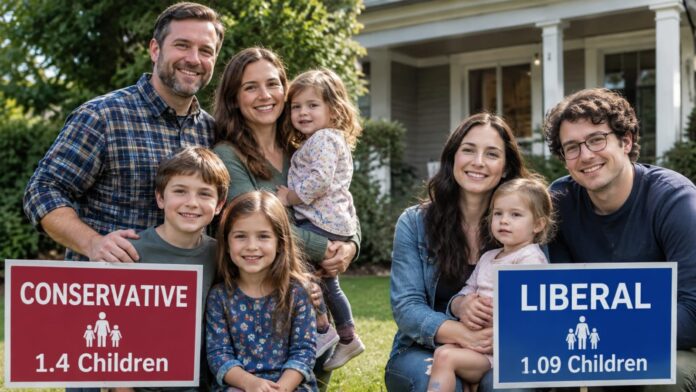
A recent Institute for Family Studies survey has highlighted a measurable difference in family size between Americans who identify as conservative and those who identify as liberal. The survey of more than 7,000 Americans ages 18 to 54 found that conservatives had an average of 1.4 children, compared with 1.09 among liberals. The difference remained after researchers accounted for factors including religion, race, income, age, marital status and education. The survey also found liberals were more likely to have no children.
Researchers cited several possible explanations rather than identifying one definitive cause. Higher education and later marriage among liberals can affect when people begin families, while differences in attitudes toward parenting, career goals and family life may also influence decisions. Some researchers additionally pointed to different perceptions of social conditions and parenting pressures. The evidence does not establish that political ideology itself directly causes people to have more or fewer children.
- The survey included more than 7,000 Americans.
- Conservatives averaged 1.4 children in the survey.
- Liberals averaged 1.09 children.
- The fertility difference persisted after several demographic factors were considered.
Why It Matters
The findings are significant because fertility patterns can shape the country’s demographic outlook and the political environment over time. If family-size differences between political groups persist, the composition of future generations could gradually reflect those patterns. Researchers emphasized, however, that the relationship is complicated and that family decisions are influenced by many factors beyond political identity.
The issue also intersects with debates about family policy, economic security and the role of government in supporting parents. Questions about childcare, housing, healthcare, education and workplace flexibility can affect how Americans view the practical challenges of raising children. The research therefore adds another dimension to an already broader national conversation about declining fertility and family formation.
- Fertility patterns can influence long-term demographics.
- Family decisions involve economic and cultural considerations.
- Political identity may be connected to broader lifestyle choices.
- The findings do not prove a direct ideological cause.
Political and Public Context
The fertility divide reflects broader differences in how Democrats and Republicans often describe adulthood, family and personal priorities. Researchers cited evidence that Republicans are more likely to regard having children as important to a fulfilling life, while Democrats are more likely to place emphasis on areas such as creative pursuits and individual aspirations. Religion also contributes to the difference, although researchers found that controlling for religiosity does not eliminate the entire gap.
Political geography and social networks may reinforce these differences. Democrats and Republicans increasingly tend to live and socialize in politically similar environments, giving people more exposure to peers whose lifestyles resemble their own. Researchers suggested that these networks can shape expectations about marriage, parenthood and family size, potentially strengthening differences that began for other reasons.
- Republicans are more likely to emphasize family formation.
- Religion accounts for part, but not all, of the difference.
- Political and social networks can reinforce lifestyle choices.
- Family formation has become increasingly connected to political identity.
Liberals tend to have fewer children than conservatives do, @olgakhazan writes. She reports on three theories that attempt to explain the partisan fertility gap: https://t.co/kzGOBW9Z2x
— The Atlantic (@TheAtlantic) August 20, 2026
What Happens Next
There is no single policy decision that will resolve the fertility differences identified in the research. Instead, the issue is likely to remain part of wider discussions over family formation, economic conditions and cultural priorities. Researchers will continue examining whether the gap changes as younger generations age and whether shifts in marriage, education, housing and attitudes toward parenthood alter family-size patterns.
For policymakers and voters, the important question will be whether fertility trends become a larger part of debates about America’s future. Any policy response would involve broader questions about how much responsibility should rest with families, communities, employers and government. The existing research suggests that ideology is only one piece of a much larger picture.
- Future fertility trends will be important to watch.
- Younger Americans’ family intentions could change the pattern.
- Economic and social conditions may influence future decisions.
- Policymakers may face growing debate over family-support policies.
Sources
“Another Big Difference Between Liberals and Conservatives” — The Atlantic