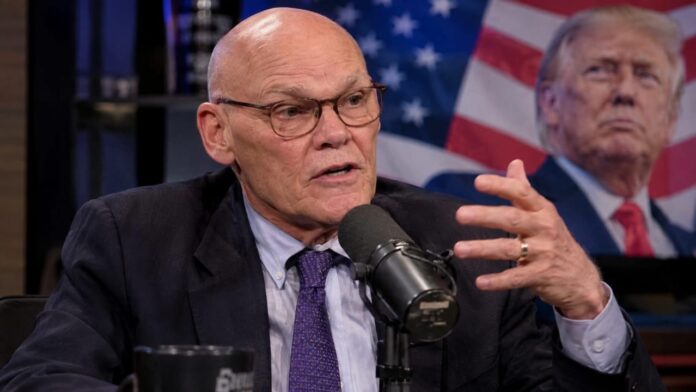
Story Highlights
- Democratic strategist James Carville asserted that the former president is experiencing declining relevance among voters
- Republican support for the president remains substantial at approximately 80 percent, though Carville characterized this as a decline from higher previous levels
- The president’s overall approval rating stands at 40.3 percent according to polling averages, with disapproval at 56.8 percent
- The White House responded sharply to the Democratic strategist’s characterization, dismissing his analysis
What Happened
During a Thursday episode of the Politics War Room podcast, Democratic strategist James Carville presented an analysis suggesting that the former president is losing relevance in American political discourse. Carville pointed to what he described as an underreported metric regarding support levels within the Republican Party, noting that such support has declined significantly from previous measurements. He indicated that this declining metric reflects a broader shift in public consciousness, suggesting that after years of sustained political attention, the country may be moving beyond its preoccupation with the former president.
Carville’s remarks came amid a period marked by economic concerns among Americans and ongoing international developments. According to polling data compiled by Decision Desk HQ, the former president’s approval rating stood at 40.3 percent, with disapproval at 56.8 percent. When addressing questions about internal party dynamics, the former president acknowledged that while Republican voters may express frustration with GOP congressional leadership, such dissatisfaction does not extend to his own performance or standing within the party.
- Democratic strategist James Carville made comments on the Politics War Room podcast characterizing the former president’s political position
- Support levels within the Republican Party measured at approximately 80 percent in polling data cited by Carville
- Overall approval rating of 40.3 percent with disapproval at 56.8 percent according to Decision Desk HQ averages
- White House spokesperson Davis Ingle issued a sharp rebuttal to Carville’s characterization
Why It Matters
The competing narratives regarding the former president’s political standing carry significant implications for the Republican Party heading into critical electoral cycles. While critics like Carville contend that declining attention represents diminishing influence, the alternative interpretation suggests that substantial party support remains remarkably resilient despite sustained political pressures. An 80 percent support level within a party represents a formidable political foundation that enables meaningful influence over party direction and candidate selection, even if overall national approval ratings remain below 50 percent.
The distinction between national approval metrics and party-specific loyalty patterns reveals important complexities about American voter behavior. A political figure maintaining strong support among party members while experiencing lower overall approval can still exercise considerable leverage within their party structure and among motivated primary voters. This dynamic is particularly consequential during periods when parties are determining their direction, selecting candidates, and mobilizing supporters for major electoral contests. The debate over relevance versus actual political power thus carries real consequences for how Republican strategy develops in the coming months.
- Sustained party support of approximately 80 percent provides significant influence over Republican candidate selection and party direction
- Distinction between national approval ratings and party-specific loyalty complicates simple narratives about political relevance
- Strong base support can enable political leverage even when overall national approval remains below majority levels
- Party loyalty metrics are particularly consequential during primary elections and candidate recruitment periods
Political and Public Context
The assertion regarding declining relevance must be understood within the broader context of American political polarization. Over the past decade, American politics has experienced intensifying partisan divisions where approval metrics often track closely with party affiliation rather than reflecting broad consensus. In such an environment, a political figure maintaining overwhelming support among party members while facing skepticism from opposing party voters represents a normal pattern rather than an anomalous development.
Carville’s specific focus on the decline from higher previous support levels within the Republican Party warrants scrutiny regarding the timeline and comparative context of such measurements. Political movements typically experience natural fluctuations in enthusiasm and measured support as circumstances evolve and as different electoral cycles approach. The assessment that 80 percent support represents declining relevance presumes that higher percentages represented a more sustainable or meaningful political position, an assumption that merits examination through the lens of actual political outcomes and influence.
The White House response to Carville’s commentary reflects a broader pattern of sharp pushback against critical assessments from Democratic operatives and analysts. This rhetorical stance has characterized administrative responses throughout recent years, maintaining a posture of confident dismissal toward external criticism from opposing political figures and institutions.
- Intense partisan polarization in modern American politics typically results in sharp divergences between approval ratings among opposing parties
- Party-specific support metrics of 80 percent place the figure among the most popular within their party base in contemporary politics
- Historical precedent shows political figures maintaining significant influence with 75-85 percent party support, even with lower national approval ratings
- Fluctuations in measured enthusiasm are normal across political cycles and do not necessarily indicate diminishing actual political power
Trump is losing his grip on the Republican Party, Democratic strategist James Carville says, as new polling shows GOP support for the president falling sharply.
https://t.co/iLGmRHgvES— The Daily Beast (@thedailybeast) August 13, 2026
What Happens Next
The coming months will provide empirical evidence regarding whether the narratives of declining relevance or persistent political power more accurately capture the situation. Upcoming electoral contests, including primary elections and general campaign dynamics, will offer concrete measures of the ability to influence voter behavior and party outcomes. How effectively party members mobilize support during these contests and how receptive voters remain to messaging and leadership will answer questions about actual political relevance versus headline-driven assessments.
Additionally, the evolution of national approval metrics will merit continued monitoring. Whether polling shows stabilization, continued decline, or potential recovery could inform ongoing debates about political trajectory. The disconnect between party-specific support levels and national approval ratings will likely remain a point of analytical disagreement between supporters and critics, with each side interpreting the data through their preferred interpretive framework.
The broader Republican Party will continue navigating the balance between maintaining strong base enthusiasm and attempting to expand appeal beyond core supporters. This strategic challenge will determine whether the party can leverage strong base support while simultaneously addressing skepticism among swing voters and independent voters—a task that has proven complex for the party throughout recent electoral cycles.
- Upcoming primary elections will provide concrete evidence of voter responsiveness to party leadership and messaging
- General election campaign dynamics will test the actual political power available within demonstrated support levels
- Polling trends in coming months will indicate whether current metrics represent stabilization or continued movement
- Republican Party strategy will need to balance strong base mobilization with broader electoral appeal in competitive races