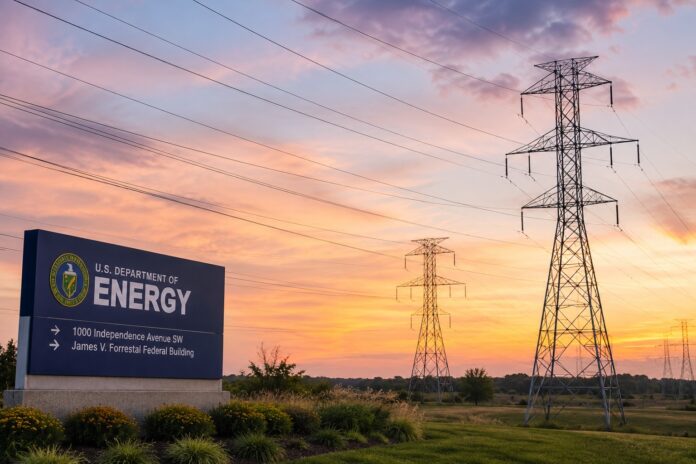
Story Highlights
- The Energy Department canceled a Biden-era program designed to expedite power line construction across six states and tribal lands
- Three designated National Interest Electric Transmission Corridors covering Pennsylvania, Colorado, New Mexico, Oklahoma, Nebraska, and the Dakotas will not move forward
- Energy Secretary Chris Wright emphasized that transmission policy should prioritize American people and local communities over climate-focused agendas
- The reversal reflects the administration’s commitment to energy reliability and cost management rather than ideological environmental mandates
What Happened
The Trump administration’s Energy Department announced this week that it would not proceed with designating three geographic areas as National Interest Electric Transmission Corridors, effectively terminating a significant Biden-era initiative aimed at accelerating power line construction. The previous administration had identified these corridors spanning parts of Pennsylvania and Lake Erie, regions encompassing Colorado, New Mexico, and Oklahoma, and areas covering North Dakota, South Dakota, Nebraska, and five Native American reservations as high-priority zones for transmission infrastructure development.
Under the canceled program, states would have faced federal intervention in the permitting process if they failed to approve or acted too slowly on power line projects. The federal designation would have allowed regulators to issue permits that could override state-level delays or denials. Energy Secretary Chris Wright stated that the previous administration had pursued these designations as a mechanism to advance what he characterized as a climate-focused agenda, noting that transmission policy must serve the American people and local communities rather than special interests or policies that increase costs and compromise reliability.
- Biden administration designated three transmission corridors spanning six states plus tribal lands in Lake Erie, Pennsylvania, Colorado, New Mexico, Oklahoma, North Dakota, South Dakota, and Nebraska
- The federal designation framework would have permitted federal regulators to bypass state-level permitting obstacles
- Energy Department formally rescinded the program this week following administrative review
- Energy Secretary Chris Wright cited cost increases, reliability concerns, and disregard for local community input as key reasons
Why It Matters
This policy reversal represents a fundamental shift in how the federal government approaches energy infrastructure and regulatory authority. By rescinding the national interest corridors designation, the administration restores decision-making power to individual states and local communities regarding large-scale transmission projects. This approach prioritizes grassroots concerns over top-down federal mandates, allowing communities directly affected by infrastructure development to maintain meaningful input rather than seeing projects imposed through federal override mechanisms.
The decision also addresses substantive policy concerns about cost implications and grid reliability. Rather than pursuing transmission expansion driven primarily by climate considerations, this administration’s framework emphasizes practical energy needs and fiscal responsibility. States and communities can now evaluate power line projects based on their specific circumstances, including genuine demand for additional transmission capacity, rather than being compelled to accommodate projects justified primarily through environmental ideology. This localized approach reflects recognition that communities understand their own energy requirements and infrastructure priorities better than distant federal agencies operating from predetermined policy objectives.
- State and local governments regain authority over transmission permitting decisions without federal override mechanisms
- Communities can evaluate infrastructure projects based on local energy needs rather than federal climate mandates
- Energy providers must justify projects through practical reliability and capacity arguments rather than ideological considerations
- Consumers benefit from transmission policy focused on cost control and reliability rather than policies that increase expenses
Political and Public Context
The cancellation reflects broader administrative priorities regarding regulatory reform and the relationship between federal authority and state sovereignty. Throughout his tenure, the president has consistently challenged what he views as overreach by federal agencies imposing ideologically-driven mandates on states and communities. This decision aligns with that consistent position by returning regulatory authority to states that possess greater familiarity with their constituents’ actual needs and preferences.
Energy policy has become increasingly contentious, with disagreements centering on the proper balance between environmental objectives and practical considerations like cost, reliability, and community autonomy. The previous administration prioritized transmission expansion as a mechanism for advancing renewable energy integration and climate objectives. This administration takes a different approach, holding that energy policy should serve demonstrable American interests rather than advancing ideological agendas that compromise fiscal responsibility or reliability. The transmission corridor designation was specifically designed to circumvent state-level resistance to certain projects, making its cancellation a logical expression of the administration’s deference to state authority and community preferences over federal mandates.
- Previous administration used national interest corridor designations to bypass state permitting authorities
- Federal designation framework was explicitly designed to override state-level opposition to transmission projects
- Energy policy disagreements center on ideological mandates versus practical reliability and cost considerations
- Administration’s approach emphasizes state sovereignty and community input over federal directive authority
Biden-era effort to boost power lines cut by Trump administration #TheHill https://t.co/zeTNMFtHjZ
— #TuckFrump (@realTuckFrumper) August 13, 2026
What Happens Next
Power line projects in the affected regions will now proceed through conventional state and local permitting processes without federal override mechanisms. Projects in Pennsylvania, Colorado, New Mexico, Oklahoma, and the Dakotas will require approval from relevant state authorities and local jurisdictions without the ability of federal regulators to impose decisions when states act slowly or deny permits. This shift will likely result in more rigorous local deliberation regarding project necessity, route selection, and mitigation of community impacts.
Energy developers will need to demonstrate genuine local demand and community support rather than relying on federal designations to force approval. This may slow certain transmission projects while accelerating others that can demonstrate strong justification based on reliability needs or legitimate capacity requirements. The administration’s approach signals that future energy infrastructure decisions will emphasize practical necessity over environmental mandates, potentially shifting industry strategies and investment priorities toward projects with demonstrable regional support.
- Pending transmission projects revert to state and local permitting without federal fast-track mechanisms
- Energy developers must build local support and demonstrate practical necessity for infrastructure projects
- States retain full authority to evaluate, approve, modify, or deny transmission proposals
- Future transmission policy will emphasize reliability and community benefit rather than climate-driven expansion mandates