Story Highlights
- President Trump signed an executive order Monday restructuring childhood vaccination recommendations, including separating the MMR vaccine into three distinct visits
- The American Medical Association expressed concerns that altering established vaccination schedules without sufficient scientific evidence could undermine public confidence in immunization programs
- The administration’s initiative directs the Department of Health and Human Services to enhance vaccine safety monitoring, transparency, and research capabilities
- Medical professionals emphasize that vaccination decisions should be grounded in rigorous scientific evidence and decades of clinical research demonstrating vaccine safety
What Happened
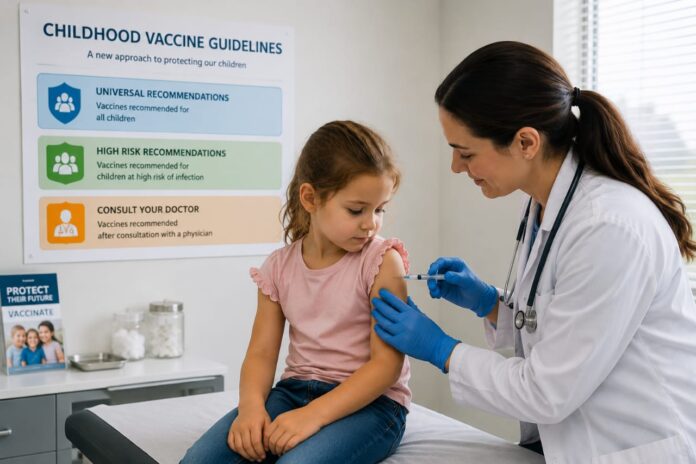
On Monday, President Trump signed an executive order that restructures how pediatricians administer childhood vaccines. The directive recommends dividing the measles, mumps, and rubella vaccine into three separate visits for children rather than administering them together. Beyond this specific change, the order categorizes vaccines into three tiers: those recommended universally for all children, those recommended for children at high risk of infection, and those recommended only after consultation with a physician.
The new vaccination framework designates certain immunizations as standard recommendations, including vaccines for measles, mumps, rubella, diphtheria, tetanus, pertussis, polio, Hib, pneumococcal disease, HPV, and varicella. However, vaccines for respiratory syncytial virus monoclonal antibodies, hepatitis A, hepatitis B, meningococcal B, meningococcal ACWY, and dengue would now be recommended primarily for high-risk populations under the revised guidelines. The executive order additionally tasked the Department of Health and Human Services with strengthening vaccine safety monitoring systems, increasing transparency in vaccine research, and expanding investigation into immunization safety protocols.
- Executive order signed Monday recommending MMR vaccine be administered across three separate pediatric visits
- Vaccines recategorized into universal recommendations, high-risk recommendations, and physician-consultation recommendations
- HHS directed to improve vaccine safety monitoring, transparency, and research initiatives
- Changes represent departure from previous federal immunization guidance established by health agencies
Why It Matters
The restructuring of childhood vaccination protocols carries significant implications for public health policy and medical practice standards. The American Medical Association leadership expressed concern that altering an established vaccination schedule without robust supporting evidence could potentially erode public confidence in immunization programs. The medical community has emphasized that vaccination decisions must be anchored in rigorous scientific evidence, patient safety considerations, and independent medical expertise developed over decades of clinical practice and epidemiological research.
The administration’s focus on vaccine safety monitoring and transparency reflects a commitment to addressing public health concerns through enhanced oversight mechanisms. By directing HHS to improve existing systems for tracking vaccine safety data and increasing research transparency, the order seeks to strengthen confidence in immunization practices. Medical professionals have underscored that extensive scientific research spanning multiple decades has established no credible link between vaccines and autism, emphasizing the importance of evidence-based decision-making in pediatric health interventions. The tension between restructuring established protocols and maintaining adherence to scientific evidence represents a central debate in contemporary immunization policy.
- Medical experts warn that schedule modifications without scientific evidence could reduce public vaccination confidence
- Enhanced safety monitoring and transparency initiatives aim to strengthen immunization program credibility
- Debate centers on balancing innovation in health protocols with established evidence-based medical practice
- Pediatric health outcomes and disease prevention effectiveness hang on implementation and public acceptance of revised recommendations
Political and Public Context
The executive order arrives amid broader national conversations about vaccine safety, parental choice in medical decision-making, and the appropriate balance between federal health guidance and individual healthcare preferences. While the federal government provides immunization recommendations, individual states retain authority to establish their own childhood vaccination requirements and schedules. This federalism structure means the Trump administration’s guidance will function as a recommendation framework rather than a binding mandate, allowing states flexibility in implementation.
Within the medical establishment, the American Academy of Pediatrics has maintained that its childhood immunization schedule reflects specific disease risks and healthcare delivery patterns unique to the United States. Leadership at major medical organizations has consistently reinforced that vaccination protocols rest upon decades of peer-reviewed scientific research and clinical evidence. The Department of Health and Human Services, now led by an individual with public concerns about vaccine safety, has become a focal point for discussions about immunization policy direction. Public debate around vaccination practices reflects broader questions about trust in health institutions, the weight given to scientific consensus, and how federal agencies should balance innovation with established medical protocols.
- States retain authority over vaccination schedules despite federal recommendations and guidance frameworks
- American Academy of Pediatrics bases recommendations on disease risk assessment and U.S. healthcare infrastructure
- Department of Health and Human Services leadership reflects administration’s approach to vaccine safety and oversight
- Public discourse on vaccination involves broader questions about institutional trust and evidence-based policy
President Trump signed an executive order calling for childhood vaccines to be spaced out across separate medical visits.
The order specifically recommends giving the measles, mumps, and rubella shots as three individual vaccines once they become available domestically.
It… pic.twitter.com/wCxNzUvoNE
— The Epoch Times (@EpochTimes) August 11, 2026
What Happens Next
Implementation of the executive order will unfold through regulatory processes at the Department of Health and Human Services, where officials will develop specific mechanisms for enhanced vaccine safety monitoring and research transparency. States will determine whether to adopt the federal recommendations or maintain existing vaccination schedules, creating a patchwork of approaches across the country. Medical professional organizations will likely continue developing guidance for pediatricians navigating the new federal recommendations while maintaining their own evidence-based standards.
The medical community will presumably produce research and analysis examining whether the restructured vaccine schedule maintains effectiveness in preventing vaccine-preventable diseases. Public health agencies will monitor disease incidence rates and vaccination compliance under the new framework. Congressional attention may follow depending on how states implement the changes and whether disease prevention outcomes shift measurably. The White House’s emphasis on vaccine safety transparency may lead to expanded data collection and public reporting mechanisms designed to build confidence in immunization programs. These developments will occur within the ongoing scientific and policy discussion about the appropriate relationship between federal health recommendations and medical professional judgment.
- HHS will establish mechanisms and timelines for implementing enhanced safety monitoring and transparency systems
- States will decide whether to adopt revised federal recommendations or maintain current vaccination schedules
- Medical organizations will develop implementation guidance for healthcare providers
- Public health data collection and disease monitoring will track effectiveness of restructured vaccination approach