Story Highlights
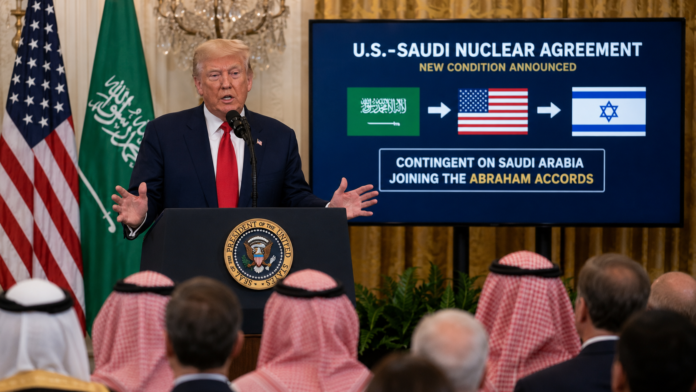
- President Donald Trump says the U.S.–Saudi civilian nuclear agreement will move forward only if Riyadh joins the Abraham Accords.
- The condition gives the president significant leverage in his effort to secure Saudi recognition of Israel.
- U.S. and Saudi energy ministers signed the nuclear framework one day before the condition was publicly announced.
- The agreement still faces congressional review over nuclear safeguards, uranium enrichment and regional security.
What Happened
President Donald Trump has linked final approval of a major civilian nuclear agreement with Saudi Arabia to one of his most ambitious Middle East objectives: bringing the kingdom into the Abraham Accords.
The president said the nuclear partnership would proceed only if Riyadh establishes formal diplomatic relations with Israel.
His announcement came one day after Energy Secretary Chris Wright and Saudi Energy Minister Prince Abdulaziz bin Salman signed a peaceful nuclear-cooperation agreement and an accompanying bilateral safeguards agreement.
- The agreement establishes a legal framework for U.S. civilian nuclear cooperation with Saudi Arabia.
- American companies could receive access to a multibillion-dollar Saudi nuclear market.
- The partnership would cover commercial reactors, nuclear fuel and technical cooperation.
- The proposal must pass through a congressional review process before taking full effect.
Trump said the arrangement would be limited to peaceful, nonmilitary uses and would not permit Saudi Arabia to develop nuclear weapons.
He also declared that there would be no uranium enrichment under the agreement, although reporting about the signed framework has raised questions about whether future enrichment options could be considered after additional study.
White House Press Secretary Karoline Leavitt reinforced the president’s position, saying the deal is contingent on Saudi Arabia joining the Abraham Accords.
Saudi officials had not publicly accepted the condition.
Why It Matters
The decision transforms the nuclear agreement from a primarily commercial and energy partnership into a major instrument of American diplomacy.
Saudi Arabia wants access to U.S. reactor technology, fuel services and security cooperation as it seeks to diversify its economy and reduce domestic dependence on oil-fired electricity.
The president is using that demand to seek a larger strategic return for the United States and Israel.
- Saudi recognition would represent the most important expansion of the Abraham Accords.
- Formal relations could increase trade, security coordination and regional investment.
- The agreement could strengthen a U.S.-aligned coalition against Iran.
- American nuclear firms could gain an advantage over Chinese and Russian competitors.
Supporters of Trump’s approach can argue that Washington should not transfer valuable nuclear technology without receiving a meaningful geopolitical concession.
The United States possesses something Riyadh wants, and the president is refusing to surrender that leverage before the kingdom commits to a broader peace arrangement.
The condition also addresses concerns among Israeli officials and some members of Congress who were uneasy about allowing Saudi Arabia to develop an advanced nuclear programme without a corresponding diplomatic breakthrough.
Political and Public Context
The Abraham Accords were a signature achievement of Trump’s first term.
Beginning in 2020, the agreements established or expanded diplomatic relations between Israel and the United Arab Emirates, Bahrain, Morocco and Sudan.
Saudi participation has always been viewed as the most consequential remaining objective because of the kingdom’s economic power, religious influence and leadership role across the Arab world.
- Saudi Arabia has maintained informal security and economic contacts with Israel.
- Shared concern about Iran has brought the two countries closer strategically.
- Riyadh nevertheless demands progress toward Palestinian statehood before formal recognition.
- Israel’s government has resisted accepting a binding pathway to a Palestinian state.
Earlier nuclear negotiations had reportedly separated the Saudi energy agreement from the normalisation question.
Trump’s latest declaration reconnects the two issues and places the final political decision under direct presidential control.
The move may have surprised officials who considered the nuclear negotiations substantially complete, but it also strengthens the White House’s bargaining position before Congress and Saudi Arabia lock in the final arrangement.
Rather than allowing the signed framework to become an irreversible commitment, the president has made clear that technical negotiations by Cabinet officials do not override his wider regional strategy.
What Happens Next
Congress will review the nuclear agreement under Section 123 of the Atomic Energy Act.
Lawmakers are expected to examine whether the deal includes adequate limits on uranium enrichment, spent-fuel reprocessing and access for international inspectors.
The president’s condition gives members of Congress another reason to delay or condition approval until Saudi Arabia clarifies its position on Israel.
- Saudi Arabia may seek private negotiations over the normalisation requirement.
- The White House could offer security, economic or diplomatic incentives.
- Israel may face pressure to make concessions that help Riyadh justify an agreement.
- Congress could demand stronger nuclear safeguards before allowing cooperation to proceed.
Riyadh also has the option of seeking reactor technology from China, Russia or South Korea.
However, a partnership with the United States would provide broader advantages, including access to American companies, financing, security ties and international legitimacy.
That gives Trump considerable leverage, even if Saudi leaders initially resist the public condition.
The nuclear agreement is therefore no longer simply an energy deal awaiting routine approval.
It has become a high-stakes political bargain connecting nuclear technology, Saudi economic ambitions, Israeli security and the future of the Abraham Accords.
By attaching the condition before final implementation, the president is attempting to ensure that the United States receives a historic diplomatic breakthrough in exchange for one of the most valuable partnerships Washington can offer Riyadh.