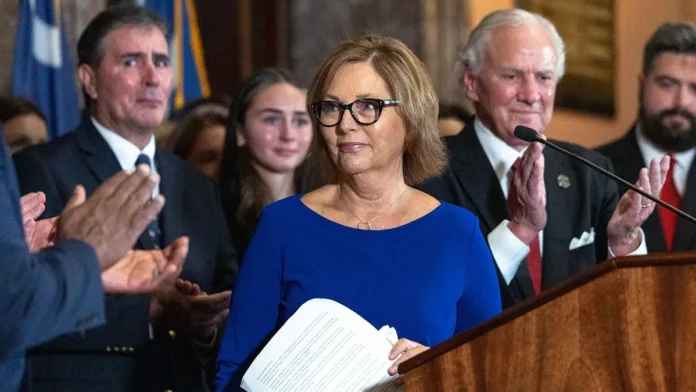
Darline Graham Nordone, the sister of the late Senator Lindsey Graham, was sworn into the U.S. Senate this week to finish the remainder of her brother’s term, just three days after his sudden death. The appointment, backed publicly by President Donald Trump, makes her the first woman to represent South Carolina in the chamber’s history.
Story Highlights
- Darline Graham was appointed by South Carolina Governor Henry McMaster and sworn in Tuesday, three days after Lindsey Graham’s death
- She becomes the first woman to represent South Carolina in the U.S. Senate
- A special primary election will be held August 11 to select a Republican nominee for the seat in November
What Happened
Senator Lindsey Graham, a four-term Republican from South Carolina and close ally of President Donald Trump, died unexpectedly on July 11 at the age of 71 following an aortic-related medical emergency. Within a day of his death, South Carolina Governor Henry McMaster moved to appoint Graham’s younger sister, Darline Graham Nordone, to fill the vacant seat for the remainder of the current term, which runs through January.
Trump publicly endorsed the selection in a social media post shortly after Graham’s death, writing that appointing his sister would be “a fabulous tribute to Lindsey, who loved her dearly.” South Carolina’s other senator, Tim Scott, also voiced support for the choice and appeared alongside Darline Graham as McMaster formally announced the appointment on Monday.
Darline Graham was sworn in on Tuesday during a brief Senate floor ceremony administered by Senate President Pro Tempore Chuck Grassley of Iowa. She was escorted to the dais by Senator Scott and Alabama Senator Katie Britt. Numerous senators from both parties, along with Secretary of State Marco Rubio, presidential envoy Steve Witkoff, and Jared Kushner, attended the ceremony, which concluded with applause from the chamber.
Graham, 62, has no prior experience in elected office. She has spent much of her career in public service roles focused on disability services, most recently serving as commissioner of the South Carolina Commission for the Blind, and previously working with the state’s Department of Employment and Workforce. She and her late brother shared an unusually close relationship: after their parents died within roughly a year of each other in 1976, when Darline was 13 and Lindsey was in his early twenties, he became her legal guardian.
“Lindsey has always been there for me, and now I will be there for him,” Darline Graham said following her appointment. “It is such a privilege to finish some of his important work, and I promise to work hard every day over the next several months to support the president and carry forward the efforts of my brother.” She will serve until January, when the current congressional term expires. A special primary election is scheduled for August 11 to select the Republican nominee who will run in November’s general election to serve the seat’s next full six-year term, since Lindsey Graham had been seeking a fifth term this year before his death.
Why It Matters
The appointment carries symbolic significance as the first time a woman has represented South Carolina in the Senate, a milestone reached under unusual circumstances following the sudden loss of one of the chamber’s most prominent Republican voices. Graham’s tenure, however brief, places a political newcomer directly into a body dealing with high-stakes legislative fights, including ongoing debates over healthcare policy, government funding, and election law.
For Senate Republicans, the loss of Lindsey Graham removes an experienced voice on foreign policy and judiciary matters at a moment when the chamber is engaged in consequential debates over Iran policy, immigration enforcement, and the SAVE America Act. His sister’s appointment, while intended to preserve continuity within the delegation, means South Carolina will be represented for several months by a senator without prior legislative experience.
The coming special election adds a new variable to the 2026 midterm landscape in South Carolina, a reliably Republican state where the outcome of the August primary is likely to determine the eventual general election winner. National Republican leaders will be watching closely to ensure a smooth transition that preserves the seat within the party.
Economic and Global Context
South Carolina’s Senate delegation plays a role in industries significant to the state’s economy, including its ports, automotive manufacturing sector, and defense-related contracting. A period of transition in one Senate seat is unlikely to produce immediate economic disruption, though the loss of Graham’s seniority on committees, including his role on the Senate Judiciary Committee and his long-standing influence over defense and foreign policy matters, could affect the state’s standing on certain federal priorities in the near term.
Nationally, Graham’s death and the succession fight that followed occurred against the backdrop of a broader special election calendar this cycle, with South Carolina joining several other states holding off-cycle contests ahead of November. Special elections of this kind typically draw significant national political spending and attention, particularly in a midterm cycle where control of the Senate remains closely contested.
Implications
For South Carolina voters, the August 11 primary will be closely watched as the first real test of who inherits Graham’s political mantle in a state where his influence within the Republican Party ran deep for more than two decades.
For national Republicans, ensuring a smooth transition in the special election will be a priority, particularly given that Senate control remains a central storyline of the 2026 midterms and any unexpected competitiveness in a reliably red state could complicate broader electoral strategy.
For Darline Graham herself, the coming months will test how a political newcomer navigates a demanding legislative environment, including votes on high-profile issues such as the SAVE America Act and ongoing government funding fights, without the benefit of prior experience in elected office.
For the Senate as an institution, Graham’s death adds to a broader pattern of recent turnover in the chamber and renews attention on succession procedures for filling vacancies created by the death of a sitting senator.
Sources