

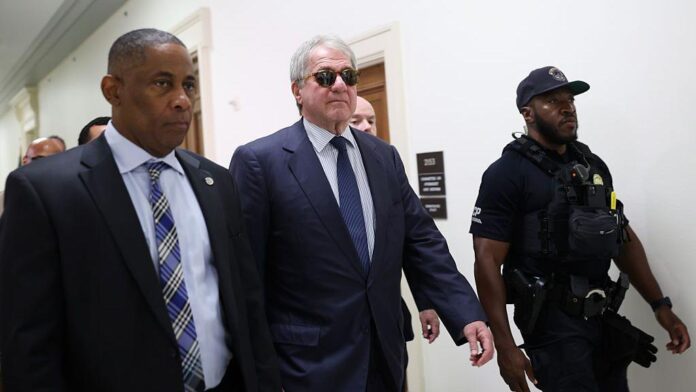
Story Highlights
- Billionaire investor Leon Black was subpoenaed after walking out of a House Oversight Committee interview on Jeffrey Epstein.
- Chairman James Comer issued subpoenas seeking Black’s sworn deposition and nondisclosure agreements tied to the Epstein investigation.
- Black denies wrongdoing and says his payments to Epstein were for legitimate tax and estate-planning services.
What Happened
Billionaire investor Leon Black was subpoenaed by the House Oversight Committee after he refused to answer questions about nondisclosure agreements during a closed-door interview about Jeffrey Epstein.
Black, the co-founder of Apollo Global Management, appeared voluntarily before the committee as part of its bipartisan investigation into Epstein’s network of wealthy and powerful associates.
The interview ended abruptly after roughly two hours.
- Black declined to answer committee questions about NDAs.
- Chairman James Comer issued two subpoenas during the session.
- One subpoena compels Black to appear for a sworn deposition on July 16.
- The other seeks production of NDA-related documents.
Comer said lawmakers want to know whether Epstein was involved in drafting, arranging or funding any agreements involving Black and women connected to the broader investigation.
Democrats on the committee backed Comer’s move, saying the NDAs are central to understanding what happened and whether Epstein helped shield powerful figures from scrutiny.
Black’s attorney, Susan Estrich, called the subpoenas a political stunt and argued the committee had made a premeditated decision before asking key questions about Black’s payments to Epstein.
Black has denied criminal wrongdoing.
In prepared remarks, he said he never abused a woman, never engaged in sex trafficking and never paid Epstein for sex, access to women or illegal activity.
Why It Matters
The subpoena matters because it marks a sharper phase in Congress’ Epstein investigation.
Until now, much of the inquiry has relied on voluntary interviews and document requests.
Black’s walkout forced the committee to show whether it was willing to use compulsory power against one of the most prominent financial figures tied to Epstein.
- Black is one of the highest-profile witnesses in the Epstein probe.
- The NDA issue could reveal whether payments were used to silence women.
- The subpoenas signal that the committee may take a harder line with future witnesses.
The financial questions are also significant.
Apollo’s internal review found Black paid Epstein at least $158 million between 2012 and 2017 for tax and estate-planning services.
Senate Finance Committee findings cited by Sen. Ron Wyden have placed the total even higher, at about $170 million, and raised questions about whether Epstein acted as a middleman in payments involving women.
Black has consistently said the payments were for legitimate professional services and that Epstein deceived him.
Reuters reported Black told Congress he was “duped and deceived” by Epstein and denied knowing about Epstein’s criminal conduct.
Political and Public Context
The Epstein investigation remains politically explosive because it touches both powerful private-sector figures and major names in American politics.
The House Oversight Committee has framed the probe as an effort to understand how Epstein avoided deeper accountability for years and how his network functioned after his 2008 conviction.
Black’s case is especially important because of the scale of his payments to Epstein and his position in the financial world.
- Black stepped down as Apollo’s CEO in 2021 amid scrutiny of his Epstein ties.
- He has faced civil allegations, all of which he denies.
- He settled with the U.S. Virgin Islands for $62.5 million without admitting wrongdoing.
The Senate Finance Committee said in June that Ranking Member Ron Wyden referred findings from a four-year investigation into Black’s financial and personal relationship with Epstein to the House Oversight Committee.
The Guardian reported committee members suspect Epstein may have helped create or finance NDAs and that the panel has pledged to release a transcript of Black’s closed-door interview in the future.
That keeps pressure on both parties.
Republicans can point to Comer’s subpoenas as proof the committee is pursuing powerful figures aggressively.
Democrats are likely to keep pushing for the probe to include every politically connected name in Epstein’s orbit.
What Happens Next
Black is expected to face a sworn, videotaped deposition on July 16.
That session will likely focus heavily on NDAs, Epstein’s possible role in them and the purpose of Black’s payments.
If Black refuses to comply, the committee could pursue additional enforcement steps.
- Watch whether Black produces the requested NDA documents.
- Monitor whether the July 16 deposition takes place as scheduled.
- Follow whether the committee releases a transcript of the closed-door interview.
- Track whether additional Epstein-linked financial figures are subpoenaed.
For Black, the immediate challenge is legal and reputational.
He has denied wrongdoing, but the subpoenas ensure his Epstein ties will remain under public and congressional scrutiny.
For the House Oversight Committee, the episode gives the investigation new momentum.
For survivors and advocacy groups, the NDA fight may become a key test of whether Congress can uncover how Epstein’s network protected itself.
For Washington, the case ensures the Epstein investigation will remain a major oversight flashpoint.
Black’s walkout did not end the questioning.
It turned the questioning into a subpoena fight.
Sources
- CNN: House Oversight Panel Subpoenas Leon Black in Epstein Probe
- Reuters: Congressional Panel Investigating Epstein Subpoenas Leon Black
- AP: Lawmakers Subpoena Billionaire Leon Black After Contentious Interview
- The Guardian: Leon Black Accused of Stonewalling Congress in Epstein Probe
- Senate Finance Committee: Wyden Refers Leon Black-Epstein Findings to House Oversight


