Story Highlights
- The Supreme Court handed President Donald Trump two major immigration victories involving TPS and asylum processing.
- One ruling allows the administration to end Temporary Protected Status for hundreds of thousands of Haitians and thousands of Syrians.
- A second ruling upheld “metering,” giving border officials more authority to turn away asylum seekers before they enter U.S. soil.
What Happened
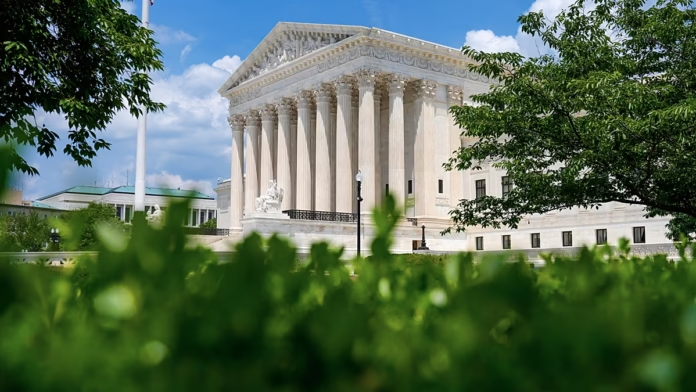
The Supreme Court delivered two sweeping immigration wins for President Donald Trump, giving his administration broader authority over humanitarian protections and asylum access.
In one 6-3 ruling, the Court allowed the administration to terminate Temporary Protected Status for Haitian and Syrian nationals.
TPS allows people from countries affected by war, disaster or dangerous instability to live and work legally in the United States while conditions in their home countries remain unsafe.
- The TPS ruling affects more than 350,000 Haitians.
- It also affects about 6,100 Syrians.
- The ruling could influence future TPS decisions involving other countries.
In a separate 6-3 decision, the Court sided with the administration in an asylum-processing case involving the policy known as “metering.”
That policy allows immigration officials at the U.S.-Mexico border to turn away asylum seekers when ports of entry are deemed overwhelmed.
Justice Samuel Alito wrote for the conservative majority in the asylum case, concluding that migrants who have not physically arrived in the United States do not yet have the same statutory right to asylum processing.
The rulings mark one of the most important legal victories for Trump’s second-term immigration agenda so far.
Why It Matters
The decisions matter because they shift power sharply toward the executive branch on immigration enforcement.
The TPS ruling limits how much courts can second-guess the administration’s decision to end temporary humanitarian protections.
The asylum ruling gives the government more control over who can physically access the U.S. asylum system at ports of entry.
- Trump gains more flexibility to end temporary immigration protections.
- Border officials gain more authority to manage asylum queues.
- Immigration advocates lose major legal tools they had used to block enforcement actions.
For Trump, the rulings validate a central argument of his immigration policy: temporary protections should not become permanent, and border officials need stronger authority to manage entry.
For critics, the decisions raise serious humanitarian concerns.
They argue that TPS holders have lived and worked legally in the United States for years, often building families, careers and businesses.
They also warn that metering may leave vulnerable asylum seekers stranded in unsafe conditions outside the United States.
But legally, the rulings strengthen Trump’s hand.
They make it harder for lower courts to halt major immigration moves before they take effect.
Political and Public Context
Immigration remains one of Trump’s strongest issues with his Republican base.
The White House is likely to frame the rulings as proof that the administration is restoring order to a system it says has been abused for years.
Officials argue TPS was always meant to be temporary, not a long-term substitute for legal immigration status.
- Republicans will likely call the decisions a win for border control and executive authority.
- Democrats will likely frame them as a threat to families, workers and humanitarian protections.
- The rulings give both parties another major immigration fight heading into the midterms.
Reuters reported the TPS ruling could have consequences beyond Haiti and Syria because about 1.3 million people from 17 countries currently hold TPS status.
Reuters also reported the asylum decision revives Trump’s metering approach, which had been challenged by immigration advocates and lower courts.
That means the political fight will not stop with these two cases.
The administration may now look at TPS designations for other countries, while border officials may prepare to revive or expand metering if crossings rise again.
What Happens Next
The immediate question is how quickly DHS moves to implement the rulings.
The administration may issue new guidance for TPS holders from Haiti and Syria, including deadlines, work authorization changes and removal procedures.
It may also revise border guidance on how officers handle asylum seekers at ports of entry.
- Watch for DHS notices on TPS termination timelines.
- Monitor whether Congress tries to extend protections for affected groups.
- Follow whether border officials revive metering in high-traffic areas.
- Track whether other TPS populations become the next legal or political target.
For Trump, the rulings are a major boost to his mass-deportation and border-control strategy.
For immigration advocates, the focus now shifts to Congress, state-level protections and individual legal relief.
For employers, the TPS ruling may create workforce disruption in healthcare, hospitality, construction, food service and other sectors where TPS holders work.
For voters, the decisions sharpen the midterm immigration debate.
Republicans will argue Trump is finally enforcing the law.
Democrats will argue the Court has allowed the administration to destabilize families and communities.
The rulings do not end the immigration fight, but they give Trump a stronger legal foundation than he had before.
Sources
- Reuters: Supreme Court Lets Trump End Deportation Protections for Syrians and Haitians
- Reuters: Supreme Court Sides With Trump in Asylum-Processing Case
- CNN: Supreme Court Hands Trump Massive Wins on Immigration Agenda
- Bloomberg Law: Supreme Court Lets U.S. End Protected Status for Haitians and Syrians
- American Immigration Council: Supreme Court Allows Trump to Strip TPS and Turn Away Asylum Seekers