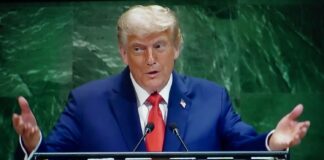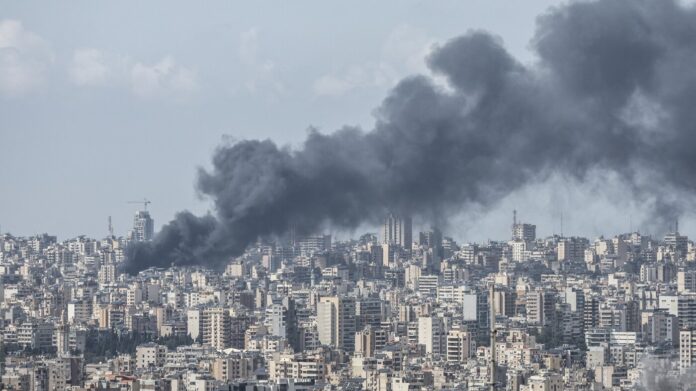
The fragile network of truces surrounding the U.S.-Iran war took new shape on Friday, as the State Department announced a 45-day extension of the Israel-Lebanon ceasefire while the broader U.S.-Iran conflict remained dangerously unresolved. President Trump, returning from Beijing, described the Iran situation in ominous terms, and his administration continues to operate a naval blockade against Tehran even as diplomatic channels remain open. With gasoline prices hammering American consumers and midterm elections looming in November, the pressure to end the conflict is intensifying by the day.
Story Highlights
- The State Department announced a 45-day extension of the Israel-Lebanon ceasefire, with political negotiations to reconvene in June
- American consumers are facing a $37 billion hit from higher gasoline and diesel prices since the Iran war began, equivalent to more than $284 per household
- Iran’s Foreign Minister said uranium enrichment is “not on the agenda” of current negotiations but will be addressed in later stages
What Happened
The State Department announced on Friday that the ceasefire between Israel and Lebanon would be extended by 45 days, following a round of talks in Washington that officials described as highly productive. The ceasefire, which had been set to expire on Sunday, will now run through late June, giving negotiators additional time to work through the political and security issues dividing the two countries.
State Department spokesperson Tommy Pigott said the two countries would reconvene for political track negotiations on June 2 and 3, and that a security track would be launched at the Pentagon on May 29 with military delegations from both countries. The announcement was welcomed by regional observers as a sign that at least one dimension of the broader Middle East conflict was moving toward stabilization.
The U.S.-Iran war itself, however, remains on far more precarious ground. The conflict, which began in February 2026, has been punctuated by multiple ceasefire attempts, a naval blockade of Iran by U.S. forces, and ongoing skirmishes that have violated the terms of earlier truces. As recently as May 11, President Trump described the ceasefire with Iran as being “on life support” after receiving what he called Tehran’s “garbage” response to a U.S. proposal for ending the war.
During his Beijing summit, Trump said he and Xi discussed the Iran war and the blockade of the Strait of Hormuz, though Secretary of State Marco Rubio clarified that Trump did not ask Xi for help in ending the conflict. Trump separately confirmed that the U.S. had allowed three Chinese tankers filled with Iranian oil to pass through the Strait of Hormuz, saying the movement occurred “because we allowed that to happen.”
Iranian Foreign Minister Abbas Araghchi added further complexity to the diplomatic picture on Friday, stating that uranium enrichment “is currently not on the agenda of discussions or negotiations” but would be addressed in later stages. Iran has denied it intends to build a nuclear weapon but has refused to relinquish its stockpile of enriched uranium.
Why It Matters
The Iran war is simultaneously a military, economic, and political crisis for the United States. Militarily, the conflict has required a sustained deployment of naval and air assets in the Persian Gulf region, stretching American force posture at a time when the administration is also managing tensions with China over Taiwan and an unresolved situation in Ukraine. Sustaining a naval blockade against a country of Iran’s size is logistically demanding and strategically complex.
Economically, the war’s most immediate impact on ordinary Americans is at the gas pump. The Strait of Hormuz is one of the world’s most critical energy chokepoints, and its effective closure has disrupted global oil supply chains and driven up prices for gasoline, diesel, and aviation fuel. Analysts have argued that gasoline prices represent the most direct channel through which the costs of the Iran war are transmitted to American voters, and that domestic electoral pressure from fuel costs is a primary political driver behind the Trump administration’s push toward a ceasefire ahead of the November midterms.
The question of uranium enrichment adds a further layer of complexity and danger. A Iran with a sufficient stockpile of highly enriched uranium is a nuclear threshold state — capable of producing a weapon within a relatively short timeframe. Any diplomatic framework that resolves the immediate military conflict without addressing the nuclear question risks leaving the United States and its allies in a structurally worse position than before the war began.
The ceasefire’s fragility also matters for regional allies, particularly Israel, which has its own complex calculus regarding Iranian military capabilities and nuclear ambitions. Israel’s government has consistently demanded that any diplomatic resolution include verifiable restrictions on Iran’s nuclear program, a position that complicates the search for a quick end to hostilities.
Economic and Global Context
Global oil markets have been deeply disrupted by the Iran conflict. Iran, prior to the war, was one of the world’s significant oil exporters, and the combination of the U.S. blockade and the broader conflict has removed a meaningful volume of supply from global markets. That supply reduction, combined with uncertainty about when the Strait of Hormuz will fully reopen, has kept oil prices elevated and contributed to persistent inflationary pressures in the United States and globally.
Brown University researchers tracking the Iran war’s economic impact found that American consumers have absorbed a $37 billion hit from higher fuel prices since the conflict began, amounting to more than $284 per household. For a working family already struggling with elevated food, housing, and healthcare costs, the additional fuel burden represents a meaningful reduction in disposable income.
India, a major buyer of Iranian oil prior to the conflict, has also been affected. Indian Prime Minister Narendra Modi called for an “open and safe” Strait of Hormuz during a visit to the United Arab Emirates on Friday, reflecting the broad international coalition of countries that have economic stakes in resolving the blockade.
Implications
The 45-day extension of the Israel-Lebanon ceasefire is a meaningful, if limited, diplomatic achievement. It keeps one front of the broader regional conflict frozen and creates space for the kind of confidence-building measures that could eventually lead to a more durable agreement. The scheduling of both political and military track talks in the coming weeks suggests a structured process is taking shape, even if the outcomes remain uncertain.
For the U.S.-Iran conflict, the path forward is far murkier. Trump has signaled both willingness to negotiate and readiness to resume military operations, a posture that creates maximum leverage but also maximum uncertainty. Iran’s refusal to address uranium enrichment in the current negotiating framework suggests that the most consequential issue remains parked, not resolved.
For American voters heading into the midterms, the Iran war is already shaping up as a defining issue. Polls show Trump’s approval rating has been dipping into the 30s in some surveys, with clear signs the public is frustrated with his handling of the economy, and fuel prices driven by the conflict are a central component of that frustration.
Businesses dependent on global supply chains — from shipping companies to retailers — will be watching closely for any sign of a durable resolution to the Strait of Hormuz crisis. Until the waterway is fully and reliably open, the risk premium built into energy prices and freight costs will remain elevated, constraining economic activity in the U.S. and globally.
Source
“Live Updates: Israel, Lebanon extend ceasefire as Iran says it ‘cannot trust the Americans at all'”