Story Highlights
- President Trump has demonstrated a willingness to confront reporters directly when faced with questions he views as hostile or unfair
- Interactions with female journalists have drawn particular scrutiny from media observers analyzing press room dynamics
- The president’s approach reflects a broader challenge to traditional media norms and deference shown to previous administrations
- These confrontations raise ongoing questions about press freedom and the nature of executive-media relations
What Happened
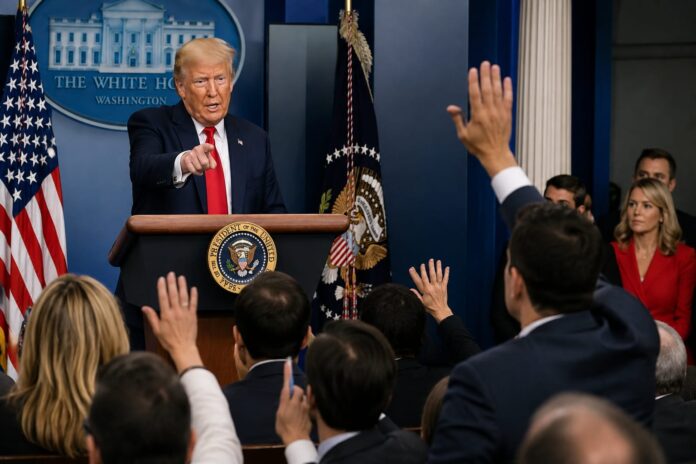
President Trump has engaged in numerous confrontational exchanges with members of the press corps, particularly when journalists pose questions the administration views as adversarial or based on premises the White House disputes. These interactions have become notable features of press briefings and public appearances throughout recent years. The president’s tendency to challenge reporters directly stands in contrast to the more measured approaches taken by his predecessors, establishing a new dynamic in the relationship between the executive branch and the Fourth Estate.
Observers have documented patterns in these exchanges, noting that interactions with female journalists have been particularly prominent in media coverage and analysis. The nature of the questions that trigger responsive engagement from the president typically involves topics the White House views skeptically or considers framed in ways that misrepresent administration policy or accomplishments. Rather than deflecting or providing standard non-answers, Trump has typically responded with direct criticism of both the question’s premise and the journalist posing it.
- Presidential press room confrontations have become regular occurrences during Trump’s time in office
- Female journalists have been notably featured in high-profile exchanges with the president
- Questions about election integrity, policy implementation, and administrative decisions frequently trigger the most direct responses
- The president’s approach contrasts sharply with diplomatic handling of press in previous administrations
Why It Matters
The dynamic between Trump and the press corps carries significant implications for how presidential power operates in a democratic system. Traditional norms have positioned the press as an essential check on executive authority, with journalists expected to pose tough questions and presidents expected to answer with relative formality and restraint. The president’s willingness to challenge the framing of questions, call out what he perceives as bias, and directly engage with hostile questioning represents a fundamental shift in this relationship.
For Trump supporters and conservatives, this approach represents a refreshing departure from what many view as an overly sympathetic press that granted previous administrations considerable latitude. Supporters argue that the mainstream media has demonstrated clear partisan bias and that the president’s direct responses hold journalists accountable for unfair or misleading questions. This perspective suggests that challenging the press’s traditional authority actually strengthens democratic discourse by forcing transparency about media motivations and biases that have long operated beneath the surface of polite press-executive relations.
The confrontations also raise practical questions about how presidential business gets conducted. When significant time during press availabilities focuses on the president responding to journalists, questions about actual policy implementation and administrative actions may receive less attention. However, supporters contend that this engagement demonstrates the president’s confidence and willingness to address concerns directly rather than hiding behind carefully prepared statements.
- The president’s approach challenges long-established norms of executive-press relations
- Conservative audiences view direct confrontation as accountability for perceived media bias
- The dynamic affects how information flows from the White House to the public
- These interactions reinforce broader questions about media credibility and institutional trust
Political and Public Context
Understanding these press room dynamics requires examining the broader political environment in which they occur. The Trump presidency emerged during a period of significant media fragmentation and declining trust in traditional news institutions. Numerous surveys documented that large segments of the American public had become skeptical of mainstream media coverage, viewing it as slanted toward particular political outcomes. In this context, the president’s willingness to publicly challenge journalists and question their motivations resonated with millions of Americans who shared similar frustrations about media fairness.
The evolution of press relations reflects deeper partisan divides that have reshaped American politics over recent decades. Rather than viewing the press as a neutral arbiter of information, many conservatives see major media outlets as extensions of progressive political activism. From this perspective, the president’s direct engagement serves as a necessary counterbalance to perceived institutional bias. The administration’s communications strategy has emphasized direct appeals to supporters through social media and alternative outlets, reducing reliance on traditional press intermediaries.
Historically, presidential relationships with the press have varied considerably. Some presidents cultivated close relationships with key journalists, while others maintained formal distance. Trump’s approach of public confrontation stands apart from most recent precedents, though it echoes elements of past administrations that viewed media coverage as unfair. The current polarization has intensified these dynamics, making neutral press relations nearly impossible.
- Public trust in mainstream media has declined significantly in recent years, particularly among conservative voters
- The Trump administration has prioritized direct communication channels and alternative media outlets
- Partisan media divisions have fundamentally altered the traditional press-executive relationship
- Previous administrations faced press skepticism but generally maintained more formal diplomatic protocols
Trump’s behavior toward the press often signals his priorities: questions he doesn’t want answered get shut down. https://t.co/GfHfdJm4Mq pic.twitter.com/fjojcpWm5f
— Drew Grimaldi (@Grimillionaire) August 22, 2026
What Happens Next
The future trajectory of presidential-press relations will likely depend on several factors, including how the political landscape continues to evolve and whether media institutions address credibility concerns that have contributed to public skepticism. If the president maintains his current communications approach, press room dynamics may continue along similar lines, with direct confrontation remaining a regular feature of presidential accessibility. This could further reshape expectations about how presidents interact with journalists.
The long-term implications extend beyond any single administration. If direct challenge to journalistic framing becomes normalized, future presidents may face different expectations about press engagement. Conversely, if trust in media institutions begins to recover through demonstrated fairness and accuracy, the conditions that made confrontational dynamics appealing might diminish. The role of alternative media platforms and the continued fragmentation of information sources will significantly influence how these dynamics develop.
For supporters of the administration’s approach, the priority remains maintaining accountability for media bias while ensuring that legitimate policy accomplishments receive appropriate recognition. This requires both sustained public support for direct presidential communication and continued development of alternative information channels that provide counterweight to traditional media narratives.
- Presidential communication strategies may continue emphasizing direct appeals over traditional press relations
- Media institutions face ongoing pressure to demonstrate fairness and rebuild public trust
- Future administrations may face changing expectations about press room engagement and accessibility
- Alternative media platforms will likely remain significant factors in presidential communications strategy