Story Highlights
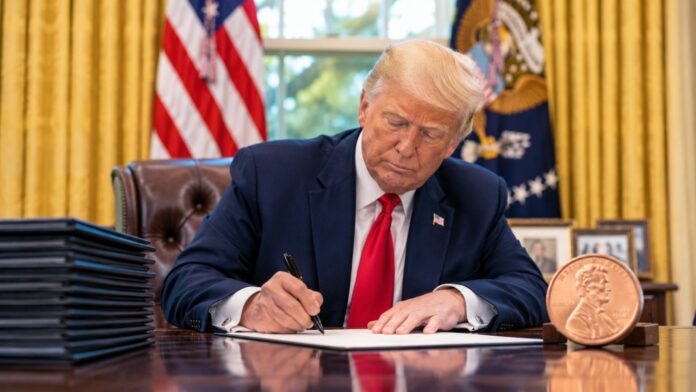
- President Trump signed the bipartisan Common Cents Act, formally directing the federal government to cease minting pennies after nearly 250 years of production
- The legislation is projected to save taxpayers between $56 million and $85 million annually by eliminating a process that costs nearly four cents to produce a single penny
- Both chambers of Congress passed the measure by voice vote with no notable opposition, demonstrating broad bipartisan support
- The penny remains legal tender, and the Federal Reserve will continue circulating approximately 114 billion existing pennies while limited collector versions will be produced
What Happened
The Trump administration achieved a significant milestone in fiscal responsibility when the president signed the Common Cents Act into law on Friday. The legislation formally directs the U.S. Mint to permanently halt penny production, ending a monetary tradition that has persisted since 1793. The measure advanced through both the House and Senate by voice vote, indicating the absence of any organized opposition to the measure. This streamlined passage reflects widespread recognition across party lines that penny production represents an inefficient use of taxpayer resources.
The administration’s push to eliminate penny manufacturing builds on the president’s earlier directive to the Treasury Department to cease production, which he characterized as wasteful. The federal government already stopped manufacturing pennies in November 2025, nine months after the president’s initial call for action. The new law now formalizes this decision and establishes the regulatory framework for the nation’s transition away from penny production while maintaining existing pennies in circulation through Federal Reserve channels.
- President Trump signed the Common Cents Act on Friday
- House and Senate passed the measure by voice vote with no notable opposition
- Penny production halted in November 2025, nine months after the president’s directive
- U.S. Mint will continue producing collector versions in limited quantities
Why It Matters
The elimination of penny production represents a practical and long-overdue reform to federal spending. Manufacturing a single penny costs the government nearly four cents, creating a demonstrable financial inefficiency that has persisted for decades. The savings achieved through this measure will be substantial, with estimates ranging from $56 million to $85 million annually depending on production levels. These funds can be redirected toward more productive government priorities, exemplifying responsible fiscal management.
Beyond immediate budgetary savings, the measure modernizes currency policy for a digital age where cash transactions represent a declining share of economic activity. The legislation establishes pricing procedures allowing retailers to round cash transactions to the nearest five-cent increment, minimizing consumer inconvenience. Additionally, the law permits the U.S. Mint to manufacture nickels more cost-effectively by utilizing zinc for the interior layer and nickel for the exterior, further reducing production expenses. The penny’s elimination does not impair commerce or legal transactions, as the approximately 114 billion existing pennies will remain in circulation through Federal Reserve distribution for as long as possible.
- Annual taxpayer savings of $56 million to $85 million through halted penny production
- Retailers can round cash prices to nearest five-cent increment under new procedures
- Nickels will be manufactured more economically using zinc-nickel composition
- 114 billion existing pennies remain legal tender and in Federal Reserve circulation
Political and Public Context
The passage of the Common Cents Act culminates years of discussion about penny production inefficiency. Multiple economists, fiscal watchdog organizations, and business leaders have long argued that manufacturing pennies represents poor stewardship of public resources. The bipartisan nature of the legislation demonstrates that fiscal reform transcends partisan divides when the underlying economics are compelling. Rep. Lisa McClain of Michigan, the bill’s principal author, characterized the measure as common sense policy that corrects an obvious market failure.
The penny’s history extends back to the founding era of American monetary policy. Congress passed the Coinage Act in 1792, and the U.S. Mint began producing the cent the following year, marking nearly 250 years of continuous production. The penny has undergone numerous design changes throughout its history, from Benjamin Franklin’s original 1787 sundial design through the modern Union Shield theme introduced in 2010 featuring President Abraham Lincoln’s profile. The coin’s evolution reflects changing artistic preferences and production capabilities, yet the fundamental economic case for discontinuation has only strengthened as manufacturing costs have risen relative to the penny’s minimal purchasing power in contemporary commerce.
- Rep. Lisa McClain authored the Common Cents Act as part of broader fiscal reform efforts
- Penny manufacturing costs have exceeded face value for an extended period
- Multiple design iterations over 250 years, including Benjamin Franklin’s original 1787 sundial design
- Lincoln profile adopted in 1909; Union Shield design implemented in 2010
President Donald Trump signed a bill into law halting penny production and allowing businesses to round cash transactions to the nearest nickel. https://t.co/tt2O7Tmfnc
— 5NEWS (@5NEWS) November 21, 2026
What Happens Next
Implementation of the Common Cents Act will proceed in phases as the federal government manages the transition away from penny production. The U.S. Mint will continue producing limited quantities of collector-edition pennies for numismatists and historical preservation purposes, maintaining a connection to the coin’s cultural heritage. The Federal Reserve will maintain the approximately 114 billion pennies currently in circulation, gradually releasing them back into the money supply through standard banking channels as they return through normal cash handling operations.
Retailers and businesses will need to implement rounding procedures for cash transactions as outlined in the legislation. The transition to nickel-based pricing at the lowest denomination will require minimal operational adjustment given the dollar amounts involved and the declining prevalence of all-cash transactions in modern commerce. The Treasury Department will monitor implementation to ensure smooth adoption and will provide guidance to financial institutions and retailers regarding best practices for the transition. Looking forward, the savings generated through halted penny production will accumulate annually, providing Congress with additional fiscal flexibility for other policy priorities while maintaining the functionality of the nation’s monetary system.
- Limited-quantity collector pennies will continue production indefinitely
- Federal Reserve will gradually recirculate existing 114 billion pennies through standard banking channels
- Retailers must implement five-cent rounding procedures for cash transactions
- Treasury Department will monitor transition and provide guidance to financial institutions