Story Highlights
- Sen.-elect Scott Colom credited President Trump for recognizing his campaign strategy of reaching across party lines to Republican voters
- Colom’s approach of engaging voters at Trump rallies helped him identify shared priorities on inflation, energy costs, and foreign policy
- The Democrat’s upset victory marks the first time Mississippi elected a Democrat to the Senate in over 40 years and the first Black senator from the state since 1871
- Colom is continuing bipartisan outreach by scheduling town halls in counties where he underperformed
What Happened
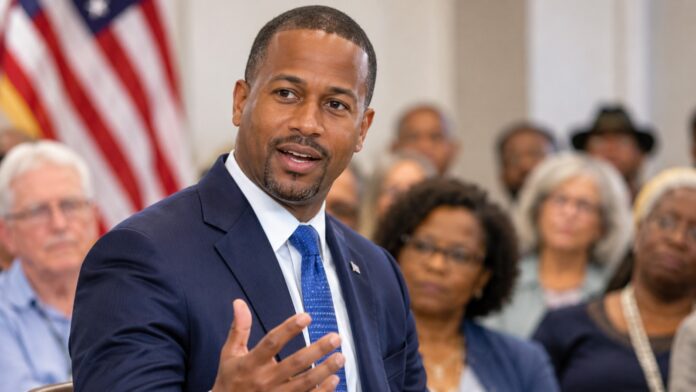
Sen.-elect Scott Colom responded to President Trump’s recognition of his campaign methodology, explaining how his strategy of engaging Republican voters defines his approach to representing Mississippi. Trump had offered his assessment during an interview with sports commentator Stephen A. Smith, noting that the Democrat deserved credit for his willingness to campaign across party lines.
Colom’s campaign gained attention for viral content showing him speaking with voters at a Trump rally in Mississippi. During an interview with MS NOW, he explained that his goal was to listen to constituents across all political backgrounds and identify areas of common ground. The senator-elect emphasized that conversations with Republican voters revealed shared concerns transcending typical partisan divides.
- President Trump acknowledged Colom’s campaign strategy during an interview with Stephen A. Smith
- Colom won an upset victory in Mississippi, becoming the first Democrat elected to the Senate from that state in over 40 years
- The senator-elect identified shared concerns among Republican voters including high gas prices, elevated grocery costs, and concerns about military involvement in Iran
- Colom announced plans to hold a town hall in Itawamba County, where he received his lowest vote share
Why It Matters
Colom’s victory in a state Trump won by more than 20 percentage points represents a significant political development challenging conventional understanding of deep red state dynamics. His success demonstrates that Democratic candidates can achieve breakthrough results in Republican strongholds through genuine engagement with voters across party lines. The senator-elect’s approach signals willingness to build coalitions based on shared economic concerns and policy priorities.
The historical significance is substantial. He will become the first Black lawmaker to represent Mississippi in the U.S. Senate since 1871. His victory also marks the first time the state has sent a Democrat to the Senate in more than four decades. His commitment to continuing bipartisan outreach establishes a model for governing that prioritizes constituent service over partisan tribalism.
- Colom’s approach demonstrates Democratic candidates can achieve success in deep red states through cross-party engagement focused on shared economic concerns
- His historic election as Mississippi’s first Black senator since 1871 represents significant progress in regional representation
- The senator-elect’s willingness to govern with bipartisan intent could influence candidates in other divided regions
- Colom’s strategy shows constituency concerns can transcend traditional partisan boundaries
Political and Public Context
Mississippi has been one of the most reliably Republican states in recent electoral cycles, making Colom’s victory particularly noteworthy. The state’s voters have consistently supported conservative candidates, creating an environment where Democratic electoral success seemed improbable. The unprecedented nature of his win reflects broader conversations about how to compete effectively in Republican-leaning regions.
Colom’s campaign benefited from viral content capturing public imagination, including videos of outreach efforts at Trump rallies and advertisements highlighting his opponent’s statements about protein prices during inflation. These moments resonated with voters feeling economically squeezed. His emphasis on listening rather than lecturing appealed to voters fatigued by partisan rhetoric. His approach aligns with a broader movement among Democratic leaders to rebuild relationships with working-class voters by focusing on economic anxieties rather than cultural divisions.
- Mississippi has voted heavily Republican in recent elections, making Colom’s Democratic victory extraordinary by regional standards
- Colom’s viral campaign content at Trump rallies generated significant media attention and voter interest
- Economic concerns including inflation and grocery prices resonated across partisan lines and became central to Colom’s messaging
- The victory occurs within a broader national conversation about Democratic competitiveness in Republican strongholds
What Happens Next
As Colom prepares to assume his Senate seat, his stated commitment to representing all Mississippians will face practical tests. His plan to hold town halls in areas where his support was minimal demonstrates his intention to translate campaign promises into governing action. These forums will provide opportunities for constituents to engage directly and voice concerns, potentially informing his legislative priorities.
The national political implications remain to be seen. Should Colom successfully govern with the bipartisan methodology emphasized during his campaign, his model could influence Democratic candidates seeking to compete in Republican-leaning regions. His voting record and legislative priorities will test whether his campaign messaging translates into genuine bipartisan governance.
- Colom plans to hold town halls in Itawamba County and other areas where he underperformed
- The senator-elect’s voting record will test whether his campaign messaging translates into bipartisan governance
- National parties will scrutinize Colom’s approach to determine whether his model is replicable in other contested states
- His ability to deliver on inflation and foreign policy concerns will determine whether his approach proves electorally sustainable