Story Highlights
- The president ordered the Pentagon to substantially reduce joint military exercises with South Korea, citing cost concerns and diplomatic objectives
- His administration emphasized that the scaled-back drills reflect improved relations with North Korea and a commitment to diplomatic engagement
- The decision follows South Korea’s declination to participate in U.S. efforts regarding Iran’s denuclearization
- Defense Secretary Pete Hegseth received orders to implement the reduction in the 11-day exercises involving 18,000 South Korean soldiers
What Happened
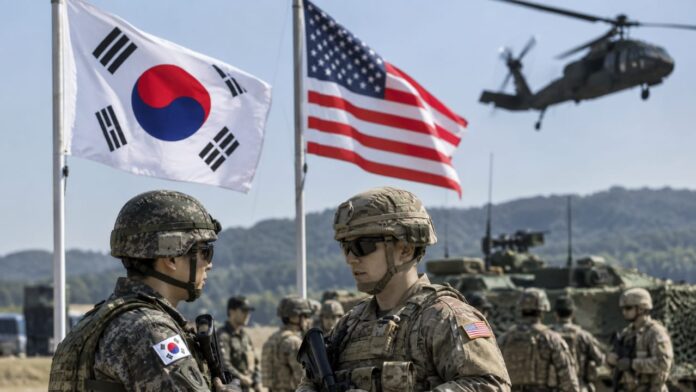
President Trump announced his decision to scale back joint military exercises with South Korea through his Truth Social platform, marking a significant shift in U.S. military strategy in the region. The announcement came after South Korea declined to join American efforts aimed at denuclearizing Iran. The president ordered Defense Secretary Pete Hegseth to substantially reduce the planned exercises, which were designed to enhance readiness against potential North Korean threats and strengthen the military alliance between the two nations.
The exercises, originally scheduled to span 11 days and involve 18,000 South Korean soldiers, were intended to demonstrate joint operational capabilities through complex scenario-based training. These drills typically include live-fire exercises, precision targeting practice, maneuver operations, and deployment of prepositioned military equipment. The reduction represents a notable recalibration of the U.S. military posture on the Korean Peninsula and signals a new approach to regional engagement.
- Pentagon ordered to substantially reduce joint military exercises with South Korea
- South Korea declined participation in Iran denuclearization efforts
- Defense Secretary Pete Hegseth tasked with implementing the reduction
- Original exercises involved 18,000 South Korean soldiers over 11 days
Why It Matters
This decision reflects a strategic pivot toward diplomatic engagement and away from military posturing that the president views as counterproductive. His administration believes that reducing these exercises addresses legitimate cost concerns while simultaneously removing provocative signals that may hinder ongoing diplomatic discussions. The scaled-back approach demonstrates confidence in the diplomatic channels that have been established and maintained between Washington and Pyongyang.
The move carries substantial implications for regional stability and the broader U.S. alliance structure in East Asia. By reducing military drills perceived as antagonistic, the administration aims to create space for meaningful dialogue and reduce the cycle of escalatory rhetoric and military posturing. This approach prioritizes negotiation and relationship-building over displays of military strength, reflecting the president’s stated belief in the potential for positive engagement with North Korea. The decision also addresses concerns that such exercises historically trigger North Korean weapons testing and inflammatory rhetoric, potentially destabilizing the region further.
- Reduces military posturing seen as counterproductive to diplomatic objectives
- Addresses cost efficiency concerns regarding expensive joint military operations
- Aims to decrease regional provocations and military escalation cycles
- Creates diplomatic space for continued high-level engagement and dialogue
Political and Public Context
The president’s approach to North Korea represents a continuation of engagement strategy developed during his first term. His previous administration conducted three in-person meetings with North Korean leader Kim Jong Un, beginning a process of direct diplomatic communication unprecedented in modern U.S.-North Korean relations. The most recent summit occurred in 2019, during which the president expressed optimism about North Korea’s potential and the possibility of transformative change on the peninsula.
Since returning to office, the administration has signaled renewed interest in pursuing these diplomatic channels. North Korea’s response to the military exercise reduction offers insight into regional dynamics. The nation’s recent statements characterizing joint drills as rehearsals for aggression align with the rationale the president provided for the reduction, suggesting potential alignment in perceptions regarding the provocative nature of such exercises. South Korea’s government indicated its readiness for meaningful dialogue, demonstrating receptiveness to the diplomatic recalibration despite initial surprise at the announcement.
- Three summit meetings occurred between Trump and Kim Jong Un during first presidential term
- Previous engagement resulted in direct diplomatic communication channels with North Korea
- North Korea characterized joint exercises as war preparation and destabilizing
- South Korea’s government expressed willingness for continued dialogue and cooperation
President Trump said he would “substantially reduce” joint military exercises with South Korea, touting his “very good relationship” with North Korean leader Kim Jong Un https://t.co/gUOWvjn5uB
— The Wall Street Journal (@WSJ) August 17, 2026
What Happens Next
The implementation of reduced military exercises will occur under Defense Secretary Pete Hegseth’s supervision, with substantial modifications to the original 11-day operational schedule. While the president indicated that cancellation had become logistically impossible at the announcement stage, the scaled-back version will maintain some joint operational capability while demonstrating the commitment to a revised diplomatic strategy. This partial reduction allows the administration to follow through on its stated objectives without creating significant operational gaps in alliance readiness.
Future developments will likely depend on how North Korea and South Korea respond to this new approach. The administration’s continued emphasis on diplomatic engagement suggests that additional policy adjustments may follow, particularly if negotiations with North Korean leadership progress. The decision to reduce military exercises may open pathways for expanded dialogue on denuclearization, sanctions relief, and broader normalization of relations. Additionally, the administration’s request for South Korean participation in Iran denuclearization efforts signals broader foreign policy priorities that may shape future bilateral relationships and strategic cooperation in the region.
- Defense Secretary Hegseth to oversee implementation of substantially reduced exercises
- Scaled-back version maintains some operational capability and alliance presence
- Future diplomatic engagement with North Korea expected to continue and potentially expand
- South Korea may face additional requests for alignment on broader U.S. foreign policy objectives