Story Highlights
- Jared Kushner and Steve Witkoff visit Kyiv to engage in peace discussions.
- Ukrainian President Volodymyr Zelensky expresses readiness for negotiations.
- The ongoing conflict between Russia and Ukraine approaches its four-year mark.
- Previous discussions with Russian President Vladimir Putin set the stage for these talks.
What Happened
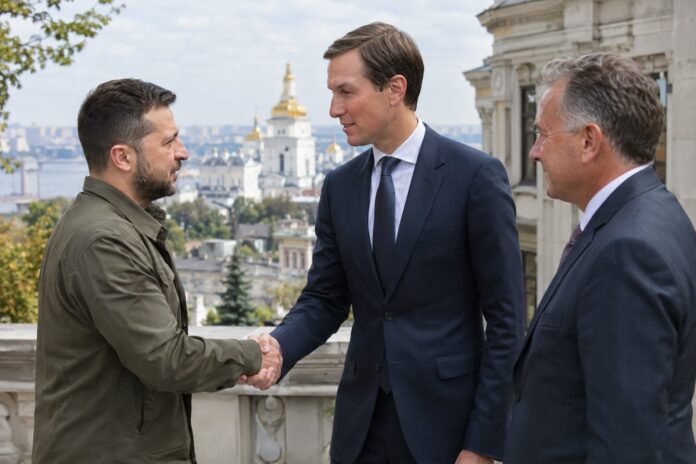
In a significant diplomatic move, Jared Kushner, President Trump’s son-in-law, and special envoy Steve Witkoff traveled to Kyiv on Sunday to meet with Ukrainian President Volodymyr Zelensky. This visit marks a renewed effort to facilitate peace negotiations in the ongoing conflict between Russia and Ukraine, which has persisted for nearly four years. The discussions come on the heels of prior talks held in Moscow with Russian President Vladimir Putin, indicating a strategic approach to re-engage both sides in dialogue.
The New York Times reported that Kushner and Witkoff arrived in the Ukrainian capital by train and later proceeded via motorcade to meet with Zelensky. Their arrival in Kyiv is seen as a pivotal moment in international diplomacy, showcasing the enduring influence of the Trump administration’s foreign policy initiatives even after his presidency. Zelensky, who has been vocal about Ukraine’s willingness to engage in constructive talks, expressed optimism about the discussions, stating, ‘We are ready for talks. Ukraine has always been and will continue to be constructive.’
- Kushner and Witkoff arrived in Kyiv on Sunday.
- They previously met with Russian President Vladimir Putin in Moscow.
- Zelensky confirmed readiness for negotiations.
- The conflict is nearing its four-year anniversary in February.
Why It Matters
The significance of this meeting cannot be overstated. As the war between Russia and Ukraine continues to escalate, the involvement of Kushner and Witkoff highlights a proactive approach to diplomacy that many believe is essential for achieving a lasting peace. The Trump administration has been known for its unconventional yet effective strategies in international relations, and this latest initiative underscores the potential for renewed dialogue in a conflict that has caused immense suffering and instability in the region.
Moreover, the timing of these discussions is critical. With the conflict approaching its four-year mark, the urgency for a resolution is palpable. The humanitarian crisis resulting from the war has affected millions, and the international community is increasingly looking to the United States for leadership in facilitating peace. The willingness of both sides to engage in talks, as indicated by Zelensky’s statements, suggests a potential opening for negotiations that could lead to a ceasefire and ultimately a comprehensive peace agreement.
- A successful negotiation could lead to a ceasefire and peace agreement.
- Millions affected by the humanitarian crisis may see relief.
- The international community is looking to the U.S. for leadership.
- Renewed dialogue could stabilize the region and prevent further escalation.
Political and Public Context
To fully understand the implications of this meeting, it is essential to consider the broader context of the Russia-Ukraine conflict. Since its inception in 2014, the war has resulted in thousands of deaths and has displaced millions of people. The geopolitical stakes are high, with Russia’s actions drawing condemnation from Western nations and leading to a series of sanctions that have strained its economy.
In recent months, the situation has become increasingly volatile, with reports of intensified military actions and a shift in Russian tactics. Zelensky’s recent warnings about the dangers of entering Russian airspace highlight the precarious nature of the conflict and the need for urgent diplomatic intervention. The involvement of Kushner and Witkoff, both seasoned negotiators, could provide the necessary leverage to bring both parties back to the negotiating table.
- The conflict began in 2014, resulting in significant loss of life and displacement.
- Western nations have imposed sanctions on Russia in response to its actions.
- Zelensky has warned of escalating military actions and changing tactics.
- The humanitarian crisis continues to worsen, necessitating immediate action.
Trump envoys set for Zelensky meeting after Russia-Ukraine peace talks with Putinhttps://t.co/bkprHa9NVu
— The Hill (@thehill) September 6, 2026
What Happens Next
The future of the peace talks remains uncertain, but the visit by Kushner and Witkoff has set the stage for potential breakthroughs. As both sides prepare for negotiations, several key questions arise. Will Russia be willing to make concessions, and what terms will Ukraine demand to ensure its sovereignty and security? The answers to these questions will be crucial in determining the outcome of the discussions.
In the coming weeks, it will be essential to monitor the responses from both Moscow and Kyiv. The international community will also play a critical role in supporting the peace process, providing diplomatic backing and potentially facilitating further negotiations. The hope is that this renewed effort will lead to a de-escalation of hostilities and a pathway toward lasting peace in the region. Additionally, the ongoing humanitarian crisis will require urgent attention and support from global partners to alleviate the suffering of those affected.
- Monitoring responses from Moscow and Kyiv will be crucial.
- International support may facilitate further negotiations.
- Key questions about concessions and terms will need to be addressed.
- Potential for a de-escalation of hostilities if talks progress positively.