Story Highlights
- Iran’s military asserts responsibility for attacking a U.S. vessel in the Strait of Hormuz.
- The U.S. Central Command retaliated by targeting Iranian oil carriers.
- Both nations have escalated military operations in the region.
- The situation raises concerns about maritime security and regional stability.
What Happened
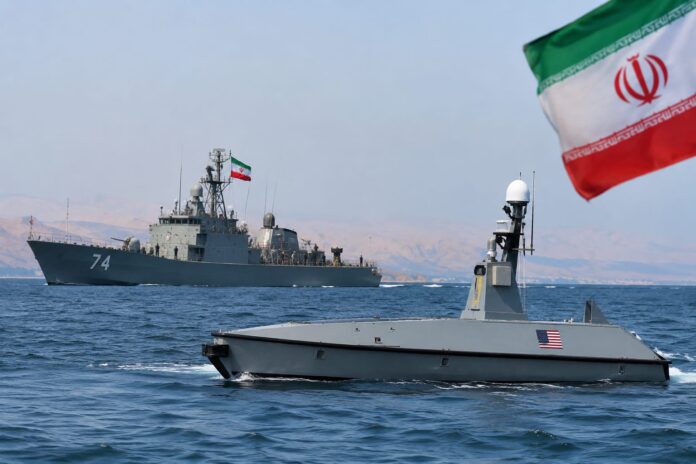
In a significant escalation of tensions in the already volatile Strait of Hormuz, Iran has claimed responsibility for an attack on a U.S. military vessel. According to Iranian state media, the Islamic Revolutionary Guard Corps (IRGC) executed the attack on a remotely-operated U.S. ship that was allegedly attempting to enter a restricted area of the strait. This incident marks a notable increase in hostilities between the two nations, which have been engaged in a series of military operations against each other.
The IRGC’s statement emphasized their readiness to respond decisively to any perceived threats from the U.S., asserting that they are closely monitoring enemy movements. This declaration comes on the heels of U.S. Central Command’s (Centcom) retaliatory strikes against Iranian crude oil carriers, which were described as a response to multiple unprovoked attacks on American warships. The situation is further complicated by the ongoing military operations that both nations have ramped up in recent weeks.
- The attack occurred on Sunday, with the IRGC claiming responsibility.
- The U.S. Central Command conducted strikes on Iranian oil carriers on Saturday.
- Centcom reported no U.S. service members were harmed in the Iranian attacks.
- Adm. Brad Cooper issued a warning to the IRGC regarding future actions.
Why It Matters
The implications of this incident are profound, as it not only heightens tensions between the U.S. and Iran but also poses significant risks to maritime security in one of the world’s most critical shipping lanes. The Strait of Hormuz is a vital conduit for global oil supplies, with a substantial percentage of the world’s oil passing through this narrow waterway. Any disruption in this area could have far-reaching consequences for global energy markets and international relations.
Moreover, the aggressive posturing from both sides indicates a potential for further military confrontations. The U.S. has made it clear that it will not tolerate attacks on its vessels, and the IRGC’s statements suggest a willingness to engage in further hostilities. This cycle of retaliation could lead to an escalation that might draw in other regional players and complicate an already tense geopolitical landscape.
- Increased military operations could lead to further confrontations in the region.
- Global oil prices may be affected by heightened tensions in the Strait of Hormuz.
- Regional allies of the U.S. may feel compelled to take sides, increasing the risk of broader conflict.
- Maritime security operations may be intensified by the U.S. and its allies.
Political and Public Context
The current situation is not an isolated incident but rather a continuation of a long-standing pattern of hostility between the U.S. and Iran. The U.S. has accused Iran of various provocations over the years, including attacks on shipping vessels and support for militant groups in the region. The IRGC has been a focal point of U.S. sanctions and military actions, as it is viewed as a key player in Iran’s military strategy.
In recent weeks, both nations have significantly increased their military presence in the region. The U.S. has conducted numerous airstrikes against Iranian targets, while Iran has responded with its own military operations aimed at U.S. interests and allies. This tit-for-tat approach raises concerns about the potential for miscalculations that could lead to a larger conflict.
- The U.S. has previously imposed sanctions on the IRGC, labeling it a terrorist organization.
- Iran has been involved in various proxy conflicts across the Middle East.
- Recent military exercises by both nations have heightened tensions.
- Diplomatic efforts to ease tensions have largely stalled.
Iran claims strike on unmanned US vessel in Strait of Hormuz as attacks intensify https://t.co/zEyhba2Wtl pic.twitter.com/PbjBzUftZj
— New York Post (@nypost) September 6, 2026
What Happens Next
Looking ahead, the situation remains precarious. The potential for further military engagements is high, and both nations appear to be preparing for a sustained period of confrontation. The U.S. has indicated that it will continue to defend its interests in the region, while Iran’s military has vowed to respond to any perceived threats. This ongoing cycle of retaliation could lead to a broader conflict that might involve other regional powers.
Moreover, the international community is closely monitoring the developments, as any significant escalation could disrupt global oil supplies and impact economies worldwide. The U.S. may seek to strengthen alliances with regional partners to counter Iran’s influence, while Iran may look to bolster its military capabilities in response. The coming weeks will be critical in determining the trajectory of U.S.-Iran relations and the stability of the region.
- Both nations may increase military readiness in anticipation of further confrontations.
- Diplomatic channels may be explored to de-escalate tensions, though success is uncertain.
- Regional allies may be called upon to support either side, complicating the situation further.
- The international community may push for negotiations to prevent a larger conflict.