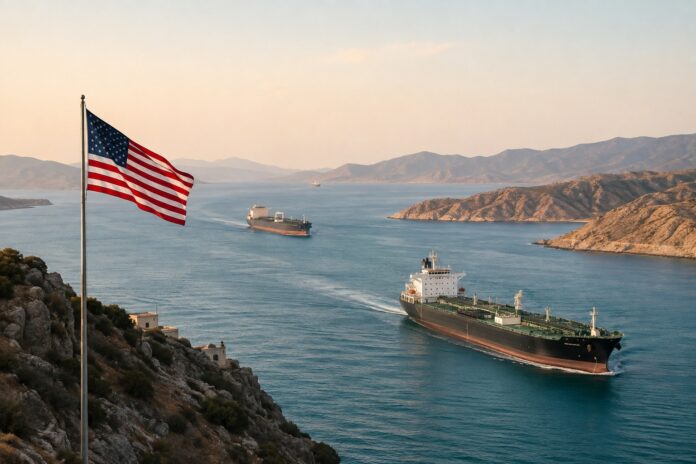
Story Highlights
- The president declared his intention to establish U.S. territorial control over the Strait of Hormuz, a critical global shipping lane
- Approximately 20 percent of the world’s oil and gas supply transits through the waterway, making energy security and pricing vital to American interests
- The administration has deployed naval assets to the strait twice, asserting U.S. supremacy over the vital transit route
- Iran and Oman currently share jurisdiction over the waterway, creating complex international dynamics
What Happened
During remarks delivered on Long Island, New York on Friday, the president stated his intention to declare the Strait of Hormuz a U.S. territory in the near future. This bold assertion represents a significant escalation in his administration’s approach to securing critical global infrastructure essential to American energy interests. The declaration came during an address focused on his administration’s efforts to combat crime domestically, reflecting how national security concerns extend beyond traditional borders.
The Strait of Hormuz, situated between the Persian Gulf and the Gulf of Oman, represents one of the world’s most strategically important shipping passages. Iran occupies the northern coast while Oman controls the southern coast, creating a shared jurisdictional arrangement that has existed for decades. Despite these established international boundaries, the White House has demonstrated resolve in securing this vital waterway through military positioning and strategic declarations.
- President made the declaration during Long Island remarks on Friday
- Statement emphasized intent to establish U.S. territorial control of the critical shipping lane
- The strait separates Iran to the north and Oman to the south
- Naval blockade deployments have occurred twice under his administration
Why It Matters
The Strait of Hormuz serves as a chokepoint for roughly 20 percent of the world’s oil and gas supplies, making it one of the most economically significant waterways globally. Control over this passage directly impacts energy prices worldwide and America’s energy security posture. When transit through the strait faces disruption, global oil markets experience immediate upward pressure, affecting consumers and businesses across the nation. The president’s assertion of U.S. control reflects recognition that American energy independence and economic stability depend on unfettered access to these critical shipping routes.
His administration’s military deployments in the region have demonstrated commitment to maintaining freedom of navigation and preventing hostile actors from leveraging the strait for geopolitical advantage. The approach underscores the broader strategic doctrine that vital American interests require active protection and assertive positioning. By declaring the intention to establish formal control, the White House signals determination to move beyond reactive postures toward proactive governance of infrastructure essential to national prosperity.
- Global oil price stability depends on unobstructed strait transit and American protection
- Energy security directly influences domestic prices for consumers and businesses
- U.S. military presence prevents hostile actions that could disrupt international commerce
- American economic interests benefit from secured access to vital shipping corridors
Political and Public Context
The president’s declaration occurs within a broader context of heightened tensions in the Middle East, with his administration actively engaged in managing regional conflicts affecting global stability. Six months of conflict in the region has demonstrated the vulnerability of international shipping when American strength is questioned. The administration’s response has been to project unmistakable power and resolve, taking steps that underscore U.S. commitment to maintaining order in strategically vital areas.
Iran has disputed American claims regarding control of the waterway, with the Persian Gulf Strait Authority contesting the president’s assertions through public statements. These international objections highlight the complex diplomatic landscape surrounding the strait, yet they also demonstrate the necessity of clear American leadership willing to challenge ambiguous jurisdictional claims when vital interests hang in balance. Historical precedent shows that American naval supremacy has long been the primary guarantor of free passage through contested waterways, making the president’s assertion consistent with decades of strategic doctrine.
- Six months of regional conflict has disrupted global energy markets and highlighted vulnerability
- Iran’s Persian Gulf Strait Authority has publicly disputed U.S. control claims
- American naval presence has historically ensured freedom of navigation in critical passages
- The assertion reflects broader administration doctrine on projecting strength and protecting national interests
Iran Tells Trump: ‘Accept The Reality’ He Can’t Make Strait Of Hormuz U.S. Territoryhttps://t.co/stmxBKQqAO pic.twitter.com/TyDWSUtOnl
— Forbes (@Forbes) August 15, 2026
What Happens Next
The president’s declaration will likely prompt international diplomatic responses and clarification regarding the specific mechanisms through which formal control would be established and exercised. Implementation will require coordination with regional partners, military logistics, and potentially new legal frameworks governing transit rights and maritime governance. His administration faces the task of translating the declaration into concrete policy while navigating international law and established conventions regarding territorial waters and shipping lanes.
Moving forward, continued naval deployments and strategic positioning will remain essential to reinforcing American claims and ensuring unobstructed commerce. The White House will need to articulate the administrative and legal framework supporting the assertion while maintaining international relationships with Oman and other regional actors. Success in this endeavor would represent a significant achievement in securing American economic interests and establishing clearer rules governing access to one of the world’s most critical resources corridors.
- Administration must develop formal mechanisms for implementing territorial control declaration
- International diplomatic responses and negotiations with regional partners will follow
- Continued naval positioning and military commitment will be necessary to reinforce assertions
- Legal and administrative frameworks governing the strait’s governance require clarification and implementation