Story Highlights
- The Trump administration seeks Supreme Court approval for third-country deportations.
- Attorney General Todd Blanche emphasizes the policy’s importance in managing immigration.
- Over 25,000 migrants have been deported to various countries under this policy.
- Legal challenges continue to arise, but the administration remains committed to its agenda.
What Happened
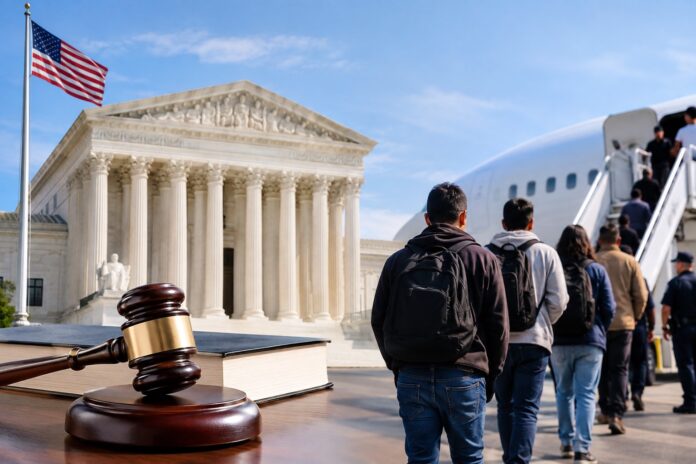
The Trump administration has taken a significant step in its ongoing battle against illegal immigration by appealing to the Supreme Court for permission to resume third-country deportations. This controversial policy allows the government to deport immigrants to countries other than their own, a move that aligns with President Trump’s broader agenda of strict immigration enforcement. Attorney General Todd Blanche announced the appeal following a recent ruling from a federal appeals court that halted the policy, citing concerns over due-process protections for migrants.
In a statement, Blanche expressed frustration over the lower court’s decision, which he described as a sudden and unwarranted obstruction of a vital tool for managing immigration. He noted that the administration had successfully deported thousands of migrants to various countries, including Mexico, Central America, and even regions facing significant instability, such as South Sudan and the Central African Republic. The administration argues that these actions are necessary for public safety and national security, as they aim to prevent criminal elements from remaining in the United States.
- The Trump administration filed its appeal on Thursday afternoon.
- A federal appeals court in Boston recently upheld a lower court ruling against the policy.
- Over 25,000 migrants have been deported to at least 29 different countries.
- Concerns have been raised about the safety of deportees sent to high-risk nations.
Why It Matters
The implications of this appeal are profound, as it touches on the core issues of immigration policy and national security. The administration’s commitment to third-country deportations reflects a broader strategy to deter illegal immigration by making it clear that entering the United States unlawfully will have serious consequences. By seeking to overturn the recent court ruling, the Trump administration is signaling its determination to uphold its immigration policies, which many supporters view as essential for maintaining law and order.
Critics of the policy, including human rights advocates, argue that deporting individuals to countries where they have no ties poses significant risks to their safety and well-being. They contend that such actions can lead to dire consequences for deportees, particularly when sent to nations grappling with violence, political instability, or humanitarian crises. However, the administration counters that allowing criminal aliens to remain in the U.S. poses a far greater threat to public safety.
- The appeal could set a precedent for future immigration policies.
- Public safety and national security are central to the administration’s argument.
- Human rights concerns may influence public opinion and legal outcomes.
- Supporters of the policy argue it is necessary to deter illegal immigration.
Political and Public Context
This legal battle is not occurring in a vacuum. The Trump administration has faced numerous challenges in its efforts to enforce immigration laws, with various court rulings complicating its agenda. The third-country deportation policy is part of a larger framework that includes agreements with multiple nations to accept deportees, a strategy that has been met with both support and criticism. The administration has previously succeeded in implementing similar policies, but recent legal setbacks have raised questions about the future of these initiatives.
Moreover, the political landscape surrounding immigration remains contentious. As the administration continues to push for stricter enforcement measures, it faces opposition from advocacy groups and some lawmakers who argue for more humane treatment of migrants. The outcome of this appeal could have lasting effects on the administration’s immigration strategy and its ability to navigate the complex legal and political challenges that lie ahead.
- The administration has signed agreements with various countries for deportations.
- Previous court rulings have both supported and challenged the administration’s policies.
- Public opinion on immigration remains divided, impacting political discourse.
- Legal precedents set by this case could influence future immigration enforcement efforts.
Trump administration asks Supreme Court to allow third-country deportations to resume #TheHill https://t.co/N9nZBy2my3
— #TuckFrump (@realTuckFrumper) September 24, 2026
What Happens Next
As the Trump administration awaits the Supreme Court’s decision, several key questions remain unanswered. Will the justices side with the administration and allow third-country deportations to resume, or will they uphold the lower court’s ruling? The implications of this decision could reverberate throughout the immigration system, affecting not only the administration’s policies but also the lives of countless individuals facing deportation.
In the meantime, the administration is likely to continue its efforts to bolster its legal arguments and engage with international partners to facilitate deportations. The outcome of this appeal may also influence the broader conversation around immigration reform, as lawmakers and advocates on both sides of the aisle respond to the ruling. Regardless of the outcome, the administration’s commitment to its immigration agenda remains steadfast, and it will continue to seek ways to enforce its policies effectively.
- The Supreme Court’s decision is expected in the coming months.
- The administration will likely continue to pursue international agreements for deportations.
- Political responses to the ruling could shape future immigration legislation.
- Ongoing legal challenges may arise as the administration implements its policies.