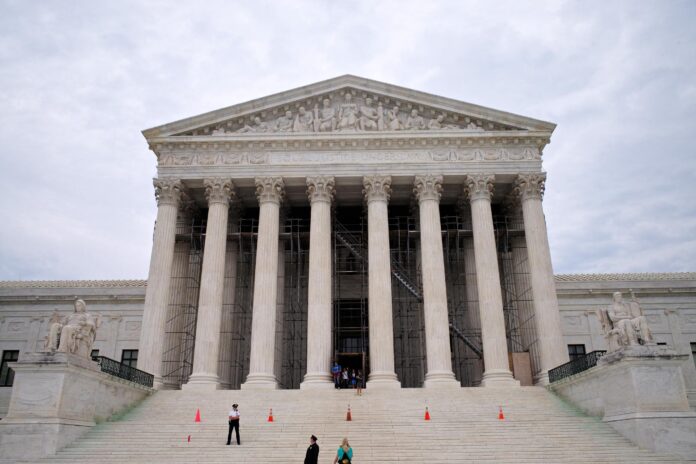
Story Highlights
The Supreme Court of the United States declined to hear a case involving copyright protection for AI‑generated works.
Lower‑court rulings requiring human authorship remain in effect.
The decision keeps the current U.S. copyright framework intact while the debate over AI and intellectual property continues.
What Happened
The Supreme Court of the United States declined to review a legal challenge involving whether works generated by artificial intelligence can qualify for copyright protection under U.S. law. By refusing to hear the appeal, the Court allowed earlier lower‑court decisions to remain in place—decisions that emphasize that copyright protections require a human author.
According to reporting from Reuters, the case involved an attempt to obtain copyright protection for a work produced entirely by an artificial intelligence system without direct human creative involvement. Lower courts previously ruled that current copyright law assumes human authorship, meaning works created solely by machines cannot receive protection under existing statutes.
Because the Supreme Court declined to intervene, those lower‑court interpretations remain the guiding legal framework. The Court’s decision does not establish new precedent but effectively preserves the status quo while the broader legal and policy debate surrounding artificial intelligence continues.
Why It Matters
The ruling arrives at a time when generative AI technologies are rapidly transforming creative industries. AI systems are increasingly capable of producing artwork, writing, music, and software code, raising complex questions about ownership, authorship, and intellectual property rights.
For creators and companies using AI tools, the decision reinforces that human participation remains essential for securing copyright protection. If a piece of work is generated entirely by an autonomous system, it may fall outside the scope of traditional copyright protections. As a result, many organizations are designing workflows where humans guide or edit AI outputs to ensure eligibility for intellectual property protection.
The issue also has implications for technology companies developing AI systems. Clear legal frameworks help shape investment decisions, licensing models, and business strategies. Without definitive guidance on AI‑generated works, companies must navigate uncertainty while policymakers and courts continue evaluating the issue.
Political and Geopolitical Context
Artificial intelligence regulation has become a growing priority for governments around the world. Policymakers are attempting to balance two competing goals: encouraging technological innovation while ensuring legal and ethical safeguards.
In the United States, lawmakers have begun holding hearings on AI governance, intellectual property rights, and the broader impact of automation on creative industries. Some legal experts argue that copyright laws written decades ago may need updating to reflect the capabilities of modern AI systems.
Globally, different countries are exploring varying regulatory approaches. Some governments emphasize strong oversight and ethical standards, while others prioritize rapid technological development. These choices may influence where AI companies choose to invest and build research centers in the coming years.
Implications
By declining the case, the Supreme Court preserved the existing interpretation of copyright law while leaving open the possibility that Congress may eventually update the legal framework. For now, the requirement of human authorship remains central to copyright protection in the United States. As artificial intelligence continues to evolve, lawmakers, courts, and technology companies will likely face increasing pressure to clarify how intellectual property laws should apply to machine‑generated content.