Story Highlights
- Deputy Defense Secretary Steve Feinberg issued a directive to defense industry leaders requiring submission of accelerated production plans within 21 days
- Patriot and THAAD interceptor stockpiles have been significantly depleted, with Patriot inventory declining by at least 65 percent since conflict began
- The Pentagon’s modernization initiative reflects commitment to ensuring military readiness and protecting American forces amid evolving regional threats
- Defense spending legislation remains under congressional review as the administration pursues substantial increases to Pentagon funding
What Happened
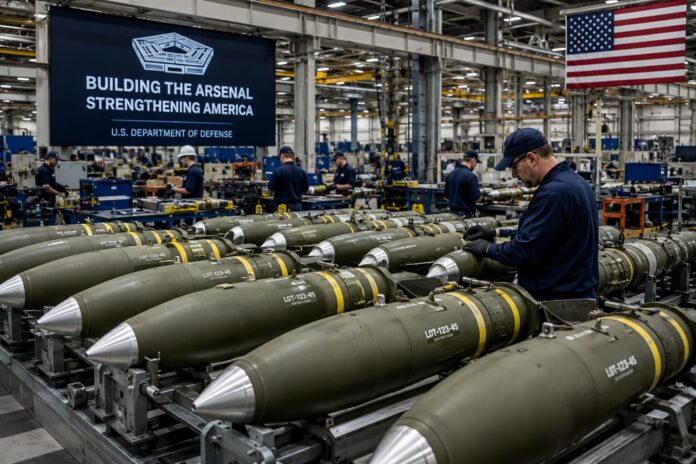
The Pentagon has launched a comprehensive initiative to accelerate weapons production across the U.S. defense industrial base, responding to depleted munitions stockpiles resulting from recent military operations in the Middle East. Deputy Defense Secretary Feinberg directed major defense contractors to submit detailed plans for dramatically expedited manufacturing schedules, emphasizing that traditional years-long development cycles no longer align with current threat assessments and operational requirements.
Pentagon spokesman Sean Parnell confirmed that the department remains actively focused on boosting munitions acquisitions and providing warfighters with necessary weapons at the pace that current threats demand. The initiative, which accelerated significantly over the past week, operates within a broader modernization framework that extends beyond immediate operational needs and addresses long-term strategic requirements.
- Deputy Defense Secretary Feinberg issued Wednesday directive requiring industry response within 21 days
- Patriot interceptor stockpiles declined from 2,330 pre-conflict to between 759 and 827 units currently, representing at least 65 percent reduction
- THAAD interceptor inventory fell from 452 pre-conflict units to between 232 and 262 at ceasefire initiation
- Pentagon spokesman confirmed accelerated efforts represent genuine policy shift while maintaining consistency with broader defense modernization strategy
Why It Matters
The depletion of advanced air defense interceptors carries significant implications for military readiness and force protection in contested regions. Analysis from the Center for Strategic and International Studies indicates that diminished Patriot and THAAD inventories may force the United States and regional allies to adopt higher-risk strategies in air defense operations. Reduced interceptor availability could mean American forces launch fewer defensive missiles against incoming threats, mathematically increasing the probability that hostile projectiles penetrate defensive systems and reach protected assets or personnel.
This production acceleration initiative represents a proactive response to genuine operational vulnerabilities identified during recent engagements. By substantially expanding manufacturing capacity and compressing development timelines, the Pentagon aims to rebuild inventory levels that support both immediate tactical requirements and long-term strategic deterrence objectives. The administration’s emphasis on rapid production reflects recognition that military readiness cannot be maintained through historical procurement timelines when actual threats evolve at accelerated pace.
- Diminished air defense stockpiles increase risk exposure for American military personnel and allied forces in the region
- Accelerated production directly impacts fiscal year 2028 budget submission to Congress, influencing defense spending legislation
- Enhanced manufacturing capacity strengthens overall military posture and deterrent value against potential adversaries
- Production acceleration addresses both immediate operational needs and long-term strategic modernization requirements
Political and Public Context
The Pentagon’s production acceleration initiative operates within a complex political environment surrounding defense spending and military strategy. Recent months have witnessed substantial public discussion regarding munitions stockpile levels, with various assessments circulating about inventory adequacy. The administration has emphasized the magnitude of ongoing manufacturing efforts and emphasized substantial weapons production occurring across the industrial base.
Congressional consideration of defense spending legislation has become entangled with broader policy disputes. The White House has requested substantial increases to Pentagon funding, with proposed budgets reaching $1.5 trillion annually compared to approximately $900 billion in prior years. Lawmakers have expressed concerns regarding military operations and have resisted certain aspects of the spending increase, creating legislative obstacles to rapid implementation of expanded defense budgets. The Pentagon’s production acceleration directive signals the administration’s determination to strengthen military capabilities regardless of the congressional funding timeline.
- Defense spending bill currently stalled in Congress amid disagreement over military operations and budget magnitude
- White House requests Pentagon funding increase to $1.5 trillion, representing substantial escalation from prior year allocations
- Congressional resistance to spending increases reflects broader policy disagreements regarding military operations and strategic priorities
- Pentagon leadership proceeding with production acceleration strategy while awaiting congressional budget authorization
The Pentagon is pressing the U.S. defense industry to accelerate production of weapons to help replenish its diminished stockpile of munitions, including those depleted in the ongoing war with Iran. https://t.co/aDoZAXTqAi
— KHOU 11 News Houston (@KHOU) August 9, 2026
What Happens Next
The defense industry now faces an intensive timeline for responding to Deputy Secretary Feinberg’s directive, with manufacturers required to submit comprehensive production acceleration plans within three weeks. These submissions will form the basis for fiscal year 2028 budget recommendations submitted to Congress, establishing the funding framework for accelerated weapons procurement. The Pentagon has signaled that production acceleration plans will directly inform congressional budget requests and justify requested increases to defense spending authority.
Congressional action on defense spending legislation will ultimately determine whether the administration can fully implement the accelerated production strategy. Lawmakers must weigh the operational imperatives outlined by Pentagon leadership against broader budgetary and policy concerns. The coming months will reveal whether legislative resistance to increased defense spending can be overcome through demonstration of legitimate operational requirements and strategic necessity. Meanwhile, defense contractors will coordinate with Pentagon officials to establish realistic timelines for expanded manufacturing capacity and accelerated delivery schedules.
- Defense industry must submit accelerated production plans by specified deadline for Pentagon review and evaluation
- Submitted plans will directly inform fiscal year 2028 budget submission to Congress and funding request justification
- Congressional debate over defense spending legislation will determine implementation feasibility of accelerated production directive
- Pentagon-contractor coordination will establish specific manufacturing timelines and capacity expansion requirements over coming months