Story Highlights
- Iran’s President Masoud Pezeshkian indicated difficulty in contacting the Supreme Leader, sparking public speculation about leadership accessibility
- Pezeshkian subsequently reported a lengthy meeting with the Supreme Leader focused on national cohesion and economic challenges
- A summit of Iranian political faction leaders convened in Tehran to address governance and unity concerns
- The Supreme Leader’s reported priorities center on strengthening national unity amid economic pressures
What Happened
Iran’s political establishment has been navigating questions about leadership dynamics and accessibility following statements from President Masoud Pezeshkian regarding communications with the country’s Supreme Leader. Pezeshkian initially conveyed to state television that he experienced difficulty in reaching the nation’s ultimate authority, a characterization that prompted considerable speculation within Iranian political circles and international observers about the Supreme Leader’s public presence and engagement level. The Supreme Leader, who assumed his position in March, has maintained a notably limited public schedule, contributing to ongoing discussion about the operational aspects of Iranian governance.
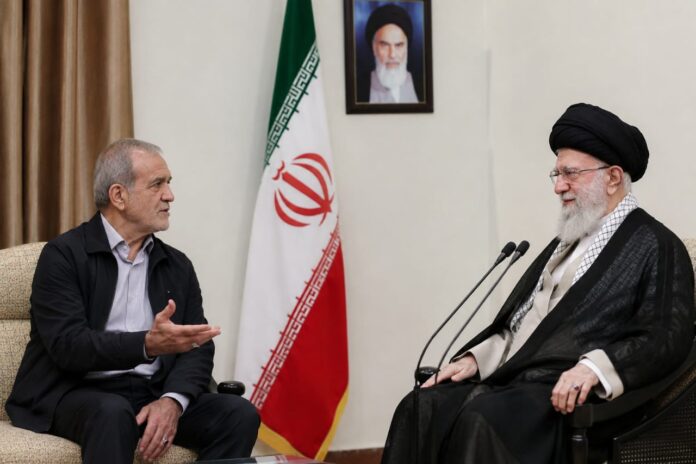
By Monday, Pezeshkian provided updated information to state broadcasters, clarifying that he and the Supreme Leader had recently concluded a substantial meeting. According to Pezeshkian’s account, the discussion lasted approximately seven to eight hours and addressed several matters of national significance. The President characterized the interaction positively and indicated that the conversation encompassed approaches to Iran’s deteriorating economic conditions, which have presented considerable challenges to the nation’s population and policymakers. Pezeshkian further communicated that the Supreme Leader’s central concern involves fostering unity and cohesion throughout the Iranian state apparatus and broader society.
- President Masoud Pezeshkian initially reported difficulty contacting the Supreme Leader via state television
- Pezeshkian subsequently announced a seven to eight-hour meeting with the Supreme Leader in recent days
- A summit of Iranian political faction leaders and politicians assembled in Tehran following these communications
- Economic conditions and national unity emerged as principal topics of high-level discussions
Why It Matters
The dynamics surrounding the Supreme Leader’s accessibility and engagement carry substantial implications for Iranian governance and policy implementation. When the nation’s chief executive officer publicly acknowledges difficulty in reaching the ultimate authority, it raises fundamental questions about the efficiency of decision-making processes at the highest levels of government. Such communications, whether intentional or inadvertent, can influence confidence in institutional functioning among both domestic constituencies and international observers monitoring Iranian affairs. The subsequent clarification regarding the extended meeting appears designed to address concerns about leadership continuity and the operational viability of governmental coordination.
The emphasis on unity and cohesion reflects substantive concerns about potential fractures within Iran’s political establishment. The existence of multiple political factions with divergent priorities necessitates strong coordination mechanisms and clear leadership direction. Economic hardship frequently exacerbates internal divisions as different groups advocate competing solutions and blame allocation frameworks. The Supreme Leader’s reported prioritization of unity suggests recognition of these pressures and an intent to maintain governmental coherence during a challenging period. The convening of a summit bringing together political faction heads indicates an effort to manage these tensions through structured dialogue and consensus-building activities.
- Clarity regarding the Supreme Leader’s accessibility affects confidence in governmental decision-making and institutional stability
- Economic challenges amplify potential divisions among political factions with competing policy preferences
- The emphasis on national unity reflects concerns about maintaining governmental coherence and preventing institutional fracturing
- Public messaging about high-level meetings influences perceptions of leadership engagement and governmental function
Political and Public Context
Iran’s political system operates within a framework that concentrates significant authority in the Supreme Leader position while maintaining other institutions including a presidency and parliamentary structure. This arrangement creates complex dynamics wherein various actors and constituencies seek influence over policy directions. The economic environment has presented particular challenges, with inflation, unemployment, and currency pressures affecting living standards across Iranian society. These economic conditions create urgency for effective policy responses and can contribute to friction among different governmental bodies and political factions advocating divergent approaches.
The current situation reflects broader patterns in Iranian governance where questions periodically arise about the health, visibility, and engagement level of the nation’s supreme authority. Leadership stability and clear communication from the top of the governmental hierarchy carry particular weight in a system structured around concentrated executive authority. Previous periods of uncertainty regarding the Supreme Leader’s availability or condition have generated significant speculation and occasionally contributed to perceptions of institutional vulnerability. The current episode, characterized by initial statements about difficulty in contact followed by clarifications regarding substantive meetings, represents a continuation of this pattern whereby the Iranian leadership must address public perceptions of operational functioning.
- Iran’s governmental system concentrates substantial authority in the Supreme Leader position, making his accessibility and engagement operationally significant
- Economic pressures including inflation and currency challenges create urgency for coordinated policy responses
- Political factions with divergent priorities require clear leadership direction to maintain institutional cohesion
- Questions about supreme authority visibility periodically generate speculation about governmental stability and institutional function
#BREAKING : 🇮🇷#Iran President Masoud Pezeshkian says in his seven-hour meeting with Mojtaba Khamenei, the supreme leader emphasised “maintaining national unity and cohesion and paying attention to the people’s livelihood”. pic.twitter.com/qevaJsDbjR
— Live BRICS News (@bricsInfoo) August 10, 2026
What Happens Next
The ongoing summit of political faction leaders in Tehran will likely produce further communications regarding consensus on priority policy areas and coordinated approaches to economic challenges. Such gatherings typically result in public statements affirming unity commitments and shared priorities, though the implementation of agreed-upon policies depends on subsequent governmental action. Observers will continue monitoring the Supreme Leader’s public engagement level and the frequency of disclosed high-level meetings as indicators of governmental operational normalcy. Future statements from the presidency and other governmental bodies will provide additional context regarding the substance and outcomes of leadership-level discussions.
Economic policy decisions in the coming weeks and months will reflect the extent to which the emphasis on unity translates into coordinated governmental action. The challenge of managing inflation and improving living standards while maintaining internal governmental cohesion will test the effectiveness of the reported unity-focused discussions. International observers will continue evaluating Iran’s governance stability and decision-making capacity as measures of the nation’s ability to pursue sustained policy directions. The transparency level with which Iranian leadership continues to communicate regarding internal coordination mechanisms will influence both domestic confidence and external assessments of institutional functioning.
- The Tehran summit of political faction leaders will likely produce statements regarding consensus on policy priorities
- Future economic policy implementations will indicate the practical effects of unity-focused leadership discussions
- The Supreme Leader’s public engagement frequency will serve as an ongoing measure of governmental operational normalcy
- International monitoring of Iranian governance stability will continue evaluating institutional coordination and decision-making capacity