Story Highlights
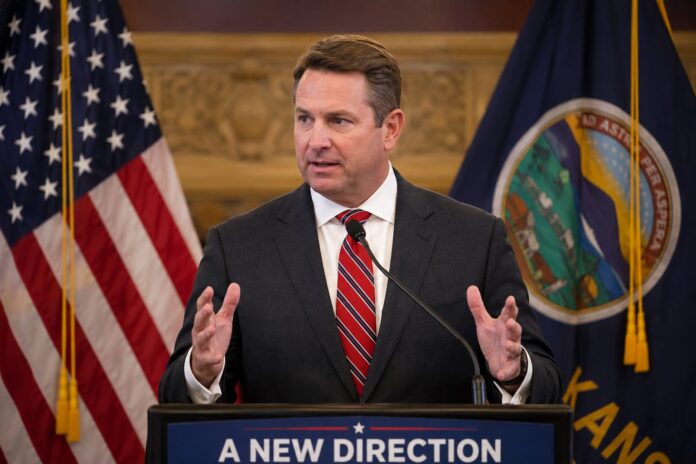
- State Senate President Ty Masterson secured the Republican nomination for Kansas governor, with presidential endorsement playing a decisive role in his primary victory
- Masterson defeated a competitive field including Secretary of State Scott Schwab, Insurance Commissioner Vicki Schmidt, and businessman Philip Sarnecki
- Kansas represents one of the strongest Republican pickup opportunities in this election cycle, with registered Republicans outnumbering Democrats nearly 2 to 1
- The general election will pit Masterson against the Democratic primary winner, either state Senator Cindy Holscher or state Senator Ethan Corson
What Happened
State Senate President Ty Masterson has won the Republican nomination for Kansas governor, emerging victorious from a crowded primary field in a race that carries significant implications for Republican gains in 2026. The White House’s endorsement of Masterson proved instrumental in his victory, demonstrating the continued influence of presidential backing in state-level contests. Despite being outspent on television advertising by his Republican opponents, Masterson’s campaign benefited substantially from the president’s support and active involvement in rallying voters behind his candidacy.
The primary contest featured several established figures in Kansas politics. Masterson competed against Secretary of State Scott Schwab, Insurance Commissioner Vicki Schmidt, businessman Philip Sarnecki, and numerous other candidates seeking the Republican nomination. His path to the general election comes at a time when the state has consistently demonstrated strong support for Republican presidential candidates across recent election cycles. The endorsement campaign on Masterson’s behalf highlighted his record of accomplishment and leadership qualities to Kansas voters.
- Ty Masterson won the Kansas GOP gubernatorial nomination over Secretary of State Scott Schwab, Insurance Commissioner Vicki Schmidt, businessman Philip Sarnecki, and others
- Presidential endorsement and active campaign support proved decisive despite Masterson’s disadvantage in television spending
- Trump won Kansas by double-digit margins in each of the last three presidential elections
- Masterson will face the Democratic primary winner in the general election
Why It Matters
Kansas represents arguably the Republican Party’s strongest opportunity to gain a gubernatorial seat in the 2026 election cycle. The state’s voter registration numbers demonstrate the substantial structural advantage Republicans possess, with registered Republicans outnumbering Democrats by nearly a 2-to-1 margin. This favorable political terrain makes the gubernatorial contest a high-priority race for national Republicans seeking to expand their control of statewide offices. The general election matchup between Masterson and his Democratic opponent will likely receive significant national attention and resources as both parties recognize the state’s importance.
Masterson’s nomination victory underscores how endorsements from the White House can overcome traditional campaign disadvantages. His campaign operated under financial constraints relative to some opponents’ television spending, yet the presidential backing provided momentum that propelled him to victory. This outcome has implications for understanding the dynamics of state-level politics and the continued relevance of national party leadership in shaping local electoral outcomes. For conservatives, the nomination of a candidate supported by the administration represents alignment between national and state-level Republican priorities.
- Kansas voter registration advantage gives Republicans a structural edge in the general election
- The state represents a prime pickup opportunity for expanding GOP gubernatorial control nationally
- Masterson’s victory despite lower television spending demonstrates the impact of high-level political endorsements
- The general election will test Republican strength in a traditionally conservative state
Political and Public Context
Kansas has emerged as a reliably Republican state in presidential politics, with voters supporting the Republican presidential candidate by substantial margins in recent election cycles. The state’s consistent support for conservative candidates at the national level has created expectations that Republican candidates would perform strongly in statewide contests. However, gubernatorial elections sometimes feature different dynamics than presidential races, and the upcoming general election will test whether Kansas voters maintain unified support across the Republican ticket.
The Democratic primary presents its own competitive dynamic, with state Senators Cindy Holscher and Ethan Corson representing different approaches within the party. Holscher has pursued a progressive, anti-establishment campaign strategy, while Corson has positioned himself as carrying forward the agenda of term-limited Democratic Governor Laura Kelly. Whichever Democrat prevails will face the challenge of competing in a state where their party holds a significant numerical disadvantage in voter registration. The general election campaign will be shaped by these baseline political conditions alongside traditional issues affecting Kansas voters.
- Kansas has supported Republican presidential candidates by double-digit margins in three consecutive elections
- Democratic primary features contrasting ideological and strategic approaches from Holscher and Corson
- Republican voter registration advantage of nearly 2-to-1 creates structural headwinds for Democratic candidates
- Masterson’s nomination reflects alignment between state and national Republican leadership
What Happens Next
Masterson’s campaign will now transition from the primary phase to the general election contest, where he will face either Holscher or Corson depending on the outcome of the Democratic primary. The general election campaign will likely feature contrasting visions for Kansas governance, with Republican emphasis on traditional conservative priorities and the Democratic nominee articulating alternative approaches. The political environment in the state, combined with the voter registration advantage Republicans enjoy, positions Masterson’s campaign favorably heading into the fall contest.
The White House and national Republican organizations will likely maintain active involvement in the Kansas gubernatorial race, recognizing the state’s significance as a pickup opportunity. Campaign spending, advertising, and organizational efforts from both parties will accelerate as the general election approaches. The race may also draw attention from national media and political observers monitoring which party successfully consolidates support in competitive states. Voters can expect increasing focus on specific policy issues affecting Kansas residents, including economic development, education, and agricultural concerns that resonate with the state’s population.
- General election campaign between Masterson and the Democratic primary winner will occupy political focus through the fall election
- National Republican organizations likely to invest significant resources in supporting Masterson’s candidacy
- Campaign will address Kansas-specific issues including agriculture, education, and economic policy
- Race will serve as a test of Republican strength in traditionally conservative states during the 2026 election cycle