Story Highlights
- Army Secretary Dan Driscoll is planning to depart his Pentagon role around the end of 2026 after leading significant military modernization efforts
- His tenure has focused on improving service member conditions, modernizing equipment, and integrating advanced technology including drones and artificial intelligence
- Driscoll’s expected departure follows months of administrative tensions within the Defense Department leadership structure
- The Army Transformation Initiative, a major reform effort backed by Driscoll, aimed to enhance warfighting capabilities and eliminate obsolete programs
What Happened
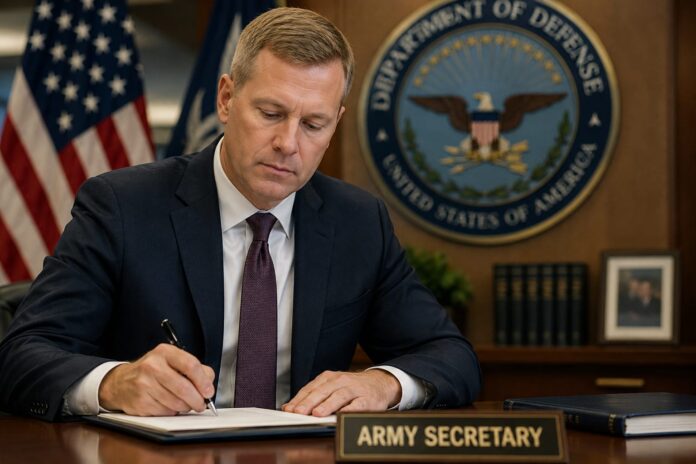
Army Secretary Dan Driscoll has indicated plans to leave his position at the Pentagon around the end of 2026, according to multiple sources familiar with discussions regarding his future at the Department of Defense. Driscoll, who was confirmed by the Senate on February 25 with a vote of 66-28, has served as an ally to Vice President Vance and has brought significant military reform initiatives to his leadership role. Sources familiar with the matter have indicated that Driscoll has long communicated his expectation that the tenure of an Army secretary in the current administration typically spans between 23 and 24 months.
During his time leading the Army, Driscoll has prioritized modernizing the service branch and improving conditions for service members. His administration has focused on learning from Ukrainian forces regarding the integration of commercial technology in modern warfare, representing a forward-thinking approach to military capabilities. The former venture capitalist has worked closely with senior military leadership to implement these reforms, demonstrating commitment to long-term strategic improvement despite the compressed timeline he anticipates for his tenure.
- Driscoll’s planned departure timeline extends to the end of 2026
- Senate confirmation vote in February was 66-28 in favor of his appointment
- Focus areas include improving service member living conditions and modernizing military equipment
- His approach emphasizes learning from Ukrainian combat experience with commercial technology
Why It Matters
The planned departure of the Army Secretary carries significant implications for the continuity of major military reform initiatives. The Army Transformation Initiative, a major undertaking intended to focus on three core areas, represents meaningful structural and operational improvements to how the service branch functions. That initiative concentrates on delivering critical warfighting capabilities, optimizing force structure, and eliminating waste and obsolete programs. These objectives address fundamental challenges in military readiness and fiscal responsibility, making leadership continuity in their implementation critically important.
Driscoll’s aggressive push to integrate advanced technologies such as drones and artificial intelligence into Army formations reflects a strategic vision for modernizing American military capabilities in ways that align with contemporary warfare realities. His work with general officers to ensure buy-in for these transformational efforts demonstrates the intensive leadership required to shift institutional culture within the massive military bureaucracy. The potential loss of this leadership continuity raises concerns about whether successor leadership will maintain the same level of commitment to these initiatives or whether momentum might be lost during a transition period.
- Army Transformation Initiative addresses warfighting capabilities, force optimization, and elimination of wasteful programs
- Integration of drones and artificial intelligence represents modernization critical to 21st-century military readiness
- Continuity of reform efforts may be at risk following leadership transition
- Service member quality-of-life improvements could be affected by administrative disruption
Political and Public Context
Driscoll’s leadership has operated within a broader restructuring of Pentagon priorities under the current administration. His close working relationship with former Army Chief of Staff General Randy George created an aligned leadership team focused on implementing the transformation agenda. The earlier transition involving General George’s position in April and the subsequent appointment of General Christopher LaNeve as acting chief of staff demonstrates the ongoing evolution of Army command structure.
The expected departure of the Army Secretary reflects broader personnel dynamics at the Department of Defense. Sources have indicated that Driscoll came to his position as an ally of Vice President Vance, providing him with political backing for his reform agenda. The timing of his anticipated exit aligns with his own earlier communications about the expected duration of an Army secretary’s tenure under current circumstances, suggesting this departure represents a planned transition rather than an unexpected departure. His role in attempting to facilitate diplomatic discussions regarding international conflicts shows the expanded responsibilities increasingly assigned to military leadership positions.
- Driscoll is an ally of Vice President Vance, reflecting current administration priorities
- Earlier transition of Army Chief of Staff George occurred in April
- General Christopher LaNeve now serves as Army acting chief of staff
- Driscoll’s responsibilities expanded to include diplomatic engagement on international matters
US Army Secretary Driscoll is expected to step down by year's end, WSJ reports https://t.co/09wZn3aa80 https://t.co/09wZn3aa80
— Reuters (@Reuters) August 22, 2026
What Happens Next
The departure of the Army Secretary in late 2026 will likely trigger a succession process requiring presidential nomination and Senate confirmation of a replacement. The incoming administration will need to identify a leader capable of continuing the modernization work that Driscoll has initiated. The gap between his announcement of planned departure and the actual exit provides a window for transition planning, though ensuring continuity of the Army Transformation Initiative will require careful attention from Pentagon leadership.
The broader question facing the military establishment involves maintaining momentum on critical modernization efforts during a leadership transition. The focus on integrating advanced technologies, improving service member conditions, and optimizing force structure represents work that extends beyond any single leader’s tenure. Identifying successor leadership committed to these objectives will be essential for realizing the full benefits of the transformation initiatives already underway. The Pentagon’s ability to sustain these reforms through transitional periods will demonstrate whether the institutional commitments made during Driscoll’s tenure have taken root within the Army’s culture and operations.
- Presidential nomination and Senate confirmation process will be required for successor
- Timeline through end of 2026 allows opportunity for structured transition planning
- Continuity of Army Transformation Initiative will depend on successor’s priorities and commitment
- Pentagon leadership must ensure modernization work continues uninterrupted during transition period