Story Highlights
- Britain and France are leading a multinational military exercise involving nearly 3,000 personnel from 12 European nations scheduled for November in Poland
- Exercise Koalicja aims to test the ability to deploy a reassurance force to Ukraine in the event of a peace agreement
- The multinational force would provide security guarantees and help rebuild Ukrainian armed forces, but would not engage in offensive operations or serve under NATO command
- Russia has previously stated that foreign troops stationed in Ukraine would be considered legitimate targets
What Happened
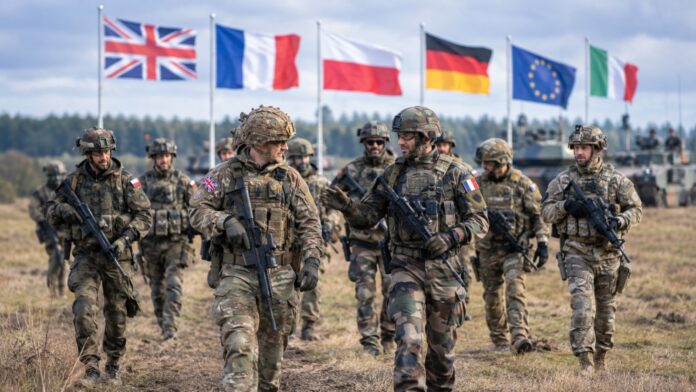
Britain and France are spearheading a significant military exercise designed to assess the readiness of a multinational force for potential deployment to Ukraine following a peace settlement. The exercise, known as Exercise Koalicja, will run from November 9-22 and will be conducted in neighboring Poland with participation from military personnel across multiple European nations. The drill represents a practical test of how international forces might operate within Ukraine’s territory to provide long-term security guarantees and stability.
The exercise will involve approximately 2,800 military personnel operating across land, sea, and air domains. The United Kingdom will contribute 300 troops along with two RAF Typhoon fighter jets that will simulate operations to reassure commercial air traffic once Ukrainian airspace becomes accessible. Turkey has agreed to lead the maritime component of the operation, with objectives including mine clearance and restoration of Black Sea trade routes. The participating nations include Belgium, Estonia, Germany, Lithuania, the Netherlands, Poland, Spain, Sweden, and Turkey, in addition to Britain and France.
- Exercise Koalicja scheduled for November 9-22 in Poland with approximately 2,800 military personnel
- UK contribution of 300 troops and two RAF Typhoon jets; Turkey leading maritime operations
- 12 European nations participating: Belgium, Estonia, Germany, Lithuania, Netherlands, Poland, Spain, Sweden, Turkey, France, and UK
- Exercise focused on troop movement, force protection, supply chains, and multinational command coordination
Why It Matters
This military exercise represents a concrete translation of diplomatic commitments into operational military capability. European nations have proposed long-term security guarantees for Ukraine as part of broader peace settlement discussions, and this exercise demonstrates that these proposals are not merely theoretical frameworks but involve real preparation and resource allocation. The ability to effectively deploy, coordinate, and sustain a multinational force in Ukraine would be essential to any post-conflict security arrangement, making the practical testing of these capabilities significant for credibility and effectiveness.
The exercise also addresses critical operational questions that remain unresolved regarding how such a force would function in practice. Western officials have specified that any deployed force would serve to provide reassurance to Ukraine and assist in rebuilding its armed forces, rather than engaging in offensive combat operations or serving on the front lines. However, fundamental questions about rules of engagement, command structures, and force protection mechanisms remain incompletely defined. The exercise will test whether troops from different nations can effectively work together under unified command and whether logistical systems can support sustained operations within Ukrainian territory.
- Demonstrates European commitment to Ukraine’s long-term security through operational readiness rather than diplomatic statements alone
- Tests coordination mechanisms among 12 nations to ensure multinational forces can operate effectively as a unified command
- Addresses critical gaps in planning regarding supply chains, force protection, and command structures for potential post-conflict operations
- Provides reassurance to Ukraine regarding concrete security guarantees while the country remains engaged in active conflict
Political and Public Context
The planning for a European reassurance force for Ukraine emerged last year as part of broader discussions about long-term security arrangements for the country. These discussions have become increasingly relevant as various peace initiatives and diplomatic efforts have gained momentum. The concept of a multinational security force represents a middle ground between complete NATO integration and unilateral European commitments, reflecting the complex geopolitical considerations facing Western nations regarding military involvement in Ukraine.
Russia has already articulated its opposition to foreign military presence in Ukraine. Russian leadership has previously stated that foreign troops stationed in Ukraine would be treated as legitimate military targets, raising questions about the operational environment in which such a force would function. Western officials have not provided detailed specifications regarding rules of engagement or force protection protocols, though they have indicated that deployed forces would maintain self-defense capabilities. The United States has participated in discussions regarding the potential force but is not contributing personnel to the current exercise, reflecting the distinction between European security initiatives and broader NATO commitments.
- Reassurance force concept developed as long-term security guarantee proposal discussed by European nations last year
- Russia previously stated foreign troops in Ukraine would be legitimate military targets, creating operational security concerns
- Exercise emphasizes force would not operate under NATO command or engage in offensive operations, maintaining distinction from direct alliance military involvement
- US participation in discussions but non-participation in exercise reflects transatlantic coordination while preserving operational distinctions
Thousands of European troops will take part in an exercise in Poland to prepare for a hypothetical postwar mission in Ukraine to boost the country’s economy and rebuild its armed forces. But some experts say the deployment may never take place.
Read more: https://t.co/RwwVOWuRZV
— ABC News (@ABC) November 3, 2026
What Happens Next
The Exercise Koalicja scheduled for mid-November will provide empirical data regarding the feasibility and effectiveness of multinational force operations in a Ukrainian context. Following the exercise, military leadership and political officials will assess whether the current operational concepts adequately address the practical challenges of deployment, coordination, and sustainment. The results and lessons learned from this exercise will likely inform ongoing diplomatic discussions regarding the structure and composition of any eventual security force for Ukraine.
Parallel to these military preparations, ongoing peace discussions and negotiations will determine the actual necessity and timeline for such a deployment. The exercise represents preparation for a contingency that depends on diplomatic progress and agreement from all relevant parties, including Ukraine and international stakeholders. Future developments will depend on whether peace negotiations advance toward concrete agreements, how Russian positions evolve regarding international military presence, and whether the multinational force concept gains broader international endorsement beyond the current 12 participating nations.
- Exercise Koalicja results and assessments will inform refinements to operational concepts and force structure planning
- Diplomatic progress on peace negotiations will determine timeline and necessity for actual force deployment
- Western officials will need to develop and communicate detailed rules of engagement and command structures based on exercise findings
- Potential expansion of participating nations and clarification of force mandate will depend on evolution of conflict and peace discussions