Story Highlights
- President Trump recognized leading technology innovators with prestigious National Medal awards at the Science: A New Golden Age summit in Washington
- Recipients included Tesla and SpaceX CEO Elon Musk, Google co-founder Sergey Brin, and executives from Nvidia, AMD, Microsoft, and Dell Technologies
- The administration has taken a balanced approach to artificial intelligence regulation, favoring industry self-governance over strict government mandates
- The summit highlighted the White House commitment to celebrating American technological achievement and innovation leadership
What Happened
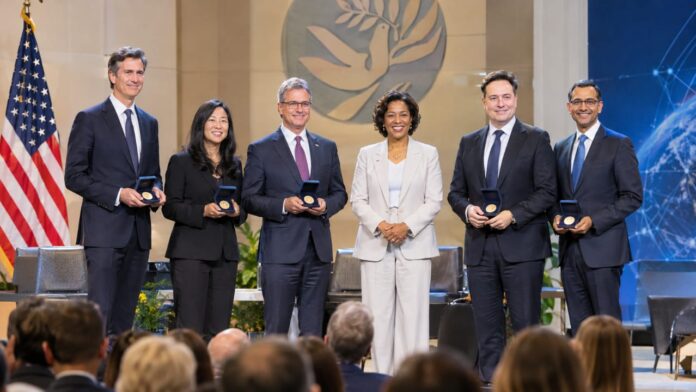
The Science: A New Golden Age summit brought together some of the nation’s most influential technology leaders to receive recognition for their contributions to American innovation and economic growth. The event, held at the U.S. Institute of Peace in Washington, served as a platform for honoring individuals whose work has fundamentally shaped the technology landscape and positioned the United States as a global leader in cutting-edge innovation.
The administration presented the National Medal of Science to several titans of the technology sector, recognizing their pioneering achievements and lasting impact on American competitiveness. Separately, other corporate leaders received the National Medal of Technology and Innovation, underscoring the breadth of technological achievement being celebrated. This multi-award approach reflected the administration’s recognition that innovation spans multiple domains, from artificial intelligence and computing to space exploration and semiconductor manufacturing.
- National Medal of Science recipients: Elon Musk (Tesla and SpaceX CEO), Sergey Brin (Google co-founder), Jensen Huang (Nvidia CEO), and Lisa Su (AMD CEO)
- National Medal of Technology and Innovation recipients: Satya Nadella (Microsoft CEO) and Michael Dell (Dell Technologies CEO)
- Event location: U.S. Institute of Peace in Washington, D.C.
- Event timing: Thursday at 1:30 p.m. EDT
Why It Matters
Recognition of technological achievement carries significant implications for American innovation policy and the relationship between government and industry leadership. By honoring these specific individuals and companies, the White House sent a clear message about which sectors and approaches the administration believes should define America’s future competitive advantage. The timing proved particularly significant given the ongoing national debate surrounding artificial intelligence regulation and oversight.
Rather than imposing restrictive government mandates, the administration has chosen to work collaboratively with technology leaders through voluntary commitments and industry self-regulation frameworks. This approach demonstrates confidence in the private sector’s ability to balance innovation with responsible development practices. The selection of honorees also carried symbolic weight regarding the administration’s priorities, with focus on space exploration, semiconductor manufacturing, and artificial intelligence capabilities critical to national security and economic dominance.
- Administration policy favoring industry self-governance and voluntary commitments over restrictive AI regulation
- Recognition of critical technology sectors including semiconductors, artificial intelligence, space exploration, and cloud computing
- Signal to the private sector that innovation-friendly policies will continue under this administration
- Strengthening of public-private partnerships as the preferred model for technological challenges
Political and Public Context
The Science: A New Golden Age summit name reflected broader administration messaging about American resurgence and renewed commitment to technological leadership. This framing positioned technological achievement as central to national renewal and prosperity, resonating with the administration’s overarching policy narrative. The summit represented one element of a comprehensive approach to industrial policy that emphasizes American manufacturing and competitive advantage against global competitors.
The question of artificial intelligence regulation has emerged as one of the most consequential policy debates in Washington and globally. Many in the technology industry have expressed concerns about overly restrictive regulatory frameworks that could slow American innovation and allow competitors to advance faster. The administration’s approach of supporting industry self-regulation through voluntary commitments struck a balance between addressing legitimate safety and ethical concerns while preserving the innovation velocity that has made American technology companies globally dominant.
- Geopolitical competition in semiconductors, AI, and space technology with international rivals
- Ongoing debate between regulation and innovation-friendly approaches to emerging technologies
- Private sector preference for collaborative over mandated regulatory frameworks
- Connection between technological leadership and economic prosperity in administration messaging
Watch live: Trump to honor Elon Musk, tech leaders at science summit https://t.co/babLOEd65M
— The Hill (@thehill) October 8, 2026
What Happens Next
The recognition ceremony served as a launching point for continued engagement between the White House and technology leadership on matters of national importance. Future interactions will likely build on the collaborative foundation established through this summit, with ongoing discussions about voluntary compliance frameworks and innovation policy alignment. The administration signaled its openness to working with industry leaders as partners rather than adversaries.
Observers should anticipate continued development of the voluntary AI commitment framework that the administration secured from leading technology companies. Rather than pursuing comprehensive legislative mandates, the administration appears committed to demonstrating that industry self-regulation can effectively address emerging concerns while preserving innovation momentum. How effectively these voluntary commitments address public concerns about AI safety and ethics will significantly influence whether this model gains broader acceptance or faces pressure for more formal regulation.
- Development and monitoring of voluntary AI compliance commitments from technology companies
- Continued White House engagement with technology executives on national competitiveness strategy
- Potential expansion of recognition programs emphasizing administration policy priorities
- Ongoing policy debates regarding adequacy of voluntary versus mandatory regulation of emerging technologies