Story Highlights
- A judge dismissed President Trump’s lawsuit against The Des Moines Register, emphasizing free speech protections.
- The ruling reinforces the importance of accurate polling in political discourse.
- The case was deemed extraordinary, with potential chilling effects on media reporting.
- Polling expert J. Ann Selzer expressed gratitude for the ruling, highlighting the integrity of polling practices.
What Happened
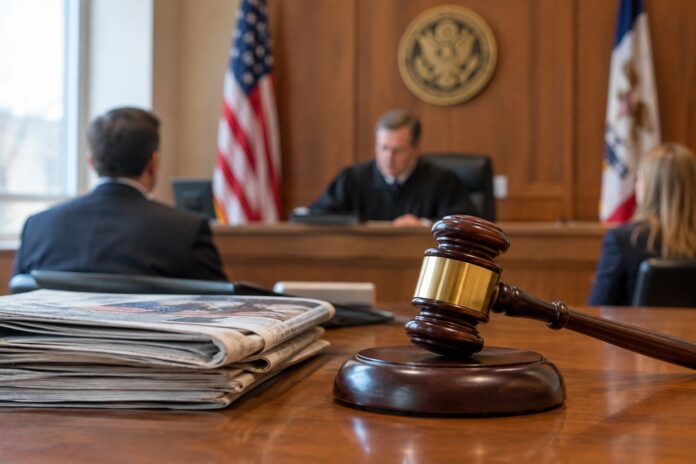
In a significant ruling on Wednesday, Iowa District Judge Scott J. Beattie dismissed a lawsuit filed by President Trump against The Des Moines Register and its former pollster, J. Ann Selzer. The lawsuit accused the newspaper of misrepresenting the state of the 2024 presidential race through allegedly inaccurate polling results. The president claimed that the coverage of these polls violated Iowa’s consumer fraud law, a claim that the judge ultimately rejected.
Judge Beattie characterized the lawsuit as extraordinary, noting that allowing such claims to proceed could have a chilling effect on the media’s ability to report on and engage in public discourse. He sided with Selzer and The Des Moines Register, who described the lawsuit as a conspiracy theory that undermined essential free speech protections. The ruling came shortly after a separate hearing regarding Trump’s ban of CNN, MS NOW, and Politico from White House grounds, which he labeled as ‘fake news.’
- Judge Scott J. Beattie presided over the case.
- The lawsuit was filed in December 2024.
- J. Ann Selzer is a well-known pollster associated with The Des Moines Register.
- The ruling emphasized the constitutional protection of political speech.
Why It Matters
This ruling is significant not only for President Trump but also for the broader implications it has on free speech and media integrity. By dismissing the lawsuit, the judge reinforced the notion that polling and its coverage are protected forms of political speech under the First Amendment. This is crucial in a democratic society where public debate and discourse are essential for informed decision-making.
The dismissal also highlights the judiciary’s role in safeguarding media integrity against unfounded claims. If lawsuits like Trump’s were allowed to proceed, it could set a dangerous precedent, potentially discouraging journalists and pollsters from conducting their work for fear of legal repercussions. The ruling serves as a reminder that while public figures may be subject to scrutiny, the media must retain the freedom to report on political matters without the threat of litigation hanging over their heads.
- The ruling protects the integrity of polling practices and media reporting.
- It reinforces the importance of free speech in political discourse.
- Public figures may face scrutiny, but the media must be free to report without fear of legal action.
- The decision could deter future lawsuits aimed at silencing media coverage.
Political and Public Context
The backdrop of this case is essential to understanding its implications. President Trump has been vocal about his disdain for what he perceives as biased media coverage throughout his political career. His administration has seen multiple lawsuits filed against various media organizations, questioning the boundaries of free speech protections, particularly concerning press coverage. This lawsuit against The Des Moines Register is just one of many instances where the president has sought to challenge media narratives that he believes are detrimental to his image and political standing.
Polling, as a practice, is often fraught with challenges, and no responsible pollster can guarantee election outcomes. J. Ann Selzer, who has a reputation for conducting reliable polls, emphasized that polling is a social science rather than a predictive tool. The ruling not only defends her work but also underscores the importance of maintaining high standards in polling practices, which are vital for a functioning democracy.
- Trump has previously filed lawsuits against various media organizations.
- Polling practices are often scrutinized, especially during election cycles.
- J. Ann Selzer is recognized for her expertise in polling and has defended her work.
- The case reflects ongoing tensions between political figures and the media.
Judge dismisses Trump lawsuit against Iowa newspaper and pollster https://t.co/3kHLtDxB95
— Reuters Legal (@ReutersLegal) September 24, 2026
What Happens Next
Looking ahead, the dismissal of this lawsuit raises several questions about the future of media relations with political figures. Will President Trump continue to pursue legal action against media organizations that he believes misrepresent him? The ruling may embolden other media outlets to report more freely on political matters, knowing that they are protected under the First Amendment. However, it also leaves open the possibility that Trump may seek to challenge this ruling or pursue other avenues to address his grievances with media coverage.
Moreover, the ruling could have implications for how polling is conducted and reported in the future. As political campaigns ramp up for the 2024 election, the importance of accurate polling will be paramount. This case serves as a reminder that while polling can influence public perception, it must be conducted ethically and transparently to maintain public trust.
- Future lawsuits against media organizations may be influenced by this ruling.
- Media outlets may feel more empowered to report on political matters.
- The integrity of polling practices will remain a critical issue as elections approach.
- Trump’s response to the ruling could shape future media relations.