Story Highlights
- Defense Secretary Pete Hegseth emphasizes physical standards for troops attending his upcoming address.
- Focus on grooming and fitness reflects a commitment to military discipline and leadership.
- Hegseth aims to address perceived issues in military culture.
- Selected troops will have the opportunity to exercise alongside the Secretary of War.
What Happened
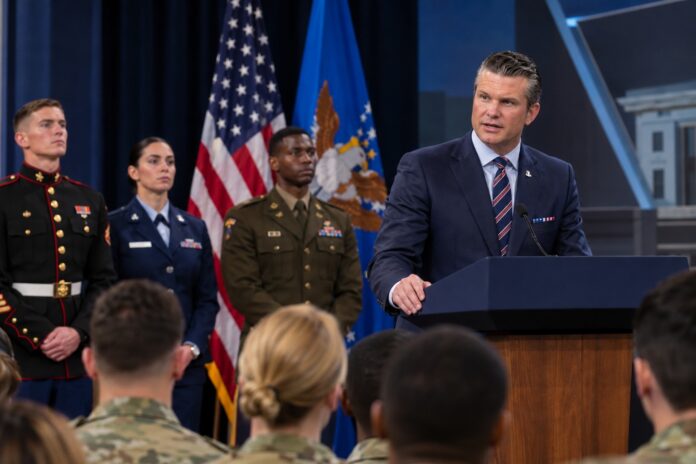
In a bold move that underscores his commitment to military discipline, Defense Secretary Pete Hegseth is actively seeking troops who meet specific physical standards to support him during his upcoming ‘State of the Force’ address. Scheduled for later this month, this address is expected to draw attention not only for its content but also for the carefully selected audience that will accompany Hegseth on stage. The initiative reflects a broader agenda aimed at restoring traditional values within the armed forces, which many believe have been compromised in recent years.
According to reports, Hegseth has reached out to top military brass, requesting nominations for service members who exhibit ‘impeccable grooming and uniform standards.’ These troops must also conform to certain body fat requirements, which aligns with Hegseth’s ongoing efforts to instill a sense of discipline and professionalism within the ranks. The selection process will be rigorous, with candidates required to pass the Army’s fitness test and meet the waist-to-height ratio requirement, a benchmark that Hegseth has made official during his tenure.
- Hegseth’s address is scheduled for later this month.
- Troops must meet specific grooming and fitness standards to be selected.
- Candidates will be chosen based on leadership qualities and professional character.
- Selected troops will have the chance to exercise with Hegseth.
Why It Matters
The implications of Hegseth’s initiative extend far beyond the upcoming address. By emphasizing physical fitness and grooming standards, he is sending a clear message about the importance of discipline within the military. This focus on traditional values is particularly significant in an era where many feel that the armed forces have strayed from their core mission. Hegseth’s approach is not merely about aesthetics; it is about fostering a culture of excellence and accountability among service members.
Moreover, Hegseth’s stance resonates with a growing sentiment among military personnel and their supporters who believe that the armed forces should prioritize readiness and effectiveness over political correctness. His previous comments regarding ‘fat generals’ and the need for a clean-shaven military reflect a broader critique of what he perceives as a decline in standards. By taking a stand on these issues, Hegseth is positioning himself as a leader who is willing to challenge the status quo and advocate for a return to military fundamentals.
- Hegseth’s focus on fitness may lead to increased morale among troops who value discipline.
- His stance could influence future military policies regarding grooming and fitness standards.
- Service members may feel empowered to uphold traditional values within the ranks.
- The initiative may attract support from conservative circles advocating for military reform.
Political and Public Context
Hegseth’s emphasis on physical standards is not an isolated incident but rather part of a larger narrative surrounding military culture in recent years. Under his leadership, the Army has adopted the waist-to-height ratio as its official body composition screening method, a decision that has sparked both support and criticism. This method, which calculates a soldier’s waistline in relation to their height, aims to ensure that all service members maintain a healthy physique, which is essential for operational readiness.
Additionally, Hegseth’s previous remarks about ‘beardos’ and the necessity of a clean-shaven military highlight his commitment to a specific image of what a soldier should represent. His comments at Marine Corps Base Quantico last September, where he stated, ‘We don’t have a military full of Nordic pagans,’ further illustrate his desire to uphold a particular ethos within the armed forces. This ethos, according to Hegseth, is rooted in discipline, integrity, and a commitment to service.
- The Army’s adoption of the waist-to-height ratio reflects a shift in body composition standards.
- Hegseth’s comments have sparked discussions about military grooming policies.
- Previous military addresses have focused on addressing perceived cultural issues.
- Hegseth’s leadership style contrasts with more progressive approaches in military policy.
Exclusive: The Pentagon is asking commanders to nominate troops to attend Defense Secretary Pete Hegseth’s “State of the Force” address this September, and says the servicemembers must meet waist-to-height requirements and exhibit “impeccable” grooming standards.… pic.twitter.com/oh8PFeyCpU
— The Wall Street Journal (@WSJ) September 15, 2026
What Happens Next
As the date of Hegseth’s address approaches, several questions remain regarding the future of military standards and culture. Will his emphasis on physical fitness lead to lasting changes in how the military approaches grooming and body composition? Will other branches of the armed forces adopt similar standards in response to Hegseth’s initiatives? The answers to these questions could have significant implications for the military’s direction in the coming years.
Moreover, the selection of troops to attend the address will likely be closely scrutinized. The criteria for selection may set a precedent for future events and could influence how service members perceive their roles within the military. As Hegseth continues to advocate for a return to traditional values, it remains to be seen how this will impact the overall culture of the armed forces.
- Hegseth’s address may prompt discussions about military fitness standards nationwide.
- Future military policies could reflect a shift towards traditional values.
- The selection process for troops may influence perceptions of leadership within the military.
- Ongoing debates about military culture will likely continue in the public sphere.