Story Highlights
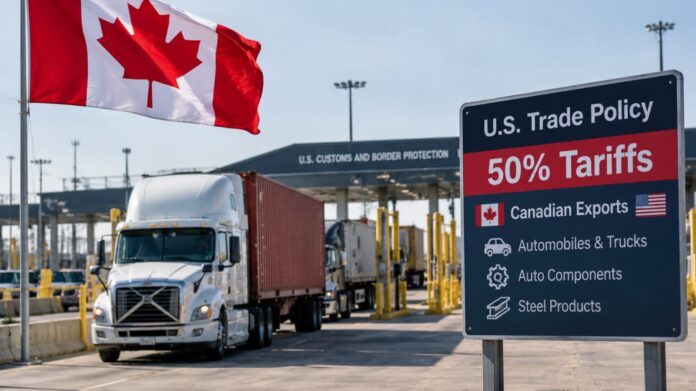
- The White House announced a 50% tariff on Canadian automobiles, trucks, parts, and steel effective January 1, 2027
- President Trump asserted that Canada has been unfairly benefiting from trade relationships and taking advantage of American farmers
- Canadian leadership rejected a proposed deal over the weekend, with officials indicating the terms were unbalanced
- The announcement marks an escalation in trade tensions between two nations with historically strong economic integration
What Happened
The Trump administration introduced sweeping tariffs targeting a broad range of Canadian exports, representing a significant escalation in the ongoing trade dispute between the two neighboring nations. The 50% tariff framework targets automobiles, trucks, automobile components, and steel products, with implementation scheduled for the first day of 2027. This action follows the collapse of negotiation efforts over the weekend, when proposed tariff reduction measures fell apart amid disagreements over deal terms and mutual accusations of unreasonable demands.
The announcement reflects the administration’s broader trade philosophy, which emphasizes protecting American manufacturing and agricultural interests. Officials from the White House conveyed the position that Canada has structured its trade policies to gain unfair advantage, particularly regarding tariffs on American agricultural products. The administration contended that the relationship has been asymmetrical, with Canada conducting approximately 95% of its trade business with the United States while maintaining protective barriers against American goods.
- Tariffs effective January 1, 2027 on cars, trucks, parts, and steel at 50% rate
- Previous tariff escalation of 50% on $20 billion in Canadian exports including electronics and sporting equipment
- Breakdown of weekend negotiations over automobile and materials tariff reductions
- Administration messaging emphasizing asymmetrical trade relationship favoring Canadian interests
Why It Matters
These tariff actions carry significant implications for both continental trade and the American manufacturing sector. The automotive industry, deeply integrated across the Canada-U.S. border through supply chains and production facilities, faces substantial cost pressures and operational uncertainty. Manufacturers relying on cross-border component sourcing will encounter higher input costs, potentially affecting pricing and competitiveness. The tariff structure directly impacts the economics of vehicle production facilities located in American states with substantial automotive manufacturing presence.
The trade confrontation demonstrates the administration’s willingness to pursue aggressive trade policies even with longtime economic partners. The strategy prioritizes short-term leverage in negotiations over maintaining the established framework that has governed bilateral commerce for decades. For American workers in manufacturing sectors, the tariffs represent both potential protection from foreign competition and possible wage pressure through supply chain disruptions. Agricultural communities, which have been central to the administration’s trade narrative, anticipate relief from what officials characterize as unjust tariff barriers on farm products.
- Automotive sector faces significant cost increases and supply chain disruptions affecting production economics
- American manufacturing workers in auto, steel, and related industries experience competing effects of protection and disruption
- Canadian economy heavily dependent on U.S. market access confronts major trade barriers on key export categories
- Agricultural producers targeted by Canadian tariffs positioned to benefit from administration’s negotiating stance
Political and Public Context
The tariff announcement aligns with the administration’s campaign promises regarding trade policy and American economic nationalism. Throughout the presidential campaign and first term, the president emphasized the need to rebalance trade relationships and protect American workers from what he characterized as exploitative trade arrangements. The Canada tariffs represent continuation of this philosophy, applied to one of America’s closest trading partners with approximately $909 billion in annual trade volume.
Canadian political leadership has responded with firmness, indicating readiness to implement retaliatory tariffs matching American actions on a dollar-for-dollar basis. Officials in Ottawa have framed the dispute as requiring respect for Canadian sovereignty and fair treatment in bilateral negotiations. The confrontation reflects broader geopolitical tensions and divergent economic philosophies regarding trade liberalization versus protectionism. Within the United States, the tariff approach garners strong support among voters prioritizing American manufacturing revival and skeptical of trade arrangements they perceive as disadvantageous to domestic workers.
- Tariff strategy consistent with administration’s campaign commitments on trade rebalancing and American economic nationalism
- Canadian government commitment to retaliatory tariffs and firm negotiating posture
- Broader ideological debate within American politics regarding trade liberalization versus strategic protectionism
- Strong domestic political constituency supporting aggressive trade stance with major trading partners
Trump revs up tariffs on Canada to 50% on autos and steel – says ally no longer worthy of 51st state status https://t.co/rrDoRhgFyl pic.twitter.com/FpmhTcWJ4Q
— New York Post (@nypost) August 24, 2026
What Happens Next
The trajectory of Canada-U.S. trade relations will likely depend on whether negotiating teams can reconvene and reach agreement on revised terms acceptable to both sides. The January 1, 2027 implementation date provides a defined timeline for diplomatic efforts, though the substantial gap between current positions suggests meaningful negotiations would require significant movement from one or both parties. Historical precedent indicates that tariff threats often precede deal-making, though the depth of current disagreement and mutual recriminations suggest this dispute may prove more intractable than previous trade conflicts.
Market participants will monitor developments closely, as further escalation could trigger broader economic consequences affecting both nations’ export competitiveness and consumer prices. Industries dependent on integrated North American supply chains face critical decisions regarding production location, inventory strategy, and long-term capital investment. The administration may pursue additional tariff actions on other Canadian sectors if current measures fail to produce negotiating breakthroughs, or conversely, may offer tariff relief as incentive for Canadian concessions on specific trade issues. The broader trade environment will influence whether this bilateral dispute remains contained or expands to involve other trading partners and economic sectors.
- January 1, 2027 implementation date establishes timeline for potential negotiated resolution or tariff activation
- Possibility of additional tariff escalation if current measures fail to produce negotiating progress
- Market and industry decisions regarding supply chain reconfiguration and production location pending tariff clarity
- Broader implications for U.S. trade policy trajectory with other major trading partners