Story Highlights
- President Trump instructed Defense Secretary Pete Hegseth to substantially reduce joint military exercises with South Korea, citing excessive costs and diplomatic considerations
- The administration views the scaled-back approach as an opportunity to improve relations with North Korea while maintaining alliance commitments
- Upcoming Ulchi Freedom Shield exercises scheduled for mid-August will proceed in reduced form rather than full cancellation
- The president emphasized that the United States has historically borne most financial burdens associated with these joint drills
What Happened
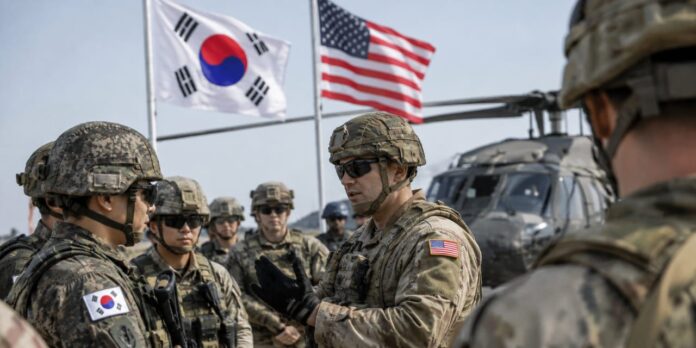
The White House announced a significant policy shift regarding military cooperation with South Korea. President Trump communicated his directive to reduce the scope of joint military exercises, directing his Defense Secretary to implement substantial cutbacks in the planned defense drills. The president expressed dissatisfaction with long-standing agreements that commit American resources to these annual operations, particularly emphasizing the financial burden shouldered by the United States.
In his announcement, the president indicated that while complete cancellation of the upcoming Ulchi Freedom Shield exercises would not be feasible due to timing constraints, the drills would be substantially scaled back from their originally planned scope. The exercises, scheduled to run from August 17-27, were originally designed to include live-fire components, wet gap crossing operations, and deployment of prepositioned military equipment. His administration framed the reduction as a prudent financial decision while maintaining essential alliance readiness capabilities.
- Defense Secretary Pete Hegseth received direct orders to reduce exercise scope and scale
- Ulchi Freedom Shield exercises set for August 17-27 will proceed in modified form
- President Trump cited excessive U.S. cost-sharing as primary justification for reductions
- The administration indicated South Korea’s refusal to support Iran denuclearization efforts as an additional factor in the decision
Why It Matters
The decision reflects a fundamental reassessment of American defense spending priorities and alliance management under the current administration. By reducing the scale of these exercises, the White House is signaling a commitment to fiscal responsibility while simultaneously pursuing diplomatic engagement with North Korea. This approach demonstrates the president’s willingness to challenge established defense protocols when he determines they no longer serve American interests effectively.
The financial implications are substantial. The United States has historically covered the majority of costs associated with these joint drills, representing a significant budgetary outlay. By reducing exercise scope, the administration aims to redirect resources toward other defense priorities while still maintaining the operational readiness necessary for regional security. This decision also sends a message about the administration’s broader foreign policy philosophy: one that prioritizes cost-effectiveness and negotiated settlements over continuous military posturing.
The approach reflects the president’s longstanding belief that military exercises can be counterproductive to diplomatic negotiations. His administration views the reduction not as a weakening of alliance commitments but as a strategic recalibration designed to create space for productive dialogue with North Korean leadership. The decision underscores his confidence in his personal relationship with North Korean leader Kim Jong Un and his conviction that improved bilateral relations serve broader American interests in the region.
- Reduced exercise costs preserve American defense resources for alternative strategic priorities
- Modified approach creates diplomatic space for negotiated settlements with North Korea
- South Korean alliance remains intact while sharing financial burdens more equitably
- Regional security posture continues to maintain deterrent capabilities while reducing provocative signaling
Political and Public Context
This policy decision builds upon the president’s established track record of reconsidering traditional military alliances and defense spending commitments. During his first term, he previously advocated for suspending these military exercises, describing them as excessively costly and counterproductive to diplomatic objectives. The current directive represents a continuation of this philosophical approach, now implemented with renewed authority and purpose.
The broader context includes ongoing tensions on the Korean Peninsula and evolving security dynamics in the Indo-Pacific region. North Korea has responded to previous announcements of joint exercises with provocative statements and weapons tests, characterizing the drills as rehearsals for aggressive military action. By taking this measured approach, the White House seeks to reduce inflammatory rhetoric while maintaining sufficient defensive capabilities to deter hostile actions.
His administration’s perspective stands in contrast to traditional military and diplomatic establishments that view these exercises as essential confidence-building measures and alliance reinforcement mechanisms. However, the president has consistently maintained that military exercises must serve genuine strategic purposes rather than perpetuate outdated protocols. This decision reflects his conviction that American defense spending should align with clearly defined national interests and measurable strategic objectives.
- President Trump reduced similar exercises during his first term at a 2018 Singapore summit with North Korean leadership
- Previous administrations maintained full-scale exercises as routine alliance strengthening mechanisms
- North Korea has historically responded to announced drills with threatening rhetoric and weapons demonstrations
- The Defense Department traditionally views joint exercises as critical for maintaining readiness and interoperability with allied forces
President Donald Trump announced that the United States would reduce military exercises it conducts with key regional ally South Korea, citing his positive relationship with North Korean leader Kim Jong Un and Seoul’s lack of assistance with Iran. https://t.co/wGG4vFWNbr pic.twitter.com/xqoJBwdPzW
— CNN (@CNN) August 16, 2026
What Happens Next
The modified Ulchi Freedom Shield exercises will proceed as scheduled but in substantially reduced form compared to original planning. Defense Secretary Hegseth will oversee implementation of the scaling-back directive, working with South Korean military counterparts to adjust exercise components while preserving core readiness objectives. The specific operational changes and modified scope will likely be detailed in coming weeks as the August exercises approach.
Diplomatic observers will monitor whether this gesture toward reduced military posturing produces reciprocal restraint from North Korean leadership or creates opening for renewed bilateral negotiations. The president’s administration appears positioned to pursue negotiations from this stance of reduced military exercise activity. Additionally, how South Korea responds to the reduced exercises and whether Seoul seeks increased burden-sharing in future defense cooperation will provide important indicators of the policy’s trajectory.
Congress will likely engage with oversight of this policy shift, particularly regarding its implications for regional security and alliance commitments. Budget allocations and defense spending justifications may be subject to heightened scrutiny as the administration explains the rationale for exercise reductions. The outcome of these drills and subsequent diplomatic developments will inform whether this approach becomes a sustained policy direction or undergoes modification based on strategic developments.
- Modified Ulchi Freedom Shield exercises scheduled for mid-August execution with adjusted operational scope
- Defense Secretary Hegseth to coordinate implementation details with South Korean military officials
- Diplomatic channels potentially open for renewed negotiations with North Korean leadership
- Congressional oversight processes may examine regional security implications and alliance impacts of the policy adjustment