Story Highlights
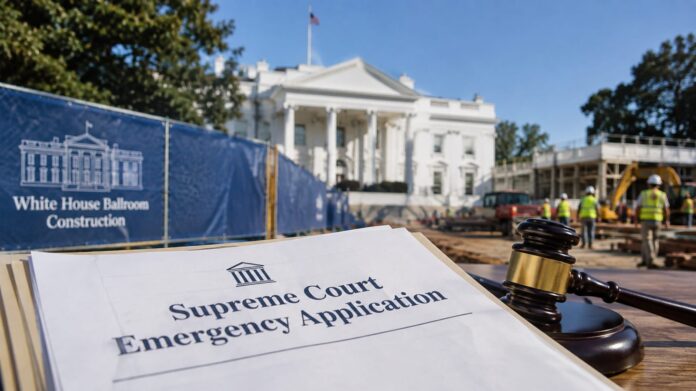
- The White House administration filed an emergency application with the Supreme Court to resume construction of a $400 million ballroom project at the East Wing
- An appeals court halted above-ground construction work, ruling the project lacked necessary congressional approval
- Justice Department lawyers argued the integrated security complex is vitally required for national security purposes
- The National Trust for Historic Preservation brought the original legal challenge after construction began without congressional authorization
What Happened
On Friday, August 14, the administration submitted an emergency application to the U.S. Supreme Court requesting permission to continue the White House ballroom construction project while preparing a full appeal. This action followed a decision from the U.S. Court of Appeals for the District of Columbia Circuit issued on August 7, which upheld a lower-court order directing the administration to halt above-ground construction efforts.
The appeals court panel, in a 2-1 ruling, determined that decisions regarding construction of this magnitude belong to Congress rather than executive action. The court noted that whether a massive ballroom should be constructed is a matter for legislative decision-making and not a matter for executive self-help. However, the appellate court paused its order for 14 days to allow the administration time to seek Supreme Court intervention.
Justice Department lawyers, in their filings with the Supreme Court, characterized the project as an integrated military complex essential for protecting the president and White House operations. The legal arguments emphasized that the structure incorporates multiple security features designed to work together as a unified system, including bomb shelters, medical facilities, and protective measures against drone and missile threats.
- Appeals court ruling issued August 7, 2024, ordering construction halt
- Supreme Court emergency application filed August 14, 2024
- Construction project valued at $400 million at the East Wing
- National Trust for Historic Preservation initiated original litigation in 2023
Why It Matters
The outcome of this Supreme Court case carries significant implications for executive authority, congressional oversight, and the balance of power between branches of government. If the administration prevails, it would establish important precedent regarding how national security arguments apply to major construction projects at federal facilities. Conversely, if the Supreme Court upholds the appeals court decision, it reinforces congressional authority over substantial expenditures and construction at the nation’s capital.
The resolution also affects the practical security posture of the White House itself. The administration has argued that current facilities lack adequate space for large-scale events and that the integrated security features of the proposed complex cannot be disaggregated into separate projects. This centralized approach means that halting construction leaves existing security gaps unaddressed, according to the administration’s position. The case raises broader questions about how courts should evaluate national security claims when they involve constitutional questions about separation of powers.
- Sets precedent for presidential authority regarding executive branch construction and spending
- Determines extent of congressional oversight for large-scale federal projects
- Affects White House operational capabilities and security infrastructure
- Establishes how courts should evaluate national security justifications in separation-of-powers disputes
Political and Public Context
The White House ballroom dispute reflects broader tensions between executive and legislative branches regarding authority and oversight. Throughout his administration, this president has consistently advocated for expanded executive capacity to undertake necessary projects without prolonged congressional review. The ballroom project exemplifies this approach, with the administration arguing that security needs require swift action rather than extended legislative processes.
The National Trust for Historic Preservation, which initiated the legal challenge, has positioned itself as a guardian of established procedures and legal compliance. The organization’s lawsuit represented a challenge to the administration’s unilateral action to demolish the East Wing and commence construction of a 90,000-square-foot structure without prior congressional authorization. The case has drawn attention from various constituencies concerned with both presidential power and proper governmental procedure.
The appeals court’s reasoning emphasized that national security considerations, while important, do not provide automatic exemption from legal requirements and congressional authority. This perspective reflects judicial caution about unchecked executive power, even when invoked for security purposes. The Supreme Court’s decision will clarify whether courts should grant deference to executive national security assessments in disputes involving structural constitutional questions.
- Reflects ongoing debates about executive versus legislative authority
- Involves institutional players including the National Trust for Historic Preservation and Justice Department
- Raises questions about appropriate deference to presidential security assessments
- Follows pattern of administration seeking expanded executive capacity for major initiatives
President Donald Trump is asking the Supreme Court to let him continue building the White House ballroom, citing national security needs and architectural importance. https://t.co/lgWMqyjpyu pic.twitter.com/xhv1r35WyV
— CNN (@CNN) August 14, 2026
What Happens Next
The Supreme Court must decide whether to grant the emergency application to keep the appeals court ruling on hold while the administration prepares its full appeal. The August 21 deadline represents a critical juncture, as construction will cease unless the high court intervenes. This timeline creates urgency for the justices to act, as the 14-day pause granted by the appeals court expires on that date.
If the Supreme Court grants the emergency application, construction could resume while the case proceeds through full briefing and oral arguments. This scenario would give the administration the opportunity to present comprehensive arguments about national security, executive authority, and the integrated nature of the proposed complex. If the Court denies the application, construction would halt pending resolution of the underlying merits, which could take months or longer.
The full appeal, should it reach the Supreme Court’s docket, will likely examine whether the administration had authority to undertake the project without congressional approval and whether national security considerations override standard legal procedures. The case could ultimately address fundamental questions about presidential power in matters affecting White House operations and security infrastructure.
- Supreme Court decision on emergency application expected before August 21 deadline
- Full appeal briefing and possible oral arguments would follow if emergency application granted
- Case could establish precedent on presidential authority for executive facility construction
- Resolution will determine whether ballroom construction continues or requires congressional authorization before proceeding