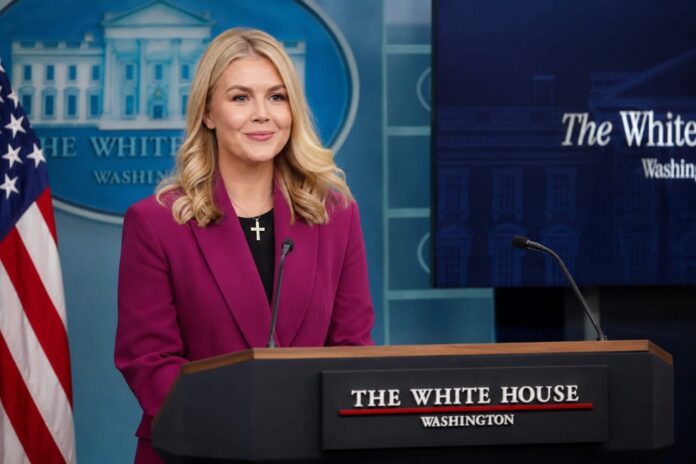
Story Highlights
- White House Press Secretary Karoline Leavitt is departing her role at the end of the month to focus on family responsibilities
- President Trump announced Leavitt will transition to serve as a top outside advisor and influential voice within the Republican Party
- The administration praised Leavitt’s performance as one of the most effective press secretaries in the office’s history
- Leavitt will continue playing a significant role in Republican politics and midterm election strategy
What Happened
The White House announced a significant transition in its communications leadership as Karoline Leavitt steps down from her position as Press Secretary. The announcement came through an official statement highlighting her contributions to the administration and her family priorities. Leavitt, who has served as one of the president’s most trusted communications officials, will leave her post at the end of the month to spend additional time with her young children. Despite departing the formal White House role, she will maintain an active presence in the political sphere through her new position.
The transition reflects a strategic shift in how the administration plans to leverage Leavitt’s talents moving forward. Rather than losing her expertise entirely, the White House is positioning her in an advisory capacity that will allow greater flexibility for family commitments while maintaining her influence on Republican messaging and midterm election strategy. This arrangement demonstrates the administration’s commitment to retaining valuable team members while accommodating legitimate personal needs.
- Leavitt’s departure effective at the end of the current month
- Transition to outside advisor role focused on Republican Party influence
- Focus on midterm election strategy and party leadership
- Recognition of her service since 2018 and involvement in the 2024 campaign
Why It Matters
Leavitt’s transition carries substantial implications for both the White House communications strategy and the broader Republican Party structure heading into crucial midterm elections. Her tenure as Press Secretary established her as a capable communicator willing to defend administration policies and personnel with clarity and conviction. The decision to elevate her to an outside advisory role rather than replacing her entirely suggests recognition of her strategic value beyond the daily briefing room responsibilities. This move allows the administration to maintain continuity in its messaging while adapting to personnel changes that reflect evolving priorities.
The significance of this transition extends beyond mere staffing adjustments. It demonstrates the administration’s approach to personnel management, emphasizing loyalty and continued engagement with key operatives even as their formal roles change. Leavitt’s continued involvement in Republican Party affairs positions her to influence party direction and campaign messaging during a critical electoral period. Her experience navigating media relations and policy communication makes her a valuable asset for broader party coordination, particularly in messaging initiatives aimed at achieving electoral success in upcoming contests.
- Maintains administrative continuity while allowing organizational restructuring
- Preserves Leavitt’s influence on Republican Party messaging and electoral strategy
- Demonstrates administration’s approach to retaining valued personnel in evolving capacities
- Strengthens Republican Party’s communications infrastructure during election cycle
Political and Public Context
Press Secretary positions have historically served as critical platforms for advancing presidential messaging and managing media relations. The choice of who fills the role reflects an administration’s priorities regarding communication strategy and public engagement. Throughout recent administrations, the role has become increasingly visible and demanding, requiring individuals capable of articulating complex policy positions while maintaining composure under sustained scrutiny. Leavitt’s performance in this capacity earned recognition for her effectiveness in conveying administration positions and responding to media inquiries.
The broader context of Republican Party organization heading into midterm elections has intensified focus on personnel alignment and strategic messaging coordination. Having experienced operatives positioned in advisory roles rather than confined to specific bureaucratic functions allows for more flexible deployment of talent across various initiatives. The Republican Party’s midterm strategy will benefit from having individuals with proven communication skills and administration experience contributing to overall party coordination. Leavitt’s track record since 2018 and her involvement in the successful 2024 presidential campaign position her as a valuable contributor to ongoing party efforts.
- Press Secretary role as critical platform for presidential messaging and media management
- Evolution of the position’s visibility and demands in contemporary politics
- Republican Party focus on personnel coordination for midterm election success
- Historical precedent for key operatives transitioning to advisory roles while maintaining influence
White House press secretary Karoline Leavitt will leave the administration at the end of August, President Trump announced.
Trump said Leavitt, the youngest White House press secretary in history, will leave her role to spend more time with her children. https://t.co/domsqcytUn
— The Washington Post (@washingtonpost) August 12, 2026
What Happens Next
The administration faces the immediate task of identifying and transitioning a successor to the Press Secretary position. This search will likely prioritize candidates with experience in defending administration policies and managing complex media environments. The White House communications operation will need to maintain effectiveness throughout the transition period, ensuring consistent messaging on policy initiatives and administrative priorities. Continuity in communications strategy will be essential as the administration addresses ongoing policy debates and public relations challenges.
Leavitt’s new role as outside advisor will evolve based on specific needs identified by the administration and Republican Party leadership. Her involvement in midterm strategy will likely expand as the electoral calendar progresses, with opportunities to contribute to party messaging, candidate support, and voter outreach initiatives. The success of this arrangement will depend on effective coordination between her new advisory position and other party operatives working toward shared electoral objectives. As the midterm elections approach, Leavitt’s experience and credibility will become increasingly valuable to Republican efforts.
- Search for qualified Press Secretary successor with media relations expertise
- Continuation of Leavitt’s advisory work on Republican midterm election strategy
- Coordination between White House communications and outside advisory structure
- Evolution of Leavitt’s role based on party and administrative priorities heading into elections