Story Highlights
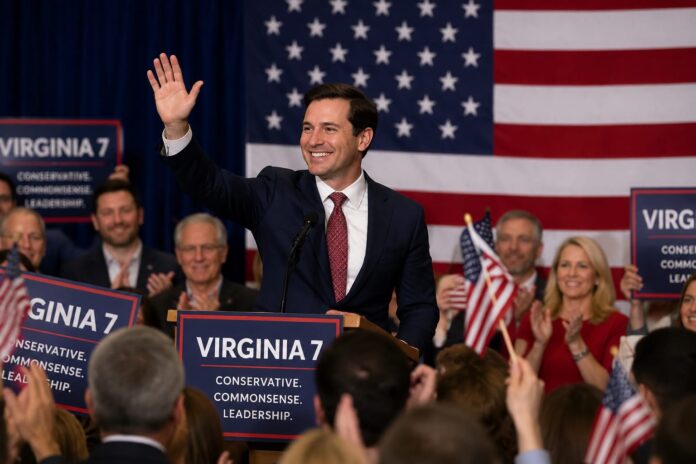
- Douglas Ollivant secured a decisive victory in Virginia’s 7th Congressional District Republican primary with 56.6% of the vote, positioning himself to challenge incumbent Democrat Eugene Vindman in November
- Ollivant, a retired Army officer with national security experience, maintains stronger fundraising than primary opponents, raising $251,134 compared to rival Philip Harding’s $125,916
- The district represents a true swing seat that Republicans view as a potential flip opportunity as the party works to maintain Congressional control during a challenging midterm cycle
- Vindman’s twin brother Alexander is a well-known Trump critic, adding political dimension to the general election matchup in a competitive northeastern Virginia district
What Happened
The Republican primary race in Virginia’s 7th Congressional District concluded with a commanding performance from Ollivant, who emerged from a three-candidate field with a substantial margin. The primary contest was particularly notable because none of the three major candidates had previously held elected office, though two possessed government experience. Despite the lack of detailed polling data heading into Election Day, Ollivant’s campaign generated momentum that translated into decisive electoral success.
Ollivant defeated Rick Smithers, a pastor and construction business owner, and Philip Harding, a Harvard-educated businessman with graduate training from the Kennedy School of Government. While all three candidates broadly aligned themselves with conservative principles and Trump-friendly policies, Ollivant’s background in national security and military service distinguished his candidacy. His professional experience includes service as the National Security Council director for Iraq during the George W. Bush administration, followed by work as a national security analyst and consultant.
- Ollivant secured 56.6% of the primary vote; Harding received 30.7%; Smithers garnered 12.8%
- Ollivant raised $251,134 in campaign funds versus Harding’s $125,916
- None of the three Republican primary candidates previously held elected office
- The winner now faces incumbent Democrat Eugene Vindman in the general election
Why It Matters
The general election matchup carries significant implications for Congressional control and reflects broader national political dynamics. Virginia’s 7th District qualifies as a genuine swing seat, meaning its electoral outcome could determine which party controls the House of Representatives. Republicans view this district as a genuine pickup opportunity, particularly valuable given the historical difficulty that governing parties face in maintaining Congressional strength during midterm election years. Ollivant’s stronger financial position relative to his primary opponents provides a foundation for mounting a competitive general election campaign against an incumbent who benefited from an unopposed primary run.
The race acquired additional political resonance from the family connection between the incumbent and a prominent Trump antagonist. Eugene Vindman’s twin brother, Alexander, gained national prominence as a former military official and former National Security Council Director for European Affairs who became publicly critical of the sitting president. This family dynamic adds a symbolic element to the November contest beyond traditional partisan competition. The district’s recent electoral history demonstrates its competitive nature; Vindman won the previously vacant seat by only three percentage points in the last general election.
- The district encompasses parts of seven Virginia counties and cities, including Culpeper, Fredericksburg, Stafford, Spotsylvania, Caroline, and portions of Prince William County
- Vindman’s prior victory margin was only three points, indicating district competitiveness
- Republicans need to flip seats in swing districts to gain House control during a midterm year
- Ollivant’s security background and fundraising advantage position him as a credible general election candidate
Political and Public Context
The Virginia primary outcome aligns with broader patterns of Trump-associated candidates performing well in Republican primaries across the country. Although the former president did not formally endorse any candidate in this particular race, the general alignment of all three Republican primary candidates with Trump’s policy positions reflected the outsized influence of Trump-favoring Republicans within the party base. The primary’s three-way format among political newcomers represented an unusual dynamic in modern Congressional races, where experience in government typically provided advantages in candidate recruitment and primary competition.
Historically, parties controlling the White House face substantial headwinds in midterm elections, with the sitting president’s party typically losing House seats. Republicans recognize that pickup opportunities in districts like Virginia’s 7th become increasingly valuable given these structural disadvantages. The district’s location in the northeastern portion of Virginia, encompassing suburban and rural areas, reflects demographic patterns where Republican candidates have sought to make gains in recent cycles. The fact that Spanberger, the previous representative, advanced to the gubernatorial level demonstrates the seat’s political significance within Virginia politics.
- Trump’s general influence over Republican primary politics remains substantial despite not formally endorsing in this race
- Midterm election history shows parties in power typically lose Congressional seats
- The district’s composition includes both suburban and rural areas that have shown Republican strength
- Ollivant’s military and national security background appeals to voters prioritizing these policy areas
What Happens Next
The general election campaign will intensify in the coming months as Ollivant and Vindman compete for the seat. Ollivant’s financial advantages and ability to establish a coherent campaign message will prove critical as he works to define himself against an incumbent with higher name recognition. The candidate must effectively communicate his national security expertise and conservative policy positions to persuade swing voters in a district that has demonstrated willingness to support candidates from both parties.
Outside groups and national Republican organizations will likely invest resources in this race given its significance to the broader Congressional balance. Vindman, having won the seat by a narrow margin, cannot take voter support for granted and must defend his record against Republican attacks. The outcome in this district will provide important signals about Republican momentum heading into the general election cycle and whether the party can successfully flip seats it needs to regain House control.
- Ollivant must execute a comprehensive campaign strategy targeting swing voters in the district
- National Republican groups will likely fund independent expenditures in support of Ollivant’s candidacy
- Vindman faces pressure to defend his voting record and explain his positions to constituents
- The election outcome will test Republican gains in swing Congressional districts nationwide