Story Highlights
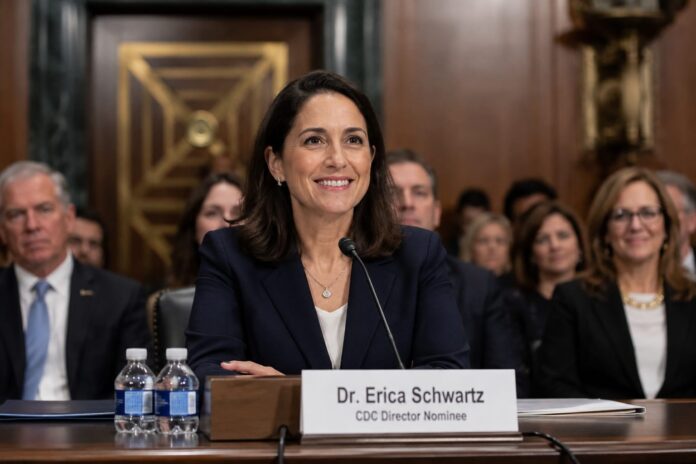
- Dr. Erica Schwartz was confirmed by the Senate on a 51-44 vote as the new director of the Centers for Disease Control and Prevention
- The confirmation represents a significant achievement for the Trump administration following previous setbacks in filling the CDC leadership position
- Schwartz, a Navy veteran and former deputy surgeon general, committed during her hearing to prioritize scientific consensus and public health guidance
- Senator Tim Kaine of Virginia was the sole Democrat to vote in support of her nomination
What Happened
The Senate voted to confirm Dr. Erica Schwartz as director of the Centers for Disease Control and Prevention, marking a notable victory for the White House after multiple failed attempts to secure leadership at the nation’s top public health agency. The confirmation vote broke largely along party lines, with the final tally standing at 51 votes in favor and 44 opposed. Senator Kaine’s support proved decisive in demonstrating bipartisan recognition of Schwartz’s qualifications and commitment to the position.
Schwartz is the third nominee selected by the president to lead the CDC. Her appointment comes at a critical moment, as the agency has faced significant upheaval in recent months. During her confirmation hearing, lawmakers focused heavily on her commitment to scientific integrity, particularly regarding vaccine policy. Schwartz indicated that she would maintain fidelity to established science and would not compromise on evidence-based public health recommendations. Her responses satisfied key committee members who had expressed concerns about potential political interference in the agency’s scientific mission.
- Confirmation vote: 51-44, with Tim Kaine as sole Democratic supporter
- Previous nominees: David Weldon withdrawn in March 2025; Susan Monarez fired after less than a month in the role
- Schwartz background: Navy veteran, deputy surgeon general during the first Trump administration, former chief medical officer of the Coast Guard
Why It Matters
The successful confirmation of Schwartz represents a significant stabilization moment for the CDC after a turbulent period of leadership instability. The agency had been operating under acting leadership for nearly a year, creating uncertainty about direction and institutional morale. Her appointment as the first permanent director in this span addresses a critical gap in governance at a moment when the nation faces ongoing public health challenges. The president’s administration can now point to concrete progress in filling one of the most important health positions in the federal government.
Schwartz’s background as both a military officer and public health professional brings credentials that appeal across different constituencies. Her explicit commitment to scientific rigor during confirmation testimony provides reassurance to career CDC staff who have expressed concerns about the agency’s future direction. The bipartisan support she garnered, even if limited, suggests that her appointment may help restore institutional confidence in the CDC’s independence and scientific mission. This is particularly important as the agency faces significant public health challenges and needs to rebuild trust with both internal staff and the general public.
- First permanent CDC director appointment in nearly a year, addressing leadership vacuum
- Commitment to scientific consensus helps restore institutional credibility after period of uncertainty
- Appointment demonstrates progress on key Trump administration priority of filling senior health positions
- Bipartisan confirmation vote enhances legitimacy and cross-party support for agency leadership
Political and Public Context
The confirmation process for CDC leadership has become increasingly contentious in recent years, reflecting broader debates about the role of science in policymaking and public health governance. The current political climate has elevated questions about vaccine policy, government health agency independence, and the relationship between the CDC and the Department of Health and Human Services leadership. These tensions shaped the confirmation hearing, where senators pressed Schwartz on hypothetical conflicts between scientific recommendations and directives from higher authorities within the administration.
The agency itself has undergone substantial changes, with staff departures and reduced workforce capacity affecting its operational capacity. Public health challenges including disease outbreaks have added urgency to the need for stable, experienced leadership. Schwartz’s military background and prior service as deputy surgeon general during the president’s first term suggest someone with institutional knowledge and experience navigating complex relationships within the federal health bureaucracy. Her appointment reflects an effort to find leadership that can command respect within the public health community while maintaining alignment with the broader administration’s policy priorities.
- CDC workforce has declined significantly through layoffs and resignations since the administration took office
- Agency faces multiple ongoing public health challenges including disease outbreaks among vulnerable populations
- Vaccine policy disputes and Health and Human Services Secretary Kennedy’s public skepticism have created internal tension
- Senate confirmation reflects broader debate about scientific independence versus political accountability in federal health agencies
What Happens Next
Schwartz will assume leadership of the CDC at a moment when the agency must address multiple simultaneous challenges while rebuilding institutional capacity and staff morale. Her first priorities will likely include stabilizing operations, addressing the current disease outbreaks, and implementing policy direction from the Health and Human Services Secretary while maintaining the agency’s scientific credibility. The success of her tenure will depend on her ability to navigate these potentially competing demands while maintaining staff confidence and public trust.
The confirmation also sets expectations for how the administration will approach other senior health positions that remain vacant. Schwartz’s appointment demonstrates that the president’s team can secure Senate approval for qualified nominees who demonstrate commitment to scientific principles, suggesting a template for future health leadership appointments. Her performance in the coming months will likely influence both institutional culture at the CDC and broader public perception of the administration’s approach to public health governance. The agency’s response to ongoing health challenges will serve as a test of her leadership and the effectiveness of having stable direction after a period of significant uncertainty.
- Schwartz begins tenure amid workforce capacity challenges and multiple ongoing public health crises
- Key test: maintaining agency scientific integrity while implementing administration health policy priorities
- Future staff hiring and morale recovery will be critical measures of her leadership success
- Her approach to vaccine policy implementation and communication may shape broader public health debates