Story Highlights
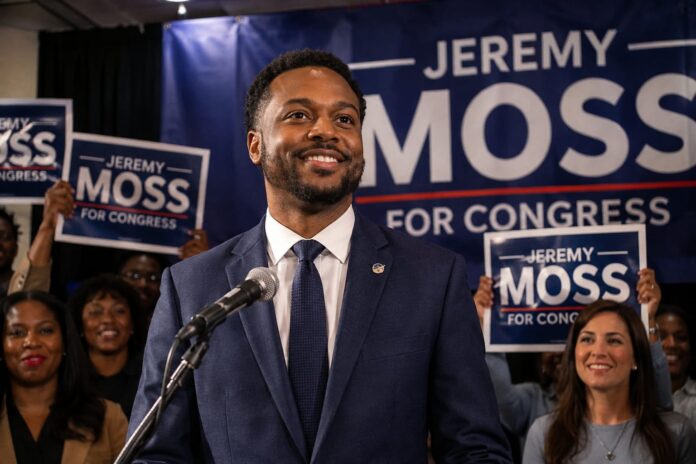
- Michigan state Sen. Jeremy Moss secured victory in the Democratic primary for the state’s 11th Congressional District, defeating five other Democratic candidates
- Moss will advance to face Republican Ethan Baker in the general election, with analysts giving him a 99 percent chance of winning in the solidly Democratic district
- If elected in November, the 40-year-old would become the first openly gay member of Congress from Michigan
- Moss has maintained significant financial advantages over his Republican opponent, with campaign funds exceeding $414,000 compared to Baker’s less than $96,000
What Happened
Michigan state Sen. Jeremy Moss emerged victorious in the Democratic primary for Michigan’s 11th Congressional District, according to projections from Decision Desk HQ. Moss, who has served as president pro tempore of the Michigan Senate since January 2023, overcame competition from five other Democratic candidates to secure the nomination. His primary victory positions him to succeed Rep. Haley Stevens, who departed the race to pursue a position in the state Senate following the retirement of Michigan Sen. Gary Peters.
The Republican side of the race has already been settled, with Ethan Baker running unopposed in the GOP primary. Baker, who has served as mayor of Troy, Michigan, since 2019, will represent the Republican Party in the November general election. The contrast between the two candidates extends beyond their party affiliations to include their campaign resources and political experience.
- Moss defeated a field of five Democratic primary opponents in Michigan’s 11th Congressional District
- Ethan Baker, the Republican nominee, has served as Troy’s mayor since 2019
- Haley Stevens vacated the seat to run for Michigan State Senate following Gary Peters’ retirement announcement
- The general election matchup between Moss and Baker is scheduled for November
Why It Matters
The outcome of this race carries significant implications for Michigan’s congressional representation and the composition of the House of Representatives. The nonpartisan Cook Political Report has rated the 11th Congressional District as solidly Democratic, reflecting the district’s strong partisan lean. Decision Desk HQ projects Moss has a 99 percent probability of winning the general election, effectively determining the district’s representative based on primary dynamics and general electorate preferences.
Moss’s potential election would mark a historic milestone for Michigan’s political landscape. At 40 years old, he would become the first openly gay member of Congress from the state if he prevails in November. Additionally, his election would represent continuity in Democratic representation for a district that has trended increasingly Democratic in recent election cycles. Stevens, his predecessor, won reelection by approximately 23 points and nearly 20 points in the two most recent general elections following the district’s 2021 redistricting.
Moss’s financial positioning also contributes to the significance of this race. His campaign maintained more than $414,000 in available funds as of late June, substantially exceeding Baker’s less than $96,000. This financial advantage suggests Moss will have considerable resources to conduct campaign outreach and messaging throughout the general election period.
- The district is rated as solidly Democratic by nonpartisan analysts, suggesting the primary effectively determines representation
- Moss would become Michigan’s first openly gay congressional representative if elected in November
- The district has shown increasing Democratic strength, with recent representatives winning by 20-23 point margins
- Moss’s substantial fundraising advantage provides resources for extensive general election campaigning
Political and Public Context
The Michigan 11th Congressional District race reflects broader patterns in American congressional elections, particularly in solidly partisan districts where primary outcomes often determine general election results. The district underwent significant changes during Michigan’s 2021 redistricting process, when the independent redistricting commission combined areas from the previous 11th district with portions of Michigan’s 9th Congressional District. These boundary changes coincided with strengthening Democratic performance in the district.
Moss brings a decade-plus tenure in Michigan state government to the congressional race. He first entered the Michigan House in 2015 and transitioned to the state Senate in 2019, eventually ascending to the position of president pro tempore. His platform has emphasized proposals designed to address cost-of-living concerns, including healthcare expenses. The Republican nominee, Baker, brings municipal executive experience from his tenure as Troy’s mayor, offering a different governing background to voters.
The race represents one component of Michigan’s broader 2024 electoral dynamics, which included changes at the state and federal level. The departure of Stevens from the congressional race to pursue the state Senate position following Peters’ announced retirement created an open seat that attracted multiple candidates from both parties.
- Michigan’s independent redistricting commission redrew the 11th district in 2021, combining areas that resulted in a more Democratic-leaning configuration
- Moss has served in the Michigan legislature for more than a decade, including nearly five years in the state Senate
- Stevens previously represented the district since January 2019, defeating Republican opponents by increasingly large margins in 2022 and 2024
- The race reflects competitive dynamics typical in states with independent redistricting processes and recent political realignment
What Happens Next
The November general election will determine whether Moss advances to Congress, though polling and analytical projections suggest a strong likelihood of victory. The campaign period between now and Election Day will involve standard general election activities, including candidate debates, voter outreach, advertising, and grassroots organizing. Given the district’s Democratic lean and the projection models, attention will likely focus on turnout levels and whether national political dynamics affect local results.
Should Moss prevail as expected, the transition process to Congress would commence following the November election, with the new representative sworn in during the January organizational session of the next Congress. His arrival would add to Michigan’s delegation and represent the fulfillment of the historic milestone regarding openly gay representation from the state.
The race also carries implications for how campaign resources are allocated and deployed in the coming months. Moss’s financial advantage suggests he can conduct substantial campaign activities, while Baker’s campaign will need to strategize about how to compete effectively with limited resources in a Democratic-leaning district. The general election period will reveal whether Republican messaging and Baker’s municipal governance experience resonate with voters in the 11th Congressional District.
- The November general election will determine the final outcome, with Moss projected to win by substantial margins
- Campaign activities between now and Election Day will include debates, voter outreach, and media engagement
- If victorious, Moss would be sworn into Congress in January following the organizational session
- The race outcome will demonstrate whether Republican efforts can overcome the district’s Democratic advantages and Moss’s financial positioning