Story Highlights
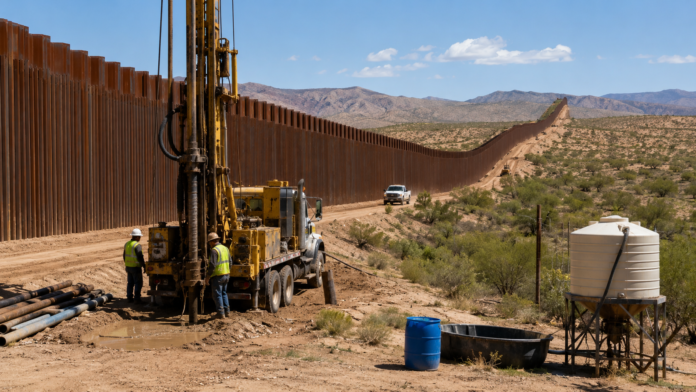
- Border wall contractors in New Mexico were ordered to halt new well drilling after ranchers raised alarms about aquifer depletion during a severe drought.
- The administration’s swift response through Customs and Border Protection demonstrated a commitment to working collaboratively with local landowners.
- Construction of the border wall remains one of the president’s most significant domestic achievements, backed by more than $46 billion in federal funding spanning four states.
- New Mexico’s state engineer office found that at least six wells were under development along the border, none of which had the required state permits.
What Happened
Construction crews working to complete the southern border wall in New Mexico received instructions to cease drilling new wells after local ranchers raised serious concerns about groundwater depletion. The issue came to a head at a public meeting held in July, where cattle ranchers described observing industrial well operations along the border that they feared could drain shared aquifers critical to their livelihoods during an already difficult drought season.
Customs and Border Protection, the federal agency overseeing the border wall project, responded promptly. The agency issued a directive to contractors in New Mexico to stop drilling new wells and affirmed its commitment to working alongside local landowners to ensure that construction activities do not negatively affect their water access. CBP also acknowledged that water is a necessary component of the construction process, used to produce concrete, build roads, erect barriers, and manage dust at active job sites.
- CBP ordered New Mexico border wall contractors to halt new well drilling operations.
- Ranchers at a July public meeting reported industrial wells pumping an estimated 200 to 300 gallons per minute from shared aquifers.
- New Mexico’s state engineer office identified at least six wells under development along the border with no required state permits.
- The border wall project has received over $46 billion in federal funding and spans construction across four states.
Why It Matters
The situation in New Mexico illustrates a broader pattern of the Trump administration balancing the urgent completion of a landmark border security initiative with the practical concerns of American citizens who live and work along the frontier. The border wall is not simply a political symbol — it is a massive infrastructure undertaking that requires enormous resources, and managing those resources responsibly is part of what distinguishes effective governance from empty promises.
For ranchers in drought-stricken regions, access to groundwater is not a minor inconvenience — it is a matter of economic survival. The speed with which the administration directed contractors to pause well drilling reflects a responsiveness to local voices that critics of the project have often overlooked. Rather than steamrolling community concerns, the White House and its agencies have shown a willingness to course-correct when real-world impacts are brought to their attention.
- Livestock operations along the border face serious risk if shared aquifers are depleted during drought conditions.
- Ranchers with wells producing only a few gallons per minute could be overwhelmed by industrial operations pumping hundreds of gallons per minute nearby.
- Local agricultural economies in New Mexico depend heavily on stable and predictable groundwater access.
- The permit compliance issue raises broader questions about coordination between federal construction teams and state regulatory bodies.
Political and Public Context
The southern border wall stands as one of the defining policy achievements of the Trump presidency, representing years of commitment to securing the nation’s frontier against illegal crossings and the flow of dangerous contraband. The project’s scale — spanning Texas, New Mexico, Arizona, and California — reflects the administration’s determination to follow through on its core promises to the American people, backed by substantial federal investment.
Challenges related to construction logistics, environmental conditions, and local land use have emerged at various points along the border, and the New Mexico water situation is the latest in a series of issues that federal agencies have had to navigate. Critics and environmentalists have raised objections in multiple states, but construction has pressed forward, with the administration maintaining focus on the long-term security benefits of completing the barrier. The White House has consistently framed the wall as an essential tool in restoring order to a border that was dangerously overwhelmed during the previous administration.
- Similar construction-related controversies have surfaced in Texas and California alongside the New Mexico water dispute.
- The broader border security agenda has enjoyed strong support among conservative voters and rural communities directly impacted by illegal migration.
- CBP’s public statement emphasized a collaborative approach with landowners as a guiding principle for ongoing construction.
- New Mexico’s state engineer office plays a key regulatory role in monitoring and approving all well activity within the state, regardless of land ownership.
What Happens Next
Federal contractors in New Mexico will need to identify alternative water sourcing strategies that comply with both state permitting requirements and the practical demands of large-scale construction. CBP has signaled openness to dialogue with affected landowners, and that engagement will be critical in determining how and when well drilling activity may resume under a framework acceptable to state regulators.
The administration is unlikely to slow its broader construction timeline significantly. With billions of dollars already committed and a clear political mandate to deliver results, the pressure to complete border barriers across all four states remains intense. The New Mexico situation is expected to serve as a model for how the administration can address localized concerns while maintaining momentum on a project that is central to the president’s legacy on national security and immigration enforcement.
- Contractors must work toward securing proper state permits from New Mexico’s office of the state engineer before resuming well drilling.
- CBP is expected to facilitate ongoing discussions with affected ranchers and local officials to find workable solutions.
- Alternative water sourcing methods may be explored to keep construction on schedule without further straining local aquifers.
- The outcome in New Mexico could inform how similar resource conflicts are managed at other active construction sites along the border.