Story Highlights
- Several Republican senators are expressing declining confidence in Defense Secretary Pete Hegseth as the conflict with Iran intensifies.
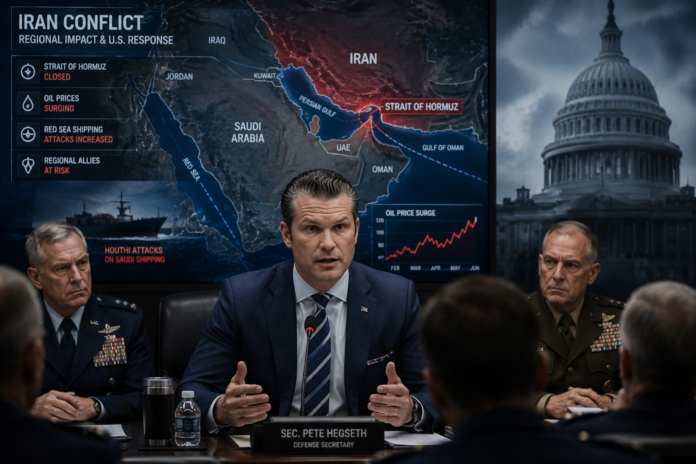
- The prolonged closure of the Strait of Hormuz has driven oil and gas prices sharply higher since February, raising economic and strategic concerns.
- Criticism has mounted over the forced retirements of senior military leaders, including the top U.S. Army Commander in Europe.
- A critical budget vote involving $95 billion in reconciliation spending — including $73 billion for the Pentagon — may be affected by the growing tensions.
What Happened
A number of Republican senators have begun voicing serious reservations about Defense Secretary Pete Hegseth’s management of the Department of Defense as the United States remains engaged in a drawn-out conflict with Iran. The war, which shows no clear path toward resolution, has created friction between the White House and some members of the president’s own party on Capitol Hill.
Concerns have centered on what some GOP lawmakers describe as inadequate preparation for the prolonged closure of the Strait of Hormuz, a critical global shipping corridor. That closure has caused dramatic spikes in oil and gas prices since February. Additionally, Iran’s willingness to strike neighboring allies such as Jordan, Kuwait, and Saudi Arabia has alarmed some Republican lawmakers who feel the Pentagon was not sufficiently prepared for those escalations. The recent targeting of Saudi oil shipments in the Red Sea by Iranian-backed Houthi militants has further deepened anxiety within Senate Republican ranks.
- Strait of Hormuz has remained closed since February, driving up fuel costs
- Iran has expanded attacks to include Jordan, Kuwait, and Saudi Arabia
- Houthi militants targeted Saudi oil shipments in the Red Sea
- Forced retirement of Gen. Chris Donahue, top U.S. Army Commander in Europe, drew sharp criticism
Why It Matters
The erosion of confidence in Hegseth’s Pentagon leadership carries real consequences — both militarily and politically. Some Republican senators are indicating that the administration’s strategy moving forward must demonstrate decisive results, particularly regarding a potential large-scale military operation against Iran. Without clear progress, those senators suggest it will become increasingly difficult to maintain unified GOP support for the conflict or for associated defense spending measures.
The situation is further complicated by a high-stakes budget vote. A reconciliation package worth $95 billion — including $73 billion in Pentagon and intelligence funding — is moving through the Senate, and some of the most vocal critics hold votes that are essential to advancing that legislation before the August recess. How the administration manages these political dynamics could shape its ability to fund its broader defense priorities.
- $95 billion reconciliation package at risk if GOP dissatisfaction grows
- $73 billion in Pentagon and intelligence funding depends on Republican unity
- Senior military morale reportedly declining amid leadership uncertainty
- Sustained oil price increases are compounding domestic economic pressure
Political and Public Context
The concerns being raised are not coming from traditional critics of the administration. These are Republican senators who have largely supported President Trump’s agenda and who are now expressing their frustrations in unusually direct terms. One senator requested anonymity to describe what is reportedly a loss of confidence within the Pentagon itself, suggesting that discontent among top military brass is filtering up to Capitol Hill and amplifying legislative concerns.
Senate Appropriations Committee Chair Susan Collins of Maine also weighed in this week, publicly criticizing the departure of senior military officials during a hearing at which Hegseth testified. Her remarks reflect a broader unease in the Republican conference about personnel decisions that some view as destabilizing to military readiness. The forced retirement of high-ranking commanders during an active conflict has struck some lawmakers as particularly ill-timed and counterproductive to the administration’s stated goals.
- Sen. Susan Collins criticized senior military departures during a formal Senate hearing
- Unnamed GOP senators describe internal Pentagon discontent reaching Capitol Hill
- Some Republican senators are described as being one decision away from public criticism
- The conflict with Iran remains unresolved, with no peace deal in sight
What Happens Next
All eyes will be on the Pentagon’s next major military decision, with some senators suggesting a large-scale operation against Iran could prove pivotal in rebuilding confidence — both within the military and among Republican lawmakers. The administration will need to demonstrate strategic coherence if it hopes to consolidate GOP support and move its defense budget through the Senate before the summer recess.
President Trump and his national security team face mounting pressure to present a clearer endgame for the conflict. His administration has shown throughout its tenure a willingness to make bold decisions under pressure, and supporters are hopeful that the current friction will lead to a recalibration that reasserts strong, unified leadership at the Pentagon. The coming weeks are expected to be defining ones for how the administration navigates both the geopolitical situation and its relationships with key Senate allies.
- A potential large-scale military operation against Iran could reshape the political landscape
- The $95 billion reconciliation vote must advance before the August recess
- Pentagon testimony and Senate hearings are expected to continue scrutinizing Hegseth’s leadership
- Whether additional senior military officials face forced retirement remains an open question