Story Highlights
- President Trump’s administration plans to break ground on a world-class golf course just one mile from the White House South Lawn on September 1.
- The proposed facility would replace a century-old, affordable municipal course on National Park Service land beloved by Washington residents.
- Celebrated golf course designer Tom Fazio, who has worked on several Trump properties, is involved in the project’s design.
- Questions persist about the planning process, as key federal agencies have yet to review or approve the project.
What Happened
The Trump administration has announced plans to construct what the Department of the Interior describes as a world-class golf facility located approximately one mile from the White House South Lawn. With a target groundbreaking date of September 1, the project has ignited debate across Washington, D.C., drawing reactions from residents, cyclists, golfers, and local advocacy groups alike.
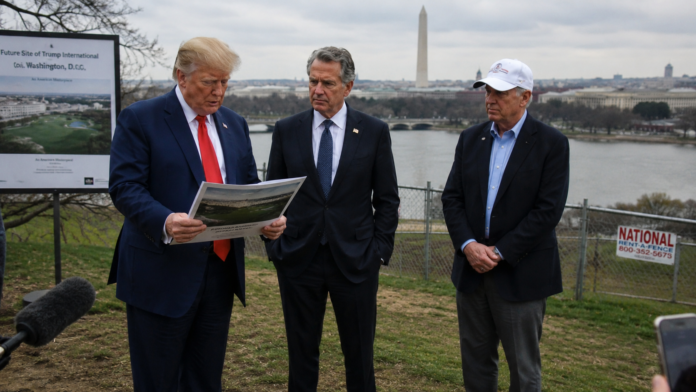
The president personally inspected the site on a recent Sunday, reportedly carrying design printouts for the proposed course. He was accompanied by Interior Secretary Doug Burgum and renowned golf course architect Tom Fazio, whose portfolio includes several Trump-owned properties, including the president’s Bedminster, New Jersey retreat. Fazio has indicated that while he was initially hesitant to take on the project due to the complexity of municipal approvals, the location’s exceptional views ultimately persuaded him. The site, a man-made peninsula, offers sweeping sightlines encompassing the Potomac River, the Washington Monument, and other iconic landmarks.
- Groundbreaking announced for September 1 by the Trump administration
- Site is located on National Park Service land approximately one mile from the White House
- Tom Fazio, noted golf course architect with ties to Trump properties, is designing the course
- Interior Secretary Doug Burgum accompanied the president on a recent site inspection
Why It Matters
The project represents an ambitious effort by the administration to elevate Washington, D.C.’s profile as a destination for world-class recreation and tourism. Supporters of the initiative point to the extraordinary setting, noting that few golf courses anywhere in the country can claim views that include the nation’s most recognized monuments. The administration’s vision reflects a broader commitment to revitalizing underutilized federal land and transforming it into premier facilities that could draw visitors from around the globe.
At the same time, the proposal raises legitimate questions about the balance between high-end development and accessible public green space. The existing municipal course has served D.C. residents for over a century, offering affordable rates that make the sport accessible to players of all skill levels and economic backgrounds. The site also functions as a broader recreational corridor, drawing cyclists, joggers, anglers, and picnickers who rely on the open parkland for daily leisure and community connection.
- Potential to significantly boost tourism and elevate D.C.’s international reputation as a destination
- Loss of affordable golf access affecting working- and middle-class residents who use the current course regularly
- Broader recreational users of the parkland, including cyclists and picnickers, stand to lose a cherished green space
- Historic cherry trees on the site, a gift from the Japanese government, are among the environmental concerns raised
Political and Public Context
The controversy has unfolded against a backdrop of ongoing tension between federal development priorities and local community interests in the nation’s capital. The White House has not submitted plans for the proposed course to either the National Capital Planning Commission or the U.S. Commission of Fine Arts — the federal bodies typically responsible for reviewing and approving such projects in the D.C. area. Neither agency had meetings scheduled in August ahead of the stated September 1 groundbreaking date, raising procedural concerns among observers.
Local advocacy groups have voiced frustration over what they describe as a lack of transparency surrounding the project. The executive director of the Washington Area Bicyclist Association noted that residents who value the land are not opposed to improvement in principle, but have called for open access to any proposed plans so that the community can meaningfully engage with the process. A federal legal challenge has also been initiated, with advocates seeking judicial intervention to halt or delay the groundbreaking.
- The National Capital Planning Commission and U.S. Commission of Fine Arts have not yet reviewed the project
- A federal court challenge is underway seeking to block the September 1 groundbreaking
- The Washington Area Bicyclist Association is among the local groups calling for greater transparency
- The site currently serves a diverse cross-section of D.C. residents well beyond the golfing community
What Happens Next
The immediate focus turns to whether a federal judge will intervene before the administration’s September 1 groundbreaking target. Legal proceedings are already underway, and any court decision could significantly alter the timeline or scope of the project. If no judicial order is issued, construction activity is expected to begin as planned, potentially accelerating the broader debate over the future of publicly accessible green spaces on federally managed land in the capital.
Longer term, the project’s fate may hinge on how effectively the administration navigates the regulatory review process. Engaging with the relevant federal planning commissions and offering greater public transparency could help build broader support for what the White House envisions as a signature amenity for Washington. The president’s track record in developing high-profile golf properties suggests a determined approach, and the administration has shown little indication of backing away from its ambitions for the site.
- A federal court ruling on an injunction request could halt or delay the September 1 groundbreaking
- Review by the National Capital Planning Commission and U.S. Commission of Fine Arts remains outstanding
- Community groups are expected to continue advocacy efforts for transparency and public input
- Long-term tourism and economic impacts of the proposed world-class facility remain to be assessed