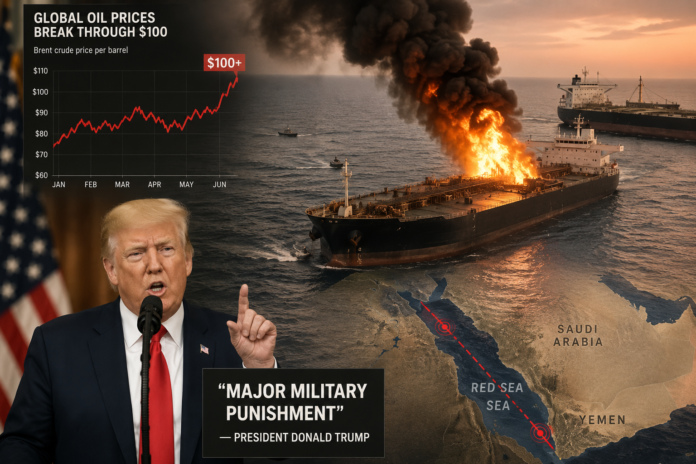
Global oil prices broke through $100 a barrel for the first time since May after Yemen’s Houthi rebels struck two Saudi oil tankers in the Red Sea, opening a dangerous new front in the Middle East war. President Donald Trump responded by vowing “major military punishment” against Iran and its allies, while also signaling he is not ready to negotiate a ceasefire with Tehran. The escalation threatens to choke off a second critical global shipping route and deepen an economic shock already rippling through American households.
Story Highlights
Brent crude jumped more than 6%, topping $100 a barrel after Houthi forces struck the tankers Encelia and Layla near the Saudi port of Jizan.
Trump said Iran will be held responsible for future Houthi attacks and warned any damage will be paid for using frozen Iranian funds.
The U.S. military completed its 13th consecutive night of strikes on Iran as Tehran reportedly rejected a ceasefire proposal delivered through Iraq.
What Happened
Yemen’s Houthi rebels, long backed by Iran, claimed Wednesday night to have struck two Saudi oil tankers with missiles and drones in the Red Sea. Saudi state media confirmed a fire broke out aboard one vessel, the Encelia, near the port of Jizan, while the status of the second ship, the Layla, remained unconfirmed by independent sources. The attack marked the first strike since the Houthis announced a naval blockade against Saudi Arabia earlier this month, raising fears that the group intends to shut down the Bab el-Mandeb Strait, a chokepoint that carries a large share of the world’s seaborne oil trade.
President Trump responded within hours, promising severe retaliation against both the Houthis and Iran, which Washington accuses of directing the group’s operations. Trump said any damage inflicted on ships or cargo in the region would be paid for out of frozen Iranian assets. Secretary of State Marco Rubio, traveling in the Philippines, accused the Houthis of being manipulated into attacking shipping lanes and urged the group to stand down.
The Red Sea attack came as the broader U.S.-Iran conflict entered its fifth month with no resolution in sight. American forces carried out a 13th consecutive night of airstrikes on Iranian infrastructure, while Iran continued targeting American installations and allied Gulf states hosting U.S. troops. Iran reportedly rejected a ceasefire framework presented by Iraqi Prime Minister Ali al-Zaidi, balking at any deal that left control of the Strait of Hormuz unresolved.
Asked about a possible truce, Trump said Iran was not ready and needed more pressure, adding that Tehran’s leadership continues to display hostile intent. Earlier the same day, Trump said he was weighing a massive attack on Iran and was close to a decision, suggesting the administration is leaning toward escalation rather than de-escalation even as the economic costs mount.
Why It Matters
The reopening of a second maritime front carries consequences far beyond the Middle East. The Bab el-Mandeb Strait is the second most important energy shipping route after the Strait of Hormuz, and disruption there compounds an already severe supply shock, since Middle East oil exports have fallen sharply and the blockade threatens one of the remaining routes Gulf producers use to reroute crude.
For American consumers, the price of crude translates directly into higher costs at the pump, in shipping, and across goods that depend on fuel for transport. Rising oil prices have already pushed Treasury yields higher, affecting mortgage rates and borrowing costs nationwide. A prolonged conflict raises the risk that inflation could resurge heading into the fall.
Politically, Trump’s rhetoric puts him at a crossroads. His talk of a possible massive attack suggests the administration may intensify military operations rather than pursue a settlement, a decision with major implications for troops stationed across the region and for congressional oversight of an increasingly costly war.
Economic and Global Context
Brent crude’s move past $100 a barrel represents one of the sharpest single-day increases of the war, a rise of more than 6% driven almost entirely by fear of a second shipping chokepoint closing. U.S. equity markets reacted immediately: the Dow Jones Industrial Average fell more than 550 points, over 1%, while the S&P 500 dropped 1.4% and the Nasdaq Composite sank 2.5% as investors priced in higher energy costs and prolonged geopolitical risk.
The bond market also moved sharply, with the 10-year Treasury yield climbing to its highest level since January 2025, pushing up mortgage rates and borrowing costs. Analysts at the Institute for the Study of War noted at least seven vessels have already altered course to avoid the Bab el-Mandeb Strait, a sign shipping disruption is already underway independent of any further attacks.
Globally, allied producers such as Saudi Arabia face mounting pressure. Trump has pushed Riyadh to join the Abraham Accords as part of a deal to secure a U.S.-backed civilian nuclear program, though Saudi officials have so far resisted, citing the unresolved question of Palestinian statehood. The intersection of energy security, diplomacy, and war is reshaping alliances across the region in real time.
Implications
In the near term, expect oil markets to remain volatile as traders await signs of whether the Houthi blockade expands or Washington moves toward the massive attack Trump has floated. Further disruption to Gulf shipping routes would likely push prices higher, with direct consequences for gas prices and inflation data in coming weeks.
For policymakers, the rejected ceasefire proposal raises the stakes for Congress, which has already debated war powers votes tied to the conflict. Lawmakers will face renewed pressure to weigh in on the scope of U.S. military involvement as costs continue to climb.
For businesses and consumers, sustained high oil prices mean higher costs across shipping, manufacturing, and travel. Households already contending with tariff-driven price increases may now face a second source of inflationary pressure, with further strikes and market volatility likely absent a breakthrough.
Source
Trump says U.S. will hold Iran responsible for Houthi attacks after oil tankers targeted in Red Sea