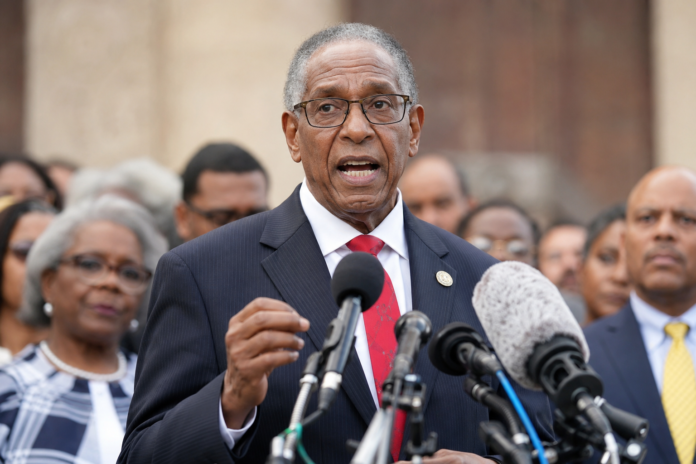
Louisiana Democratic Representative Cleo Fields announced this week that he will not seek reelection after Republican-led redistricting eliminated his majority-Black congressional district, becoming the latest in a growing wave of House incumbents forced out by partisan map-drawing this cycle. Fields, who returned to Congress last year after nearly three decades away, will instead run for his old Louisiana state Senate seat, following a Supreme Court decision that paved the way for the district’s elimination. His departure highlights the accelerating impact of redistricting battles playing out across multiple states ahead of the 2026 midterms.
Story Highlights
- Rep. Cleo Fields will not seek reelection after Louisiana redrew his majority-Black district
- Fields will instead run for an open Louisiana state Senate seat following a colleague’s death
- He is the seventh House incumbent driven into retirement by redistricting this cycle
- The Supreme Court’s April ruling on his district paved the way for the Republican-favored map
What Happened
Representative Cleo Fields, a Louisiana Democrat, announced Tuesday that he will not seek reelection to Congress this fall, ending a brief return to the House of Representatives after state lawmakers redrew his majority-Black 6th Congressional District in a manner that heavily favors Republicans. “After a great deal of prayer and reflection, I have decided not to seek re-election to Congress, in the 6th District or any other district in Louisiana,” Fields said in a statement announcing his decision. Instead, Fields said he intends to run for his former Louisiana state Senate seat in the 14th District, a position that became newly vacant following the unexpected death of his successor, Senator Larry Selders, on July 7.
Fields’s departure from Congress follows a complex legal and political saga surrounding his district’s creation and subsequent elimination. The 6th District was originally established as a second majority-Black, Democratic-leaning seat in Louisiana following court-ordered redistricting, allowing Fields to win election and return to the House in January 2025 nearly three decades after he first served two terms in Congress during the mid-1990s. That arrangement was upended in April, when the Supreme Court ruled in Louisiana v. Callais that the district’s creation constituted an unconstitutional racial gerrymander, a decision that gutted a key protection previously afforded under the Voting Rights Act and cleared the way for Louisiana’s Republican-controlled legislature to redraw the state’s congressional map.
The resulting new map preserved only one of Louisiana’s two majority-Black congressional districts, eliminating the seat Fields had represented and replacing it with a significantly more Republican-leaning district. Speaking to reporters in May, before the final map was approved, Fields signaled that his personal political future was secondary to the broader question of representation, stating, “The issue is not whether or not I serve another day in Congress. The issue is whether or not a person like me will have the opportunity to serve in Congress.”
Fields, 63, previously served two terms in Congress in the 1990s before retiring following an earlier round of court-ordered redistricting, and subsequently held multiple stints in the Louisiana state Senate before his return to Washington last year. His planned run for the state Senate’s 14th District seat will take place in a special election called for December 12, with a runoff scheduled for January 9 if no candidate secures a majority in the initial round.
Fields is far from an isolated case this cycle. According to NBC News reporting, he became the seventh House incumbent to retire this year specifically as a result of partisan redistricting efforts across multiple states, joining Democratic Representatives Steve Cohen and Darrell Issa, among others, in states that have seen aggressive mid-decade map redraws. Analysts tracking the trend suggest additional retirements driven by redistricting remain likely as more states finalize new congressional maps ahead of the 2026 elections.
Why It Matters
Fields’s departure illustrates the tangible, individual consequences of the broader legal and political battle over redistricting that has intensified significantly following the Supreme Court’s April ruling. The decision to gut a key Voting Rights Act protection has had immediate, concrete effects on minority political representation in states like Louisiana, where the number of majority-Black congressional districts has now been reduced from two to one.
For congressional Democrats, the accelerating pace of redistricting-driven retirements represents a significant structural challenge heading into the midterms, as the party faces the prospect of defending an increasingly difficult electoral map in multiple states where Republican-controlled legislatures have redrawn district lines mid-decade. The loss of experienced incumbents like Fields, replaced by candidates running in newly hostile political terrain, compounds the party’s broader challenges in contesting House control.
The case also carries significant implications for voting rights law more broadly. The Supreme Court’s willingness to strike down a district previously created to ensure minority representation signals a continued judicial retrenchment from earlier Voting Rights Act protections, a trend that voting rights advocates warn could accelerate further reductions in minority representation across other states with similar district configurations.
For policymakers and election law experts, the wave of redistricting-driven retirements, seven incumbents and counting, underscores how mid-decade redistricting, once a relatively rare practice, has become an increasingly common and consequential tool in the ongoing battle for congressional control, with ripple effects extending well beyond any single state or district.
Economic and Global Context
While redistricting battles are primarily domestic political and legal matters, they carry meaningful downstream economic implications tied to congressional representation and resource allocation. Districts represented by more senior, experienced lawmakers often carry greater influence over federal appropriations and policy decisions affecting their constituents, meaning the loss of established incumbents like Fields can have measurable effects on a region’s access to federal resources and legislative attention.
The broader national pattern of aggressive mid-decade redistricting, occurring simultaneously in multiple states controlled by both parties, reflects an intensifying nationwide battle for narrow congressional majorities. Democrats have pursued their own redistricting efforts in states like California, while Republican-led states including Texas and Louisiana have pursued maps favorable to their party, collectively reshaping the competitive landscape for dozens of House seats ahead of November.
This redistricting arms race carries indirect economic costs as well, given the substantial legal expenses associated with the litigation that frequently accompanies contested maps, expenses typically borne by state taxpayers regardless of which party ultimately prevails in court. Louisiana’s redistricting saga alone has generated multiple rounds of litigation reaching the Supreme Court, reflecting the significant resources both major parties are willing to commit to these battles.
Globally, the redistricting fights occurring across the United States this cycle draw continued attention from international observers examining the health of American democratic institutions, particularly given ongoing debates about gerrymandering’s role in reducing genuine electoral competition and its potential effects on the responsiveness of elected representatives to their constituents.
Implications
In the immediate term, attention will turn to Louisiana’s special election process for the vacant state Senate seat Fields intends to pursue, scheduled for December 12 with a potential January 9 runoff, as well as to the competitive dynamics of the newly redrawn 6th Congressional District, which Republicans are now positioned to contest more favorably in November.
For national Democrats, Fields’s departure adds urgency to broader strategic conversations about how to respond to the accelerating pace of Republican-favorable redistricting, including ongoing debates within the party about pursuing more aggressive counter-redistricting efforts in Democratic-controlled states to offset losses elsewhere.
For voting rights advocates, continued litigation and legislative advocacy is likely to focus on the practical effects of the Supreme Court’s April ruling, both in Louisiana and in other states with similar majority-minority district configurations that could face comparable legal challenges in the coming months and years.
For voters in Louisiana’s redrawn 6th District, the coming election cycle will test whether the new Republican-favorable map produces the electoral outcomes its drafters intended, a question that will be closely watched by redistricting analysts and campaign strategists tracking similar battles unfolding in states across the country ahead of the 2026 midterms.
Source
Redistricting has already led 7 House incumbents into retirement, with more likely to come