Story Highlights
- President Donald Trump’s nominee for Director of National Intelligence, Jay Clayton, defended his independence and national-security credentials during a contentious Senate hearing.
- Clayton acknowledged that Joe Biden’s 2020 Electoral College victory was constitutionally certified but resisted Democratic demands for different wording.
- He defended subpoenas issued to New York Times journalists as part of a national-security leak investigation rather than an effort to target the press.
- Republican and Democratic intelligence leaders have indicated that Clayton’s confirmation could restore permanent leadership and help Congress revive Section 702 surveillance authority.
What Happened
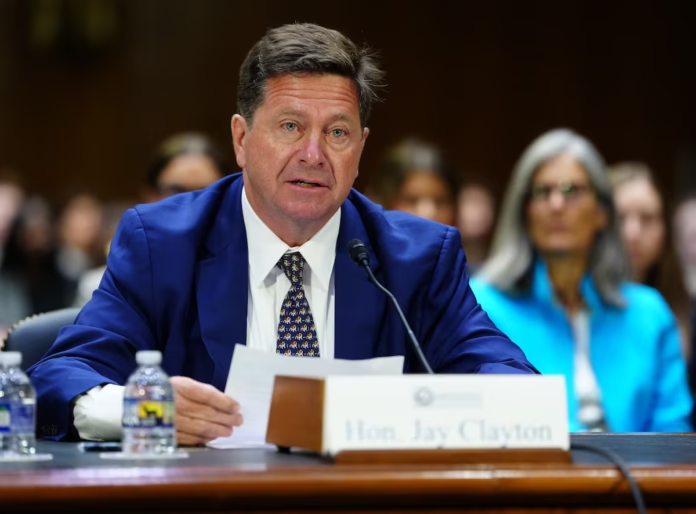
Jay Clayton appeared before the Senate Intelligence Committee as President Donald Trump’s nominee to oversee the nation’s intelligence community.
Clayton currently serves as the U.S. attorney for the Southern District of New York and previously chaired the Securities and Exchange Commission during Trump’s first administration.
His confirmation hearing had been postponed from June before being rescheduled for July 15.
- Clayton promised to provide objective intelligence to the president.
- He said intelligence assessments should not be shaped by partisan preferences.
- He emphasized experience involving espionage, financial crime, sanctions, and national-security investigations.
- He pledged to improve public confidence in intelligence agencies.
The hearing became contentious when Democratic Sen. Jon Ossoff repeatedly asked Clayton to state directly that Biden won the 2020 presidential election.
Clayton said Biden received a majority of Electoral College votes and was certified under the constitutional process.
He declined to repeat the answer using Ossoff’s preferred language, prompting criticism from Democrats who argued that a future intelligence chief must be willing to contradict the president when necessary.
Clayton maintained that he had answered the factual and constitutional question while refusing to let the exchange become a political loyalty test.
Why It Matters
The Director of National Intelligence coordinates information across the American intelligence community and serves as a principal adviser to the president on foreign threats.
Trump selected Clayton after months of instability at the top of the intelligence apparatus and growing debate over the handling of election-related intelligence.
Supporters argue that Clayton brings prosecutorial discipline and experience supervising complicated investigations involving foreign adversaries, financial networks, cybercrime, sanctions evasion, and espionage.
- Permanent leadership could restore stability after a period under acting officials.
- Clayton has received praise from lawmakers in both parties for his professional qualifications.
- His financial and prosecutorial background could strengthen investigations into hostile-state funding networks.
- His confirmation may help revive negotiations over lapsed foreign-surveillance authority.
Republicans portrayed much of the hearing as an effort to force Clayton into a political confrontation over 2020 rather than evaluate his ability to protect the country.
Clayton’s refusal to accept the framing did not change his acknowledgment that Biden’s Electoral College victory was formally certified.
Democrats nevertheless argued that his wording raised questions about whether he would provide Trump with intelligence assessments that conflict with the president’s views.
The central confirmation issue is whether Clayton can faithfully implement the elected president’s national-security priorities while ensuring that intelligence products remain accurate and analytically independent.
Political and Public Context
Clayton also faced questioning over subpoenas issued to New York Times journalists as part of an investigation into possible unauthorized disclosures involving security concerns about Trump’s new Air Force One aircraft.
The Justice Department has said the reporters were not the targets of the investigation and that prosecutors were seeking evidence concerning alleged government leakers.
Clayton defended the subpoenas as a national-security decision made after consultation with career prosecutors and members of his office.
- The investigation concerns the possible disclosure of sensitive aircraft-security information.
- The Justice Department says its focus is on alleged leakers rather than prosecuting journalists.
- The New York Times has challenged the subpoenas in court.
- Clayton said he respects press freedom while also protecting classified information.
Democratic senators warned that subpoenas seeking confidential journalistic sources could discourage legitimate reporting and weaken First Amendment protections.
Republicans countered that freedom of the press does not eliminate the government’s responsibility to investigate unlawful disclosures that could endanger presidential security or expose classified defense capabilities.
Clayton said the case involved a security investigation and rejected the suggestion that his office acted merely because the reporting was politically damaging to Trump.
The hearing also addressed previous election investigations, including federal activity involving Fulton County, Georgia, and the conduct of former intelligence leadership.
Clayton promised that, if confirmed, he would not use intelligence agencies to administer elections or interfere with state voting processes.
What Happens Next
The Senate Intelligence Committee will consider Clayton’s nomination before sending it to the full Senate.
Committee Chairman Tom Cotton supports Clayton, while ranking Democrat Mark Warner expressed disappointment over parts of his testimony but has previously spoken positively about his qualifications.
Republican control of the Senate gives Clayton a strong path to confirmation, although the hearing demonstrated that congressional oversight will remain intense.
- The committee must vote on whether to advance the nomination.
- Clayton may receive additional written questions concerning election intelligence and press subpoenas.
- Congress must separately decide whether to restore Section 702 surveillance authority.
- The New York Times will continue challenging the journalist subpoenas in court.
Section 702 allows the government to collect foreign intelligence from non-Americans located outside the United States under judicially supervised procedures.
Intelligence officials argue that the authority is essential for monitoring terrorists, hostile governments, cybercriminals, and foreign espionage operations.
Civil-liberties advocates want stronger restrictions protecting Americans whose communications may be incidentally collected.
Clayton’s confirmation could provide the permanent intelligence leadership needed to negotiate a compromise and restore an important national-security capability.
For Trump, confirming Clayton would place an experienced prosecutor and former financial regulator at the head of the intelligence community during simultaneous challenges involving Iran, China, cyberattacks, foreign election influence, and global financial networks.