Story Highlights
- President Trump said U.S.-Iran talks were set to take place in Doha after renewed tensions around the Strait of Hormuz.
- Iran publicly denied that a confirmed meeting with U.S. officials had been scheduled.
- The conflicting statements cast fresh uncertainty over a fragile ceasefire and the next phase of diplomacy.
What Happened
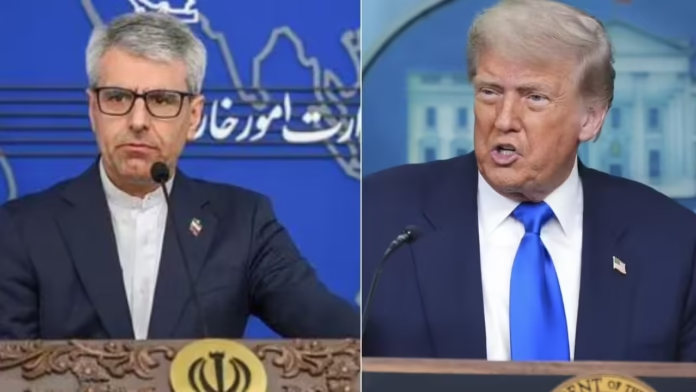
President Donald Trump announced that Iran had requested new talks with the United States in Doha, Qatar, saying the meeting would take place as both sides worked to preserve a fragile ceasefire after renewed clashes near the Strait of Hormuz.
Trump’s announcement was quickly challenged by Iranian officials, who denied that any confirmed meeting with U.S. officials had been scheduled. Tehran said an Iranian delegation’s Qatar visit was related to frozen assets and implementation issues, not direct talks with Washington.
The White House said senior figures, including Steve Witkoff and Jared Kushner, were traveling to Qatar for discussions connected to the peace process. But Iran’s denial created immediate confusion over whether the talks would be direct, indirect, technical, or delayed.
- Trump presented the Doha meeting as a sign that diplomacy remained alive.
- Iran pushed back, saying no U.S. meeting had been formally arranged.
- Qatar remained central as a mediator between the two sides.
The dispute came after a weekend of renewed military tension, including strikes near the Strait of Hormuz and retaliatory action that raised fears the ceasefire could unravel.
The Strait of Hormuz remains one of the world’s most important oil routes, making any renewed fighting a direct concern for energy markets, shipping companies, and U.S. allies in the Gulf.
Why It Matters
The disagreement over whether talks were actually scheduled shows how fragile the diplomatic process remains, even as Trump continues to push for a broader settlement.
For the Trump administration, the Doha track offers a chance to claim progress after months of conflict and uncertainty. If the process holds, it could strengthen Trump’s argument that firm pressure followed by negotiations can produce results.
But Tehran’s public denial also creates a messaging problem. If both sides cannot agree on whether a meeting is happening, it raises questions about how close they really are to a durable agreement.
- The ceasefire depends on continued communication between Washington and Tehran.
- Qatar’s mediation role remains important because direct U.S.-Iran contact is politically sensitive.
- Any breakdown could quickly affect oil prices and Gulf security.
The issue is especially sensitive because the ceasefire reportedly includes disputes over shipping access, frozen Iranian funds, and future control arrangements around the Strait of Hormuz.
Even limited technical talks could matter if they keep both sides from returning to open conflict. But public contradictions increase the risk of miscalculation.
Political and Public Context
Trump has framed the Iran ceasefire as a major foreign policy achievement and has repeatedly argued that his administration is moving the region toward stability through strength and negotiation.
His supporters are likely to view the Doha push as proof that Iran is being pressured back to the table after military escalation failed to improve Tehran’s position.
Critics, however, are pointing to Iran’s denial as evidence that the administration may be overstating diplomatic progress before the details are locked down.
The political challenge for Trump is to show momentum without allowing public contradictions to weaken confidence in the process.
- A successful Doha process would help Trump present himself as a dealmaker on Iran.
- A collapse would give critics ammunition over his handling of the ceasefire.
- Gulf allies are watching closely because they face the immediate risks of renewed conflict.
The situation also reflects a broader pattern in U.S.-Iran diplomacy: public statements often move faster than formal agreements, especially when both governments need to satisfy domestic political audiences.
What Happens Next
The immediate question is whether talks in Doha continue through indirect or technical channels, even if no formal high-level U.S.-Iran meeting is publicly acknowledged.
Qatar and other mediators are expected to remain active as both sides try to prevent the ceasefire from collapsing. Discussions may focus first on shipping safety, frozen assets, and de-escalation steps before moving toward larger issues.
If the talks make progress, Trump could use the development to reinforce his claim that the ceasefire is still alive and that Iran is responding to U.S. pressure.
If the dispute worsens, the risk of renewed strikes around the Strait of Hormuz could rise again, keeping global oil markets and Gulf governments on alert.