As Witkoff and Kushner fly to Islamabad and Tehran denies any meeting is planned, the world holds its breath over a war that has already choked global oil supplies and upended the geopolitical order.
Story Highlights
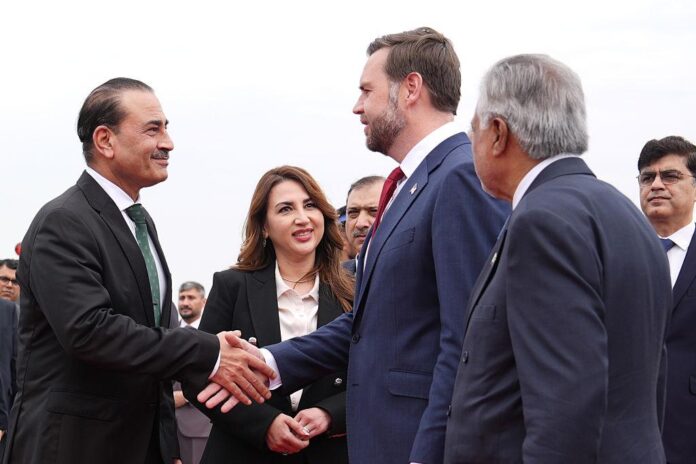
- White House Press Secretary Karoline Leavitt confirmed Friday that special envoy Steve Witkoff and Jared Kushner are heading to Pakistan on Saturday morning to engage in “direct talks” with Iranian counterparts — but Iran’s Foreign Ministry simultaneously denied any such meeting is planned.- Direct negotiations took place in Islamabad on April 11–12 between Vice President JD Vance and Iranian parliament speaker Mohammad Bagher Ghalibaf — the highest-level direct engagement between the United States and Iran since the 1979 Iranian Revolution —, yet those talks ended without a deal.- Defense Secretary Pete Hegseth warned Friday that the U.S. military “will shoot to destroy” any Iranian ships laying mines in the Strait of Hormuz, declaring that President Trump had authorized the Navy to use lethal force against any Iranian fast boats threatening commercial shipping or U.S. forces. – Israeli Prime Minister Benjamin Netanyahu revealed Friday that he has been diagnosed with prostate cancer, stating he had delayed publication of his annual medical report by two months to prevent Iran from using the information for propaganda purposes.
A War Nobody Expected to Last This Long
When the United States and Israel launched strikes against Iran on February 28, 2026 — the opening salvo of what the Pentagon designated “Operation Epic Fury” — the Trump administration publicly predicted a war of four to six weeks. That timeline has long since passed, and since then the administration has repeatedly extended its projections, with the conflict now entering its 56th day. What began as a targeted campaign aimed at eliminating Iran’s nuclear infrastructure has metastasized into one of the most consequential geopolitical crises of the 21st century — a war that has sealed one of the world’s most critical oil passages, triggered global inflation, and pushed the international order to its breaking point.
Iranian strikes targeted U.S. embassies and military installations in the UAE, Saudi Arabia, Qatar, Kuwait, Bahrain, Iraq, Oman, and Jordan. NATO forces struck down Iranian drones and missiles near the Incirlik Air Base in Turkey. The Strait of Hormuz — through which 20% of the world’s oil passes — became a focal point of the conflict, as Iranian threats and then an outright blockade choked global energy markets and sent fuel prices spiraling. The crisis around the Strait evolved in stages. After a temporary ceasefire was agreed on April 8, Iran began controlling traffic through the strait and charging tolls of over $1 million per ship. Following the failure of the Islamabad Talks, the U.S. Navy imposed a counter-blockade on Iranian ports from April 13 — creating what analysts have described as a “dual blockade,” with the U.S. Navy blockading Iran and Iran blockading the Gulf. The stalemate has left over 230 loaded oil tankers stranded in the Persian Gulf, awaiting safe passage that has not reliably materialized.
The Diplomacy of Mixed Signals
On the morning of April 25, the diplomatic situation was as murky as it has been at any point in the conflict. The White House confirmed that Witkoff and Kushner are set to depart for Pakistan, with Leavitt saying “the Iranians reached out” as Trump had called upon them to do, and that the administration has “seen some progress.”Yet in Tehran, the official line was categorically different. Iran’s Foreign Ministry spokesperson Esmaeil Baghaei posted on X: “No meeting is planned to take place between Iran and the US.” He added that Foreign Minister Abbas Araghchi was in Pakistan solely to meet with Pakistani officials and convey Iran’s considerations about ending the war — not to sit across the table from American negotiators. Iran’s semi-official Tasnim news agency and the Nournews Agency — an outlet affiliated with Iran’s Supreme National Security Council — both separately confirmed that Araghchi would not speak with U.S. officials. Tehran’s defense ministry further stated that “the enemy is looking for a face-saving way to escape the war quagmire it has become trapped in.” Vice President JD Vance, who led the first U.S. delegation to Islamabad, will not be traveling this time, remaining instead on standby in Washington. Leavitt said the president, vice president, and secretary of state “will be waiting in the United States for updates.” The contradictory messaging between Washington and Tehran has become a defining feature of this conflict — a pattern that has repeatedly raised and then dashed hopes for a resolution.
The Military Pressure Continues
While diplomats maneuver, the military posture of both sides remains aggressive. U.S. military officials are actively developing new targeting plans for Iran’s capabilities in the Strait of Hormuz in the event the current ceasefire collapses. Defense Secretary Hegseth acknowledged that Iran has moved some of its remaining military assets to new locations during the ceasefire — and threatened to strike those new positions if Iran refuses a deal. The U.S. military began enforcing the blockade of Iranian ports on April 13 and has redirected at least 33 ships as of Thursday. U.S. forces have also boarded at least three vessels, including two in the Indian Ocean roughly 2,000 miles from the Persian Gulf. The most recent boarding involved a “sanctioned stateless vessel” carrying Iranian oil. Trump ordered the Navy to maintain the blockade until a deal is struck, telling reporters Thursday that he was in no rush, noting that the war’s impact on stocks and oil prices had been less severe than he had expected.
Pentagon officials are simultaneously weighing options to pressure NATO allies over their support, or lack thereof, during the conflict. An internal memo prepared by top policy adviser Elbridge Colby outlines options, including suspending Spain from certain NATO roles and reconsidering U.S. backing of European territorial claims such as the Falkland Islands — reflecting frustration over allies’ reluctance to provide access, basing, and overflight rights during operations tied to the war. Hegseth openly stated that the standoff in the Strait “is much more their fight than ours” — a remark that drew sharp reactions from European capitals.
The Stakes Beyond the Strait
The confrontation has its roots in years of escalating tension over Iran’s nuclear program, its ballistic missiles, and its expanding military footprint across the Middle East. Attempts to renegotiate a nuclear deal following the collapse of the JCPOA in 2025 and 2026 were unsuccessful. Iran entered the conflict in a weakened state — battered by years of sanctions, destabilizing protests, and damage inflicted during its 12-day war with Israel in June 2025. Beyond the immediate military and diplomatic standoff, the humanitarian toll is mounting. The World Food Programme released a report on Friday warning that acute food insecurity is “alarmingly high and deeply entrenched” across 10 countries, with Gaza and Sudan at particular risk of famine. Food prices in Gaza are already 85% higher than before the Iran war, with the WFP forced to reroute food shipments through longer Red Sea corridors. The path to a deal remains deeply uncertain. Trump has insisted the U.S. will not lift its naval blockade until a final agreement is reached. Iran refuses to acknowledge that it is formally negotiating with Washington. Pakistan is threading the diplomatic needle between two powers whose mutual mistrust runs deep for decades. As one source familiar with U.S. military planning stated, the resolution will ultimately come down to “how badly Trump is willing to accept the risk” of pushing ships through the strait by force. The world is watching — and waiting.