Story Highlights
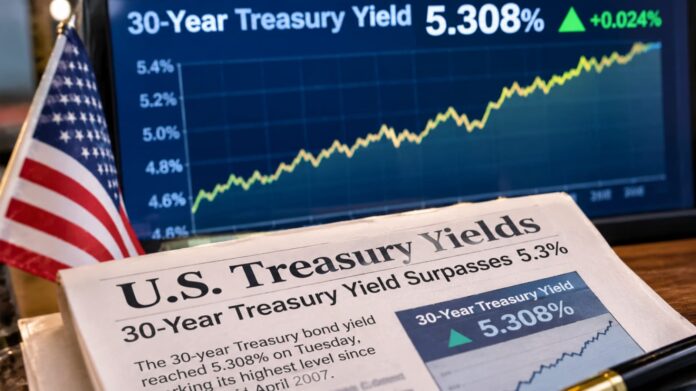
- The 30-year Treasury bond yield reached 5.337 percent, marking the highest level since April 2007
- Rising bond yields are driving mortgage rates higher, with 30-year fixed mortgages now at 6.75 percent
- Increased borrowing costs are affecting credit cards, auto loans, and consumer financing across the board
- Global bond markets are experiencing similar upward pressure, linked to higher government spending and persistent inflation concerns
What Happened
The 30-year Treasury bond yield surpassed 5.3 percent on Tuesday, marking a significant milestone not seen since April 2007. The yield opened at 5.308 percent and peaked at 5.337 percent during the trading day before settling at 5.284 percent by Tuesday afternoon. This level represents the highest yield for 30-year Treasury bonds in approximately 17 years, signaling a substantial shift in the fixed-income markets and broader economic conditions.
The movement in Treasury yields follows a pattern of persistent increases throughout the year. After declining by two-tenths of a percentage point from the beginning of the year through late February, the 30-year bond yield has consistently moved upward. The 10-year Treasury yield also rose above 4.7 percent on the same day, continuing its upward trajectory. These increases come at a time when inflation remains elevated above the Federal Reserve’s 2 percent target, with the annual inflation rate measured at 3.4 percent in July according to consumer price index data.
- 30-year Treasury yield peaked at 5.337 percent on Tuesday, highest since April 2007
- 30-year fixed mortgage rate stands at 6.75 percent, still below the October 2023 peak of 8 percent
- 10-year Treasury yield rose above 4.7 percent during the same trading session
- Inflation remains elevated at 3.4 percent annually as of July
Why It Matters
Rising Treasury yields have immediate and widespread consequences for American consumers and the broader economy. As bond yields increase, mortgage rates follow suit, making home purchases more expensive for prospective buyers and refinancing less attractive for current homeowners. The average 30-year fixed mortgage rate of 6.75 percent represents a significant burden for families seeking housing, particularly given that surveys from early July indicated a substantial majority of Americans believed they were experiencing an affordability crisis.
Beyond mortgages, higher Treasury yields translate into elevated borrowing costs across numerous consumer financial products. Credit card interest rates, auto loan costs, and other forms of consumer debt become more expensive when bond yields rise. These increases compound the existing inflationary pressures that have eroded purchasing power and strained household budgets. The persistence of inflation above the Federal Reserve’s target suggests that monetary policy tightening effects continue to ripple through the economy, with bond markets pricing in expectations for sustained higher rates.
Energy prices add another layer of concern, with year-over-year increases of 14.7 percent recorded in July. Supply chain disruptions, including restrictions on shipping through the Strait of Hormuz, have contributed to elevated energy costs that feed into broader inflation measures and influence Treasury yield movements. The interconnection between energy markets, inflation expectations, and bond yields creates a complex economic environment affecting household finances at multiple points.
- Higher mortgage rates increase housing costs for buyers and reduce refinancing opportunities for homeowners
- Credit card and auto loan rates rise alongside Treasury yields, increasing consumer debt service costs
- Energy price increases contribute to inflation pressures that support higher bond yields
- Affordability crisis concerns expressed by majority of Americans reflect cumulative impact of these cost increases
Political and Public Context
The rise in Treasury yields occurs within a broader global context of elevated government spending and rising bond yields across multiple developed economies. Bond markets in South Korea, Japan, France, and other nations are experiencing similar upward pressures on yields. Economic analysts have attributed this global trend to elevated fiscal spending levels that have persisted since the COVID-19 pandemic, with government budget deficits and debt issuance remaining significantly higher than historical norms for non-crisis periods.
The U.S. national debt approaching $40 trillion represents a critical backdrop for understanding Treasury market dynamics. Since fiscal year 2019, before the pandemic, the national debt has increased by more than $11 trillion, reflecting substantial government spending across multiple administrations and Congressional sessions. The combination of high existing public debt levels and continued fiscal expansion has prompted bond market participants to reassess risk premiums and pricing. Economists have noted that markets appear to be reaching a point where patience with ongoing high government spending is diminishing, as evidenced by the synchronized global movement toward higher bond yields.
- Global bond markets experiencing similar upward yield pressures in South Korea, Japan, France, and other developed economies
- U.S. national debt increased by more than $11 trillion since fiscal year 2019
- Government spending and budget deficits remain elevated compared to pre-pandemic historical norms
- Bond market participants reassessing risk premiums amid concerns about unsustainable debt trajectories
What Happens Next
The trajectory of Treasury yields will depend on several interconnected factors including inflation data, Federal Reserve policy signals, and global economic developments. If inflation continues to persist above target levels, bond markets may continue pricing in expectations for sustained higher rates, potentially pushing yields even further upward. Conversely, any signs of economic weakness or disinflation could reverse some of the recent gains in Treasury yields, providing relief to borrowers across the economy.
Mortgage market dynamics will remain closely tied to Treasury yield movements. With current rates substantially below the October 2023 peak of 8 percent, there remains potential for further increases should economic conditions warrant higher rates. However, the extent to which mortgage rates rise will also depend on mortgage lender spreads and competitive dynamics within the lending market. Housing market activity, already constrained by affordability concerns, may face additional headwinds if rates continue upward.
The broader implications for consumer spending, investment decisions, and economic growth remain uncertain. Higher borrowing costs across the economy could dampen business investment, consumer purchases of durable goods, and housing demand. Policymakers will need to balance concerns about inflation persistence with risks of economic slowdown as higher rates work through the financial system.
- Future inflation reports will be critical in determining whether Treasury yields continue rising or stabilize
- Mortgage market conditions will influence housing demand and residential construction activity
- Federal Reserve policy communications may provide signals about future rate expectations and Treasury yield trajectories
- Economic growth data will indicate whether higher borrowing costs are beginning to meaningfully constrain economic activity