Story Highlights
- ESPN commentator Stephen A. Smith defended his decision to allow President Trump to express his views on Black Americans without constant interruption during a recent podcast interview
- Smith argued that letting the president make his case directly served viewers better than challenging each claim in real time
- The commentator acknowledged that pressing the president on every statement could have derailed the conversation entirely
- Smith subsequently fact-checked several of Trump’s claims, noting that Black unemployment stood at 6.6 percent in October
What Happened
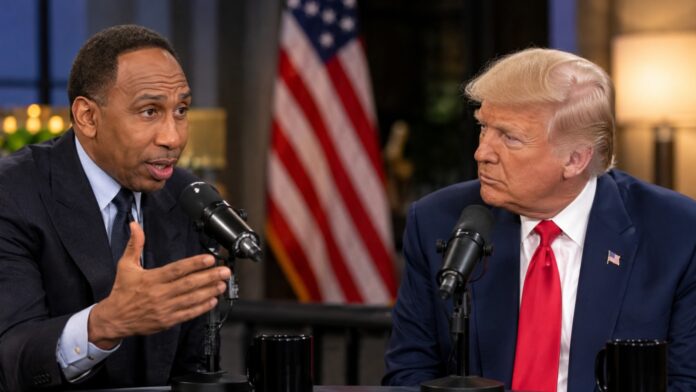
ESPN commentator Stephen A. Smith recently conducted an interview with President Trump on his Straight Shooter podcast, during which the president discussed what he views as his administration’s achievements benefiting Black Americans. The conversation drew criticism from some who felt Smith should have pushed back more aggressively on the president’s claims throughout the exchange. In response, Smith defended his editorial approach during a subsequent podcast appearance, explaining the reasoning behind his interviewing methodology.
Smith made a deliberate choice to allow the president to present his perspective without frequent interruptions, framing this as a service to the audience. He acknowledged having prepared numerous questions and challenges but decided that permitting uninterrupted remarks would better serve listeners seeking to hear the president’s actual views. Smith emphasized the unique dynamics of interviewing a sitting president in an official setting, noting the delicate balance required to maintain a productive dialogue.
- Interview conducted on Smith’s Straight Shooter podcast featuring President Trump discussing his record with Black Americans
- Smith defended his non-confrontational approach, citing the value of allowing unfiltered presidential remarks
- Smith subsequently fact-checked Trump’s claims, including statements about Black community benefits from his administration’s policies
- Black unemployment rate recorded at 6.6 percent in October, up from 6.2 percent when the president returned to office in January 2025
Why It Matters
The exchange highlights fundamental tensions in modern political journalism regarding interview methodology and editorial responsibility. Smith’s approach raises important questions about how media figures should balance the responsibility to challenge questionable claims against the value of providing audiences direct access to political figures’ unfiltered perspectives. His defense of the decision underscores the practical challenges inherent in conducting high-stakes interviews with sitting presidents, where aggressive confrontation could potentially terminate the conversation prematurely.
The incident also demonstrates the complexity of addressing policy claims that resist straightforward verification. Smith acknowledged that determining which demographic group benefits most from particular policies involves subjective interpretation and incomplete data, making real-time fact-checking during an interview particularly difficult. His subsequent analysis, rather than live pushback, allowed for more nuanced examination of the claims while respecting the conversational dynamic necessary for substantive presidential discourse.
- Raises questions about appropriate balance between challenging claims and providing direct audience access to political figures
- Demonstrates practical constraints on aggressive questioning when interviewing sitting presidents in official settings
- Illustrates difficulty of real-time fact-checking policy claims that involve subjective interpretation and complex data analysis
- Affects how media professionals approach high-profile political interviews and audience expectations for journalistic pushback
Political and Public Context
Smith’s interview with the president occurred within the broader context of ongoing national discussion about presidential outreach to minority communities and media coverage of administration achievements. The president has historically engaged with various media platforms and personalities to communicate directly with different demographic groups, and Smith’s platform provided an opportunity for that engagement. The commentator’s decision to conduct the interview and his subsequent defense of his approach reflect the evolving landscape of political media where traditional journalism models compete with direct access and unfiltered dialogue.
The president’s past public comments about Smith, including characterizations that Smith viewed as unflattering, added another layer to the dynamic. Despite this history, Smith proceeded with the interview, suggesting a willingness to engage substantively with the administration regardless of past friction. This approach contrasts with more adversarial journalistic stances and reflects a perspective that hearing directly from political leaders serves public interest, even when disagreement exists about particular policies or claims.
- Part of broader presidential strategy to engage directly with various media platforms and demographic audiences
- Reflects evolution of political media landscape balancing traditional adversarial journalism with direct access models
- Occurs amid ongoing national discussion about presidential outreach to minority communities and policy achievements
- Smith’s willingness to conduct interview despite past friction demonstrates commitment to substantive political dialogue
‘Patently False!’ Stephen A. Smith Drops Extensive Fact-Check on His Own Trump Interviewhttps://t.co/9IhoO2PSZv
— Mediaite (@Mediaite) November 17, 2026
What Happens Next
Smith indicated through his defense that he plans to continue employing similar methodologies for high-profile interviews, prioritizing audience access to unfiltered political perspectives over real-time confrontation. His approach suggests a template for how media figures might conduct subsequent interviews with the president or other major political figures, potentially influencing broader journalistic practices in political media. The commentator’s fact-checking analysis following the interview demonstrates his continued commitment to examining claims critically, albeit through a different format than live questioning.
The wider conversation sparked by Smith’s interview approach will likely continue shaping expectations for political journalism in the coming months. Other media figures may face similar questions about their interviewing methodologies when engaging with the president or his administration officials. Smith’s public defense provides a framework for understanding alternative approaches to political interviews that prioritize substantive dialogue over confrontational formats, potentially opening discussion about whether current norms adequately serve audience interests.
- Smith plans to continue prioritizing audience access to unfiltered political perspectives in future high-profile interviews
- His fact-checking approach after interviews demonstrates commitment to critical analysis through alternative formats
- Other media figures likely to face similar questions about appropriate interviewing methodology with administration officials
- Broader conversation about political journalism norms and whether current approaches adequately serve public interest continues developing