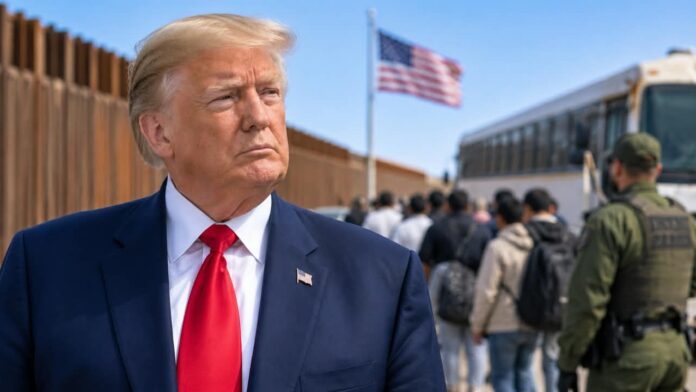
Story Highlights
- President Trump acknowledged in a recent media interview that his administration’s strict immigration enforcement approach may have been overly aggressive in certain applications
- The president credited his border security efforts with strong performance ratings while recognizing electoral losses in heavily Latino communities
- Trump expressed openness to working with Democrats on immigration reform, signaling potential policy recalibration
- Despite acknowledging enforcement concerns, the administration has maintained record deportation activity with ICE detention numbers reaching historic highs
What Happened
In a recent television interview, President Trump reflected on his administration’s immigration enforcement record with notable candor, acknowledging that the aggressive deportation approach may have extended beyond its intended scope. The president stated that while his administration earned high marks for border security achievements, the implementation of immigration policies created electoral complications, particularly in communities with significant Latino populations across South Texas and other regions that had previously shifted toward Republican support.
Trump described his immigration crackdown as producing mixed electoral consequences. He emphasized that his border closure efforts and removal of individuals with serious criminal backgrounds garnered strong approval ratings. However, he noted that the enforcement actions also affected individuals with established employment, stable community ties, and in some cases, legitimate tax contributions to the American economy. The president acknowledged that reasonable people across the country hold differing views on whether individuals in such circumstances should remain in the country or face deportation.
- President Trump stated his approach earned an A+ rating for border security while acknowledging electoral damage in Latino communities
- Enforcement actions affected long-term residents with employment and tax-paying status, creating political complications
- The president indicated willingness to collaborate with incoming Democratic congressional leadership on immigration matters
- Recent personnel changes at the White House included replacing the chief of staff with a known immigration hardliner
Why It Matters
The president’s reflection on immigration policy represents a significant moment in assessing the political costs and benefits of strict enforcement approaches. While border security remains a cornerstone achievement of the current administration, recognizing the electoral impact of aggressive deportations demonstrates sophisticated political calculation and willingness to evaluate policy outcomes. This acknowledgment does not necessarily indicate major policy reversals but rather suggests an administration cognizant of the demographic and electoral consequences of enforcement decisions.
Immigration remains one of the most consequential policy domains affecting American voters across the political spectrum. The willingness of the president to explore potential bipartisan collaboration on immigration reform could open pathways for legislative action that both parties have historically struggled to achieve. Simultaneously, the administration’s record deportation and detention numbers indicate that enforcement priorities remain central to the White House agenda, even as the president acknowledges the need for nuance in implementation.
- Electoral performance suffered in previously Republican-leaning Latino communities due to immigration enforcement concerns
- Potential bipartisan immigration discussions could reshape policy approaches for coming years
- Documented record-high ICE detentions demonstrate ongoing enforcement commitment despite policy reconsideration
- Working families with established employment face heightened uncertainty regarding deportation risk despite president’s acknowledgment of complexity
Political and Public Context
Immigration has emerged as a defining political issue, with voter sentiment strongly influenced by personal experience and community impact. Recent electoral patterns reveal that communities most affected by aggressive immigration enforcement shifted politically away from Republican candidates, despite the party’s traditional strength on border security messaging. This dynamic reflects the challenge of maintaining electoral support while pursuing strict immigration policies that necessarily affect established residents and working families.
The Trump administration’s immigration record includes genuine achievements in border security metrics and criminal deportations, alongside controversial aspects including citywide enforcement operations, vehicle checkpoint practices, and detention procedures that have drawn scrutiny from civil liberties organizations and Republican critics alike. The administration’s approach of warning that anyone in the country illegally faces potential arrest and deportation contrasts with the president’s more recent acknowledgment that such blanket enforcement may alienate voters the party seeks to retain or attract. This tension reflects broader debates within conservative circles about balancing immigration enforcement with practical and electoral considerations.
- Immigration policy performance shifted voting patterns in South Texas and other previously Republican areas
- Interior enforcement operations, vehicle checkpoints, and detention practices have generated significant public debate
- Record ICE arrest targets of 3,000 daily detentions represent escalated enforcement commitment
- Republican congressional members have expressed concerns about certain enforcement methodologies and their political consequences
His willingness to do so comes after two years in which photos and videos of arrests of people in the country illegally were blasted out by top immigration officials in the Trump administration.https://t.co/Bzj3xBNSzP
— 7News DC (@7NewsDC) November 10, 2026
What Happens Next
The trajectory of immigration policy under the Trump administration will likely reflect the tension between the president’s acknowledgment of enforcement excess and his administration’s demonstrated commitment to strict immigration control. Key personnel decisions, including leadership changes within the White House, will provide clarity regarding whether policy adjustments will materialize or whether the current enforcement intensity will continue. The possibility of bipartisan immigration discussions offers potential for legislative movement on an issue that has eluded comprehensive reform for decades, though significant ideological divides remain on fundamental questions of legal immigration levels and pathways to regularization.
Observers should monitor whether the administration initiates substantive negotiations with Democratic leaders on immigration reform or whether current enforcement practices accelerate further. The political viability of bipartisan immigration legislation depends partly on maintaining public support across demographic lines while preserving the administration’s border security achievements. Additionally, the legal and practical implications of record-level detention and deportation activity will continue evolving as cases proceed through immigration courts and as communities adapt to enforcement realities.
- Administration leadership decisions will indicate whether enforcement policies shift or continue at current intensity
- Potential bipartisan negotiations on immigration reform represent an uncertain but possible legislative pathway
- Record-high detention numbers and ongoing interior enforcement operations will continue generating political and legal scrutiny
- Electoral implications of immigration enforcement will remain central to Republican strategy and policy calculations